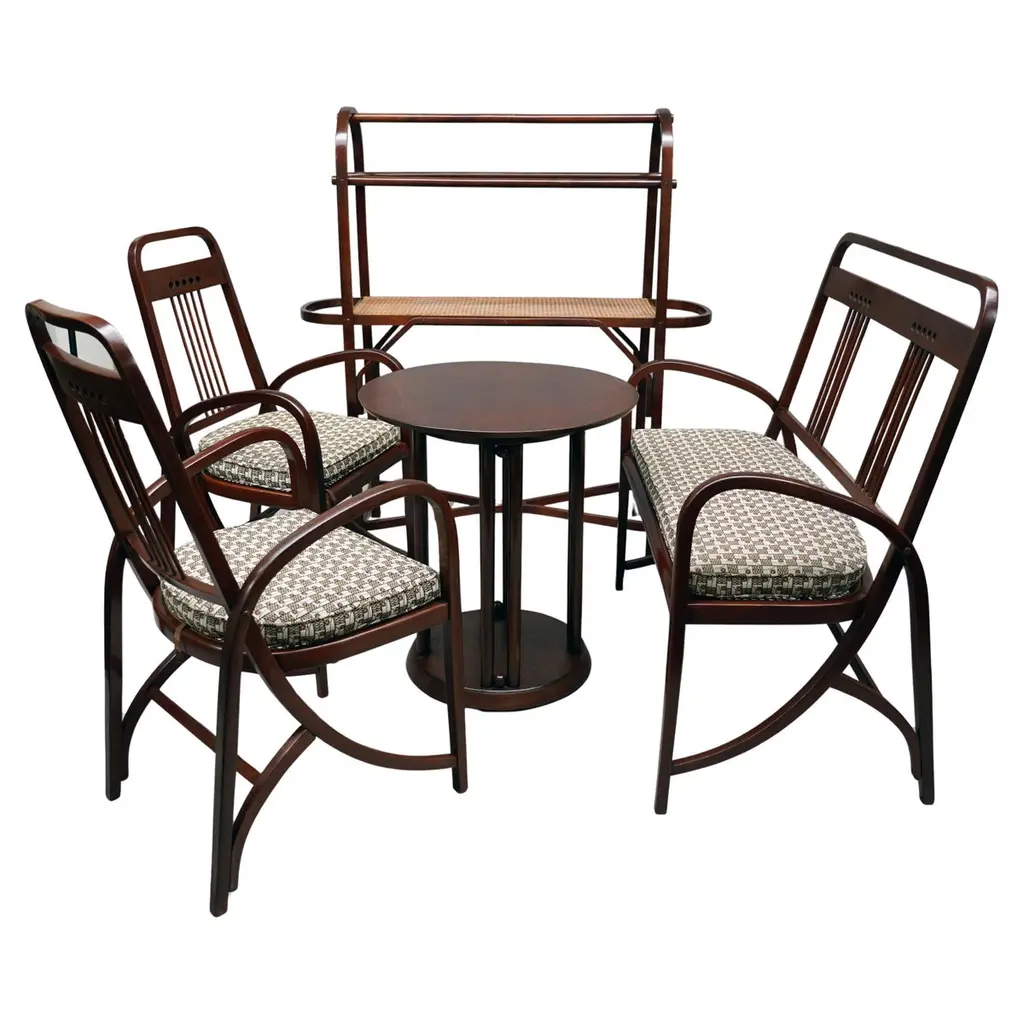
Thonet, Salon Set, Austria, Circa 1904
$13,774
1st Dibs
Stamped and bearing the label THONET WIENArmchairs – Height : 106 cm (41,7 in.) ; Width : 54,5 cm (21,5 in.) ; Depth : 55 cm (21,7 in.)Sofa – Height : 106 cm (41,7 in.) ; Length : 105,5 cm (41,5 in.) ; Depth : 53,5 cm (21 in.)Gueridon – Height : 74 cm (29,1 in.) ; Diameter : 65,5 cm (25,8 in.)Jette-habits – Height : 137 cm (53,9 in.) ; Length : 130 cm (51,2 in.) ; Depth : 44 cm (17,3 in.)Elegant salon set in curved wood and cane, composed of two armchairs, a sofa, a gueridon and a jette-habits. The armchairs and the sofa have openwork backs decorated with five circular perforations and five vertical bars, and a geometric patterned cushion covers the seat.The jette-habits is made up of three upper crosspieces in the shape of a humpback, an intermediate cane shelf extended by umbrella stands at the ends, and finally, a base ending in metal trays used to collect water from umbrellas or rain clothes.They are accompanied by a gueridon designed by Josef Hoffmann and Gustav Siegel, with a circular top and base connected by four uprights formed of double columns separated by a sphere.Related work :The armchairs and the sofa are derived from the 511 model produced by Thonet from 1904, the bench under the number 2511, and the armchair under the number 1511. The jette-habits is listed under the number 11951Biography :Michael Thonet (1796-1871) was a German-Austrian cabinetmaker and industrialist spotted, brought by Prince Clemens Metternich, Chancellor of Austria to Vienna in 1842, where he presented his creations to the Emperor. Employed by Clemens List, the leading Viennese cabinetmaker, the latter recommended him to the English architect of the Prince of Liechtenstein, and he was entrusted with the creation of the furniture and parquet flooring for the Liechtenstein Palace. In July 1851, Thonet presented his latest furniture at the London Universal Exhibition, where he received the Bronze Medal, contributing to his international reputation. Faced with the influx of orders, he expanded his facilities and purchased his first steam engine. Around forty employees worked in the company when he handed it over to his five sons, including a chemist ; but he actually continued to run it until his death.International exhibitions expanded markets, and Thonet increased production. He moved the factory to Koryčany, Moravia, in July 1856, employing 300 workers and producing 200 pieces of furniture per day. In 1859, he decided to create a new company, and there he developed chair No. 14, which he created for Anna Daum, director of the Daum café, who dreamed of “practical, elegant and space-saving chairs.” Orders quickly followed, and Thonet decided to mass-produce No. 14 ; it would become his first industrial model, even bearing his name.By the time of his death in 1871, his company had six factories in Europe, supplying a commercial network of 14 stores worldwide, including 15 Boulevard Poissonnière in Paris, which would become the headquarters of Thonet Frères France. Other shops were also located in Chicago and New York at this time. After 1945, Gebrüder Thonet was headquartered in Frankenberg, Germany. In 1976, the Austrian branch became independent under the name Thonet Wien. In 2006, the German company became Thonet GmbH.
Similar Items