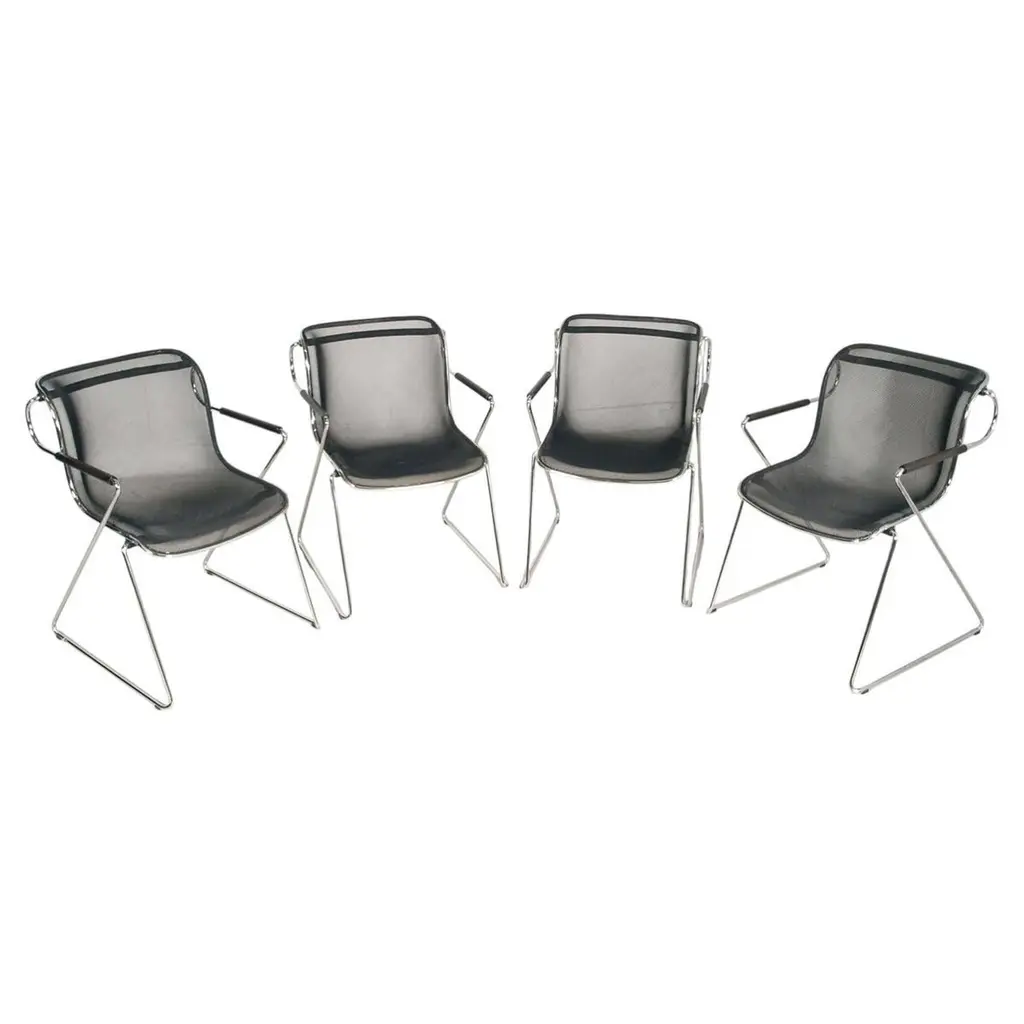
Vintage Italian Penelope Armchairs By Charles Pollock For Anonima Castelli, Italy, 1982, Set Of 4
Chairish$3,186
Vintage Italian Penelope Armchairs By Charles Pollock For Anonima Castelli, Italy, 1982, Set Of 4
Chairish$3,186
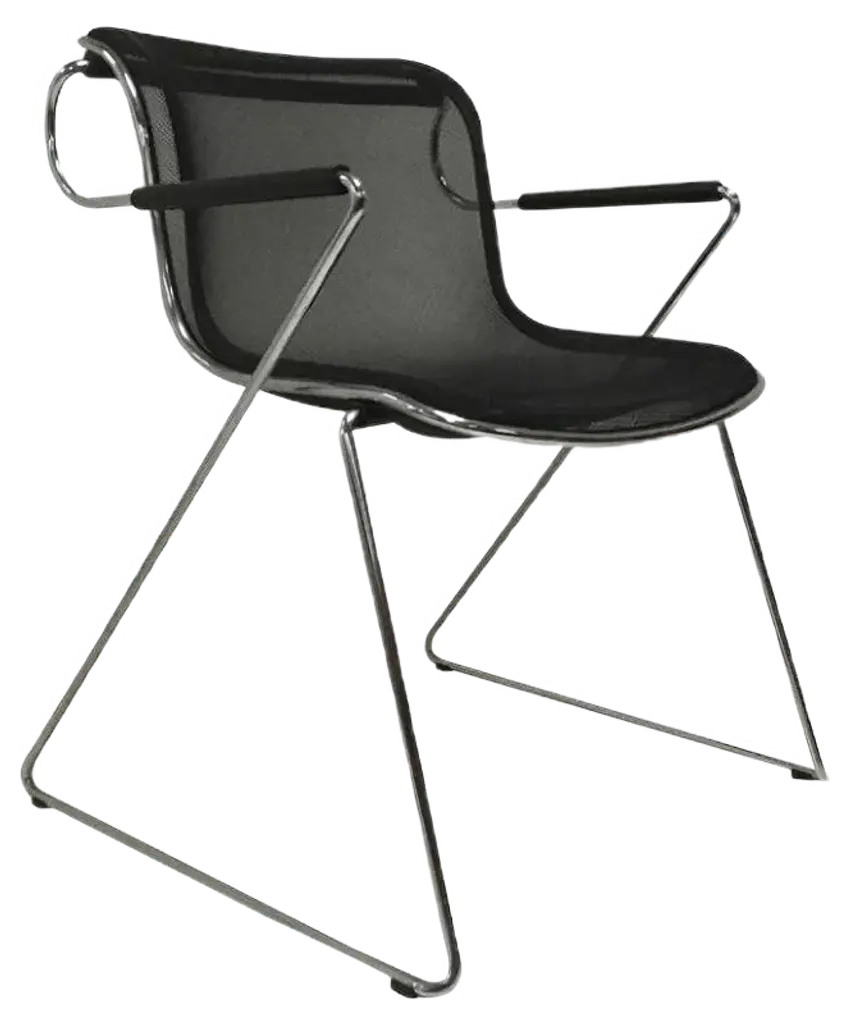
A refined and architecturally expressive set of four “Penelope” armchairs, designed by Charles Randolph Pollock and produced by Anonima Castelli in Italy in the early 1980s. Conceived at the intersection of engineering and design, the Penelope model embodies Pollock’s distinctive approach—where structural logic becomes aesthetic language. The chairs are defined by their continuous metal mesh shell, delicately suspended within a slender chrome-plated steel frame, achieving an exceptional sense of lightness and transparency. The signature polyurethane-wrapped tubular armrests introduce both a visual and functional innovation: acting as subtle flex points, they provide a controlled elasticity that enhances comfort while preserving the purity of form. This integration of resilience and minimalism eliminates the need for visible mechanical systems, resulting in a design that is both technically advanced and visually restrained. Elegant yet pragmatic, this set reflects the sophisticated industrial culture of Italian design in the 1980s—where experimentation with materials and production techniques led to enduring, quietly radical forms. Perfectly suited for a curated dining environment, executive setting, or collectible design interior, these chairs maintain a strong sculptural presence while remaining highly versatile. Condition In very good vintage condition, with light, even wear consistent with age and use. Chrome surfaces retain a bright finish; mesh is well-preserved and structurally sound. Details Designer: Charles Pollock Manufacturer: Anonima Castelli Country of Origin: Italy Date: circa 1982 Quantity: Set of 4 Materials: Chrome-plated steel, coated metal mesh, polyurethane Type: Armchairs Style: Postmodern / Italian Modern / Industrial Design This piece is attributed to the mentioned designer/maker. It has no attribution mark and no official proof of authenticity, however it is well documented in design history. I take full responsibility for any authenticity issues arising from misattribution
Similar products