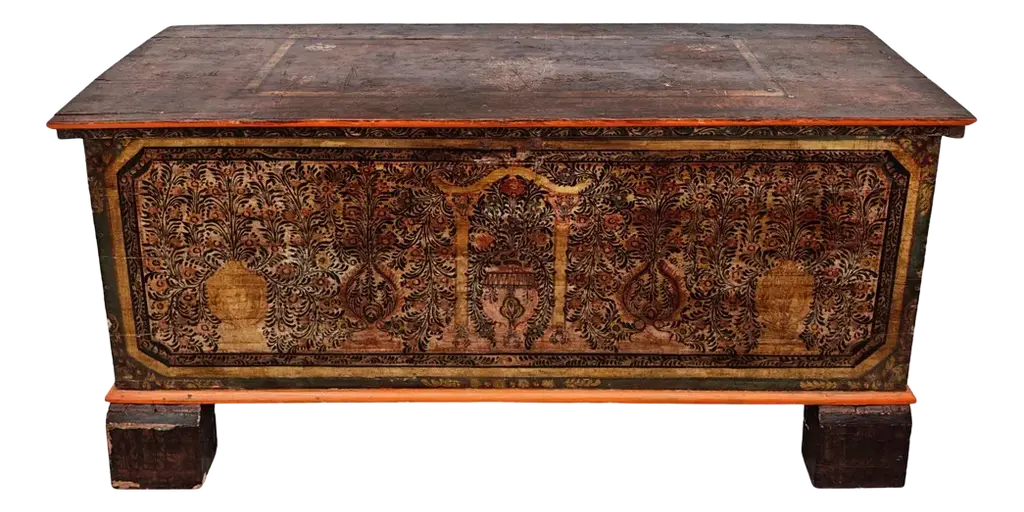
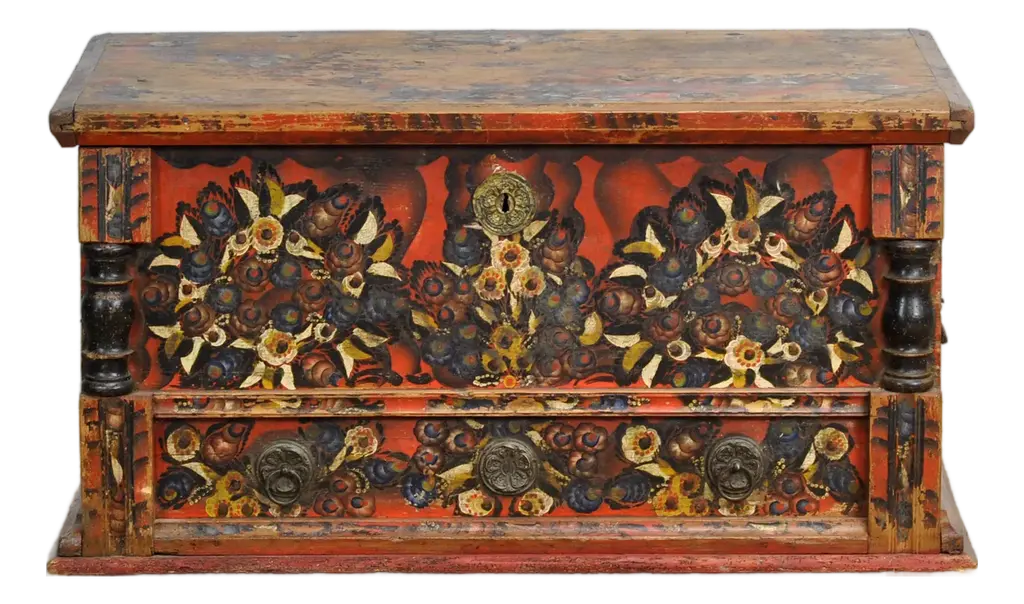
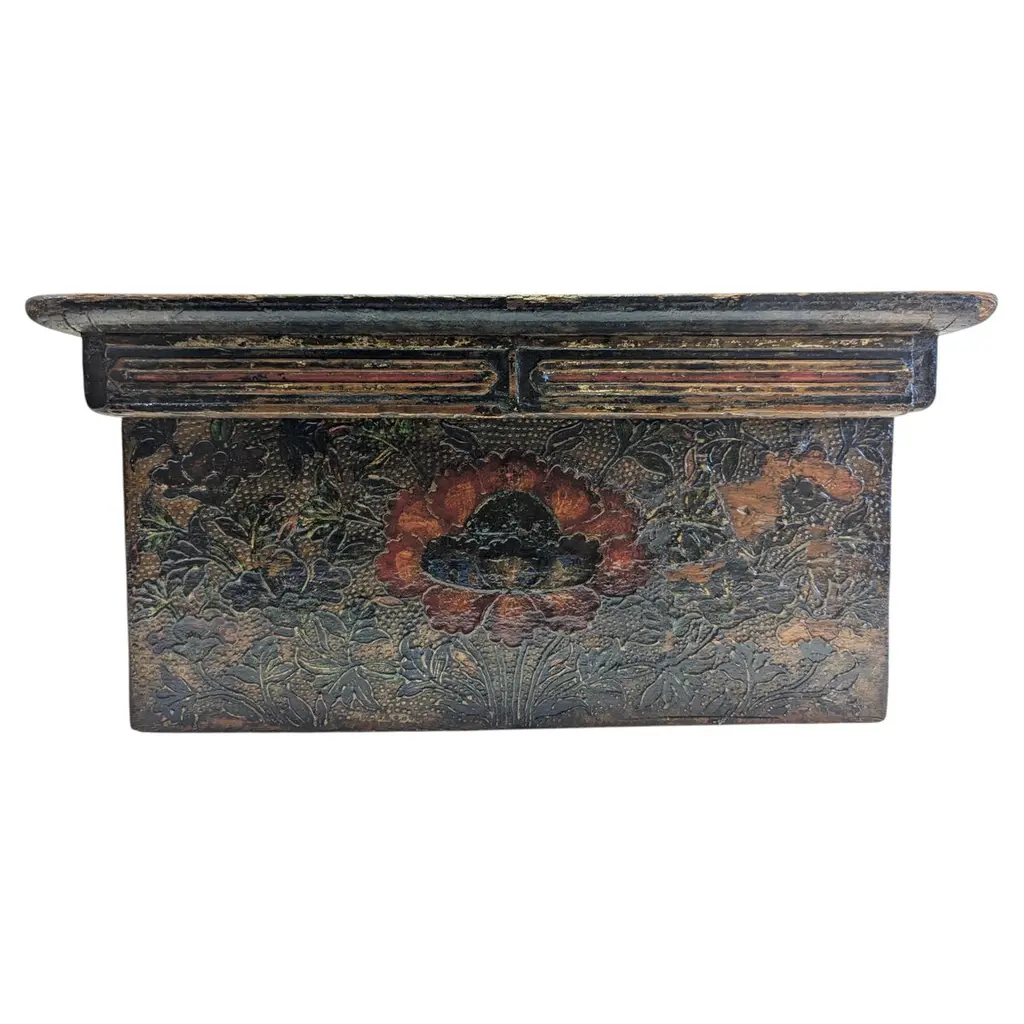
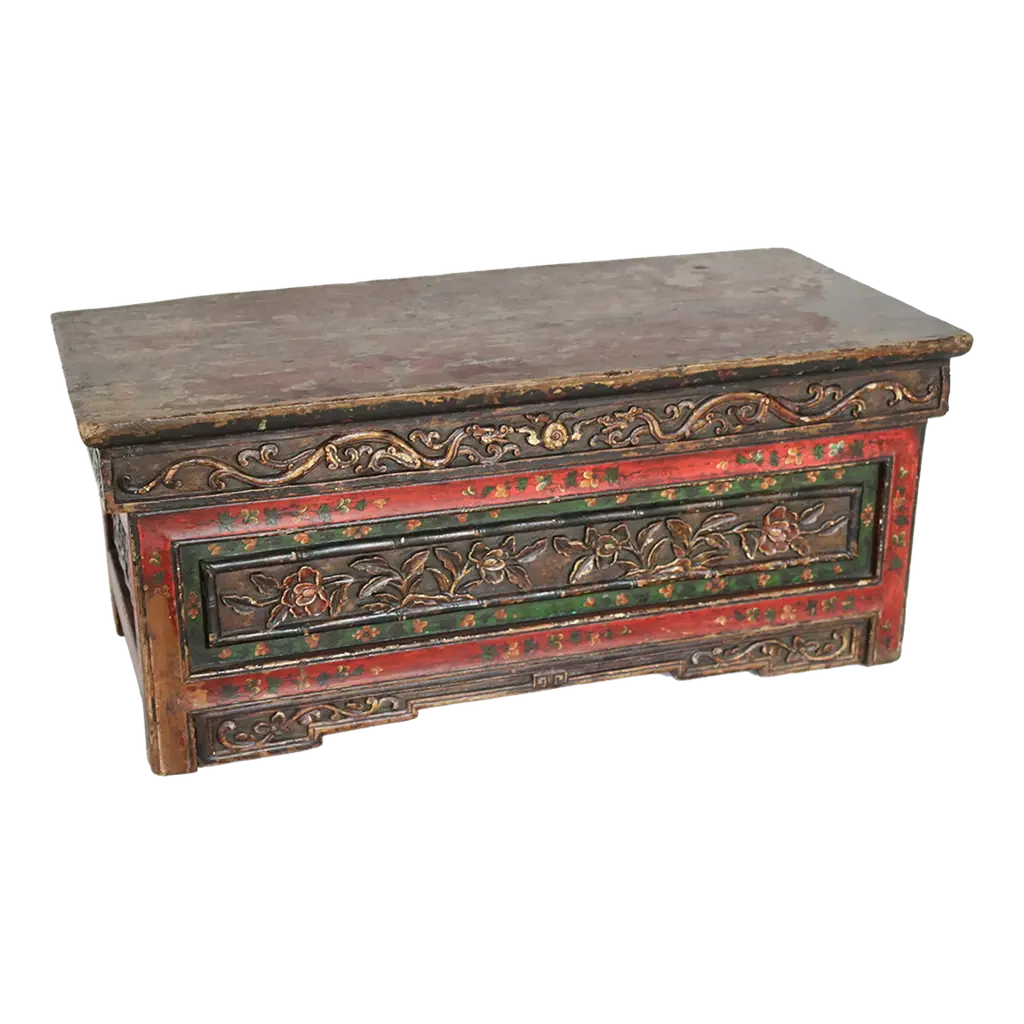
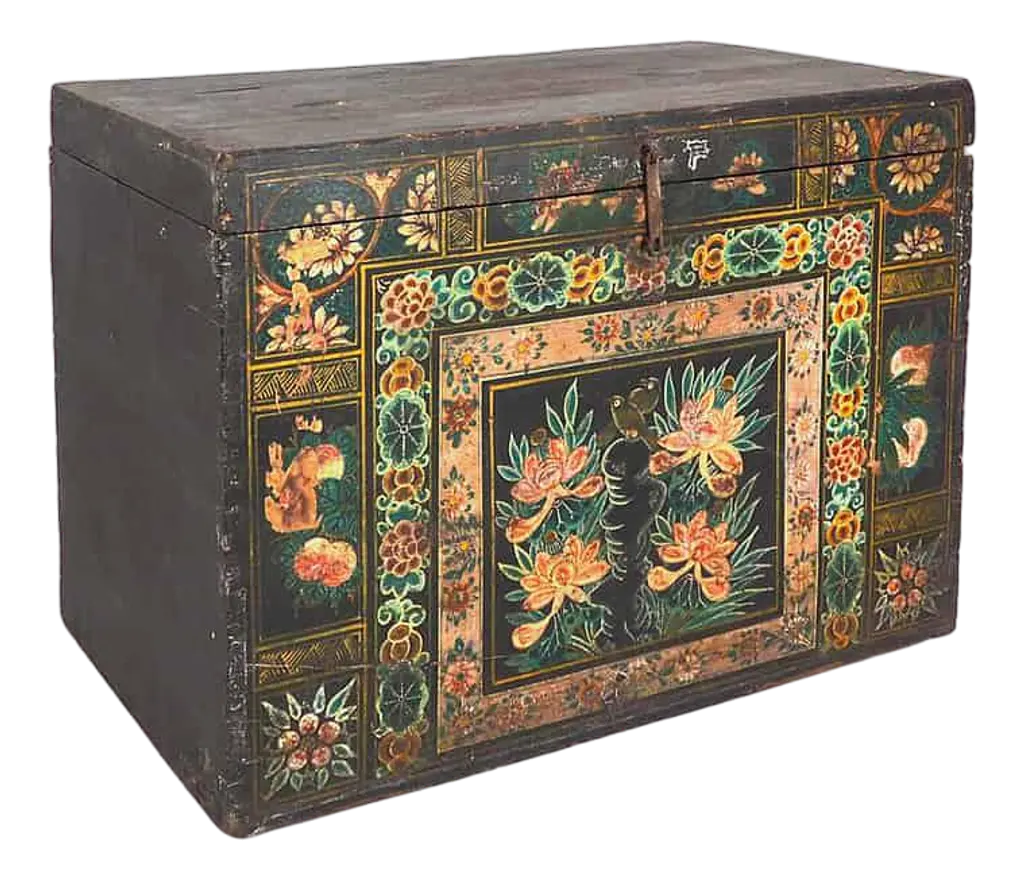
Rare hand carved and painted folding table Tibetan designs are heavily influenced by Tibetan Buddhism and often feature vibrant colors and intricate symbolism. The designs vary, but commonly include dragons, mythical creatures, flowers, and geometric patterns, sometimes with raised plasterwork. Buddhist imagery and mythology Auspicious symbols: Other Buddhist symbols, such as the Dharma wheel, may also be incorporated into the designs. Floral motifs: Intricate, colorful floral patterns, including chrysanthemum and lotus blossoms, are common, either as the main design or as borders. The lotus flower, representing purity and enlightenment, is a significant Buddhist symbol. Artistic techniques Vibrant colors: Traditional mineral pigments create the rich, vibrant palette of colors found on choksars. Deep red, gold, green, and blue are often used, with red often forming the background. The government controlled the supply of 'azurite' the deep blue color, suggesting that this piece, with strong blue color throughout was a gift to a high lama, or person of importance within the monastry. Kyungbur: Some pieces, particularly older ones, feature kyungbur gesso work. This technique uses a mix of glue and plaster to create raised, three-dimensional designs on the painted surface. Provenance While living and working in Kathmandu, Nepal, I met Dr. Ruth Sumerlin Hayward, a scholar and collector with a deep interest in Himalayan material culture. She was professionally associated with my husband, Julio (Andy) Andrews, and we quickly became close friends. During that period, we spent significant time at the 4th Century Stupa, Boudhanath, which held an enclave of Tibetan immigrants. Often even in the middle of the nigh caravans of newly arrived Tibetan refugees were unloading extraordinary chests, cabinets, and ritual furniture. Many of these pieces—then largely unknown in the West— would later appear in major publications, museum collections and some tribal art dealers inventory Dr. Hayward was among the early and discerning collectors of this material. A portion of her collection was later donated to the Los Angeles County Museum of Art (LACMA). My own collection, assembled during those same years and closely tied to these shared experiences, is only now being made available for scholarly and public appreciation References: Kamansky, David. Wooden Wonders. Pacific Asia Museum and Serinda Publications Inc., Chicago, IL, US 2004 ISBN 10: 1932476172 / ISBN 13: 9781932476170 Corona, Camilla & Corona, Luca. Auspicious by Design. Mera Publications Pvt. Ltd., 2021 ISBN: 978-9937-0-8899-2. Buckley, Chris. Tibetan Furniture. Floating World Editions, Warren, CT, 2005 ISBN 10: 0500512779 Marie is an Associate Member of ATADA The Authentic Tribal Art Dealers Association https://atada.org/intro-about
Similar products