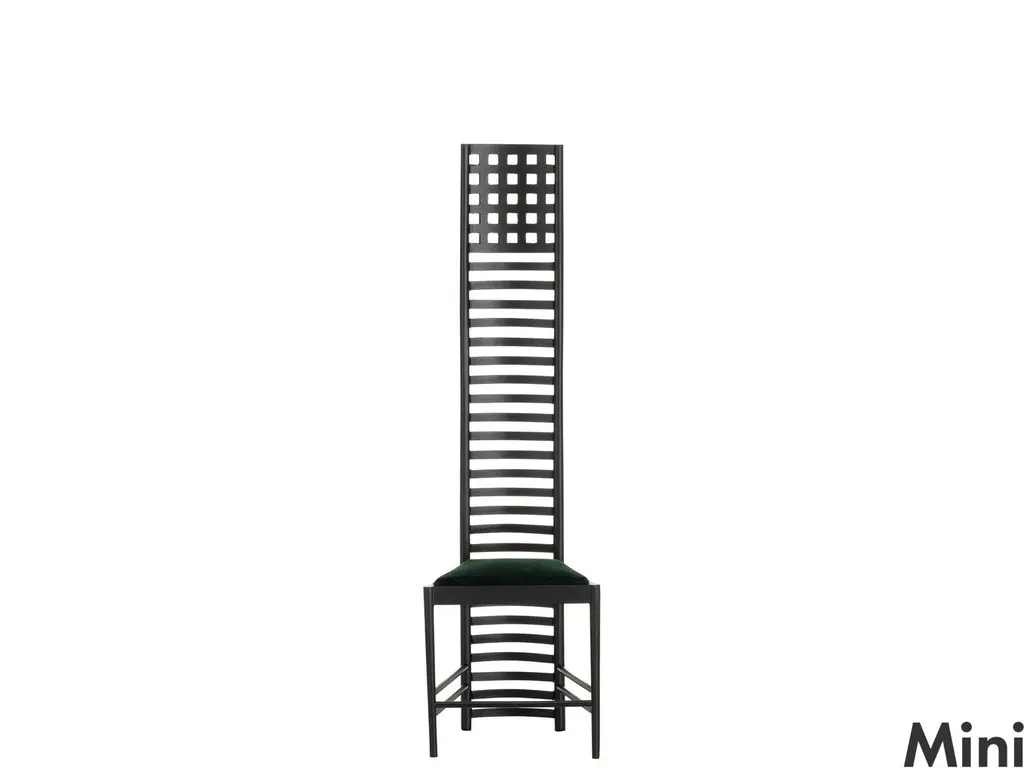
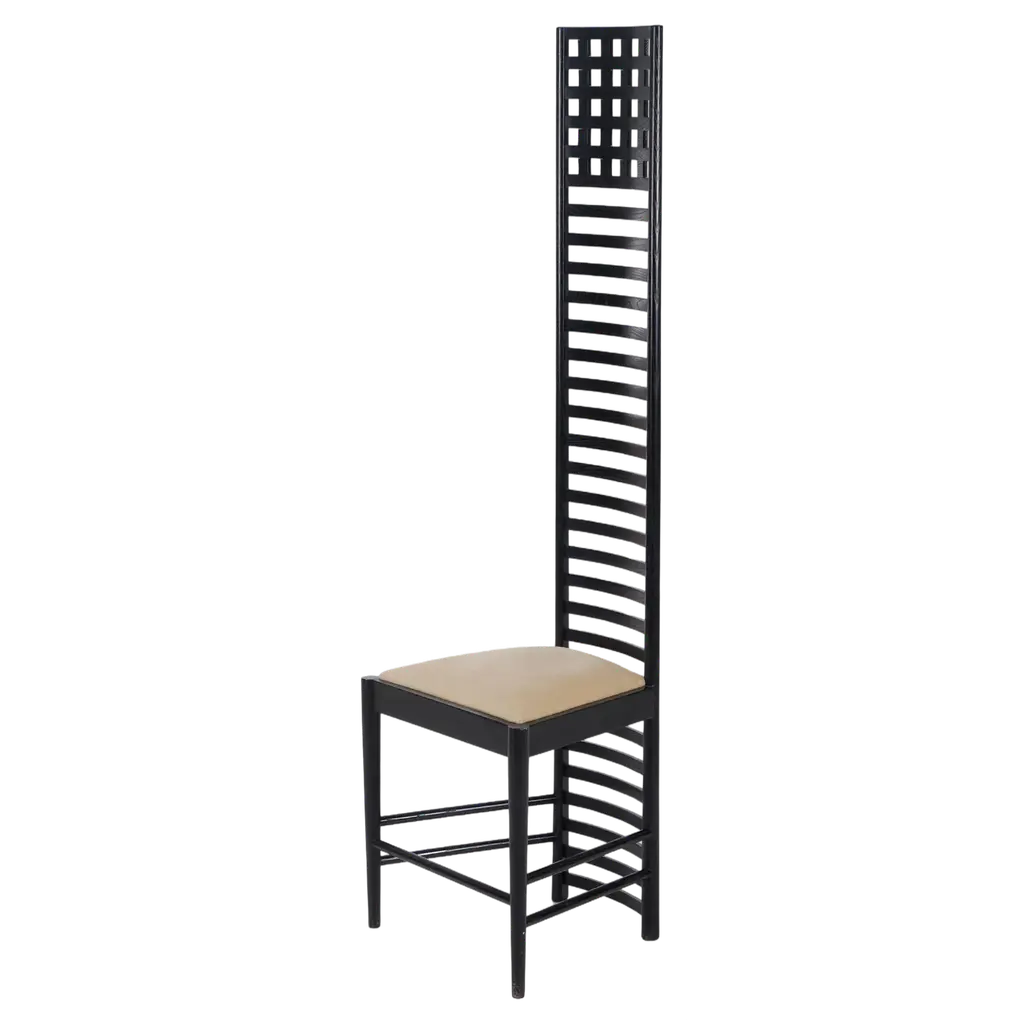
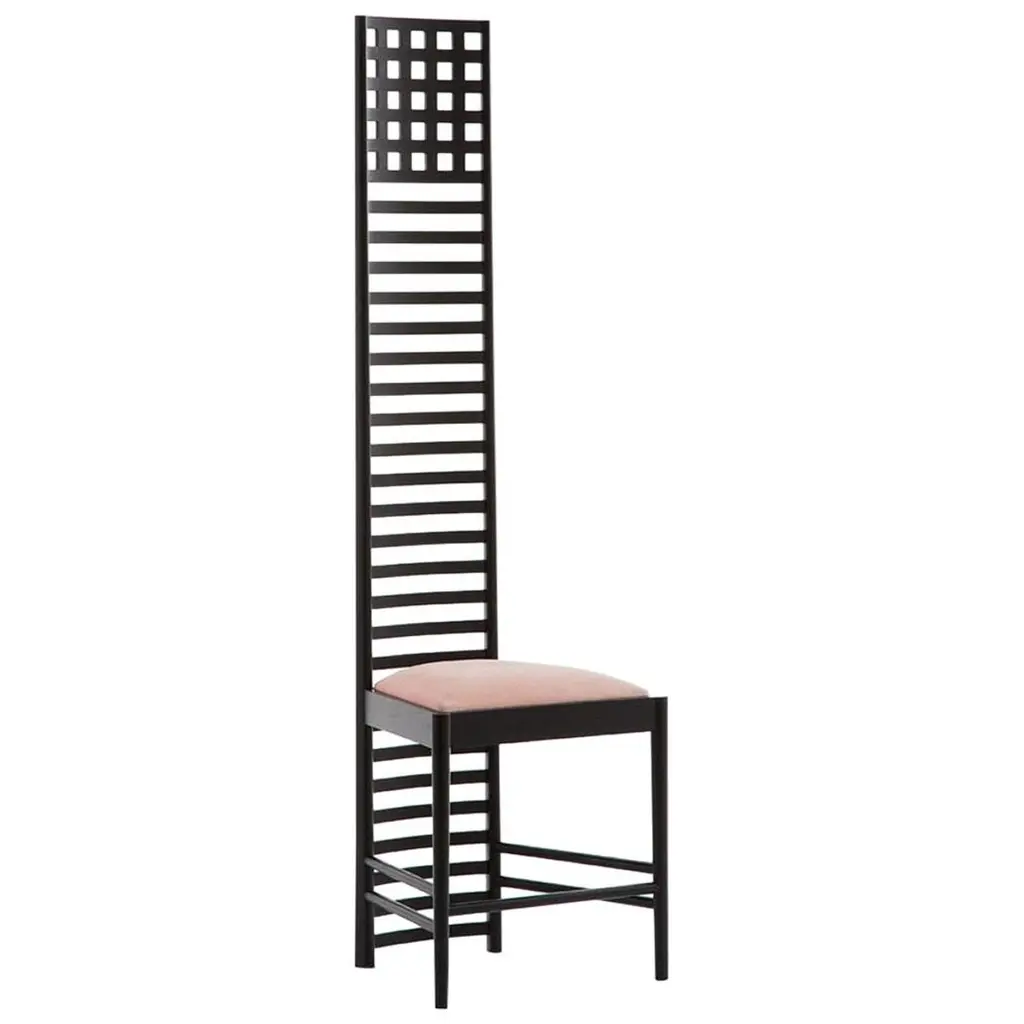
Charles Rennie Mackintosh Hill House 1 Chair For CassinaAn iconic chair, a timeless design furnishing made entirely of solid wood that accurately reflects the style of the Scottish master Mackintosh, known for the complex challenges he set himself, like this ageless piece still considered an authentic treatise on spatial intricacy.Designed for the Hill House project in Scotland, from which it takes its name, its linear geometric shape suggests the minimalism and abstract graphic techniques of Japanese design combining symbolic and figurative values in a single, distinctive piece of furniture with great stage presence. Cassina revisits Hill House 1 relying on the talent of the skilled Meda artisans who, with absolute mastery, reproduce the chair in ash with the high backrest in its original progression of vertical lines contrasted by a grid pattern of vertical and horizontal pieces at the limit of material resistance.STRUCTURESolid ash.SEATSolid beech with crisscrossed elastic webbing.UPHOLSTERYExclusive velvet in wisteria or petroleum green color.This iconic chair reflects Charles Rennie Mackintosh’s style and his fearless approach to the most challenging manufacturing processes. Originally a furnishing accessory for one of Mackintosh’s major design projects, Hill House in Helensburgh, near Glasgow, Scotland, from which its name derives. The linear, geometric form is evocative of the minimal, abstract lines of Japanese graphics, which confer symbolic and figurative symbolic value to the piece’s striking visual impact. This piece is seen by many critics as not only a chair but also a veritable treatise on the way space can be articulated. The tall back is defined by a succession of vertical lines that are topped with a grid of verticals and horizontals. Thanks to the mastery of the furnitire makers of Meda, in the Brianza area north of Milan, Cassina has re-issued the Hill House chair, which is available in black-stain ashwood, with a velvet seat-cushion.Important information regarding images of products:Please note that some of the images show other colors and variations of the model, these images are only to present interior design proposals. The item that is selling is on the first image.Important information regarding color(s) of products:Actual colors may vary. This is due to the fact that every computer monitor, laptop, tablet and phone screen has a different capability to display colors and that everyone sees these colors differently. We try to edit our photos to show all of our products as life-like as possible, but please understand the actual color may vary slightly from your monitor.About the Designer:Charles Rennie Mackintosh was born in Glasgow in 1868 and died in London on 10th December 1928. His personality is one of those that characterize the period immediately preceding the Modern Movement.His name is mainly connected with the design for the Glasgow School of Art: he was the animator and most authoritative exponent of the group known as the “Glasgow School” and he distinguished himself principally because he recovered the most authentic values of the Scottish idiom and of neo-Gothic taste.The group, also named “the School of Ghosts”, became known throughout Europe – in Liege in 1895, London in 1896, Vienna in 1900, Turin in 1902, Moscow in 1903, Budapest etc.Besides the School of Art, the most interesting works are undoubtedly: the “Windyhill” house at Kilmacolm (1900), the “Hill House” at Helensburgh (1902-3), the arrangement of the Derngate house, Northampton (1916-20), and the decorative work in Miss Cranston’s Tea-Rooms in Glasgow. Among the furnishings of his decorative interiors, it is above all the chair – an object of special attention in the “Cassina I Maestri” collection – which represents the focal point for coordinated spatial action.Within it, the controlling force of the composition is always resolved, sometimes articulated in fluent and delicate forms, at other times in severely geometric forms.About Manufacture:Established in 1927 by Cesare and Umberto Cassina in Meda, Italy, Cassina launched industrial design in Italy in the 1950s, based on a totally innovative approach that marked the transition from artisan production to mass production. With a mindset focused on research and innovation, Cassina combines technology and long-standing artisan craftsmanship. Memory, research, innovation. Cassina blends traditional skills and superior productivity, meticulous attention to detail and passion, uniqueness and experimentation, wellbeing and sustainability. Today, the company continues to address new lifestyles with the creation of complete, harmonious interior decor solutions that embody the best contemporary design for all areas of the home.
Similar products