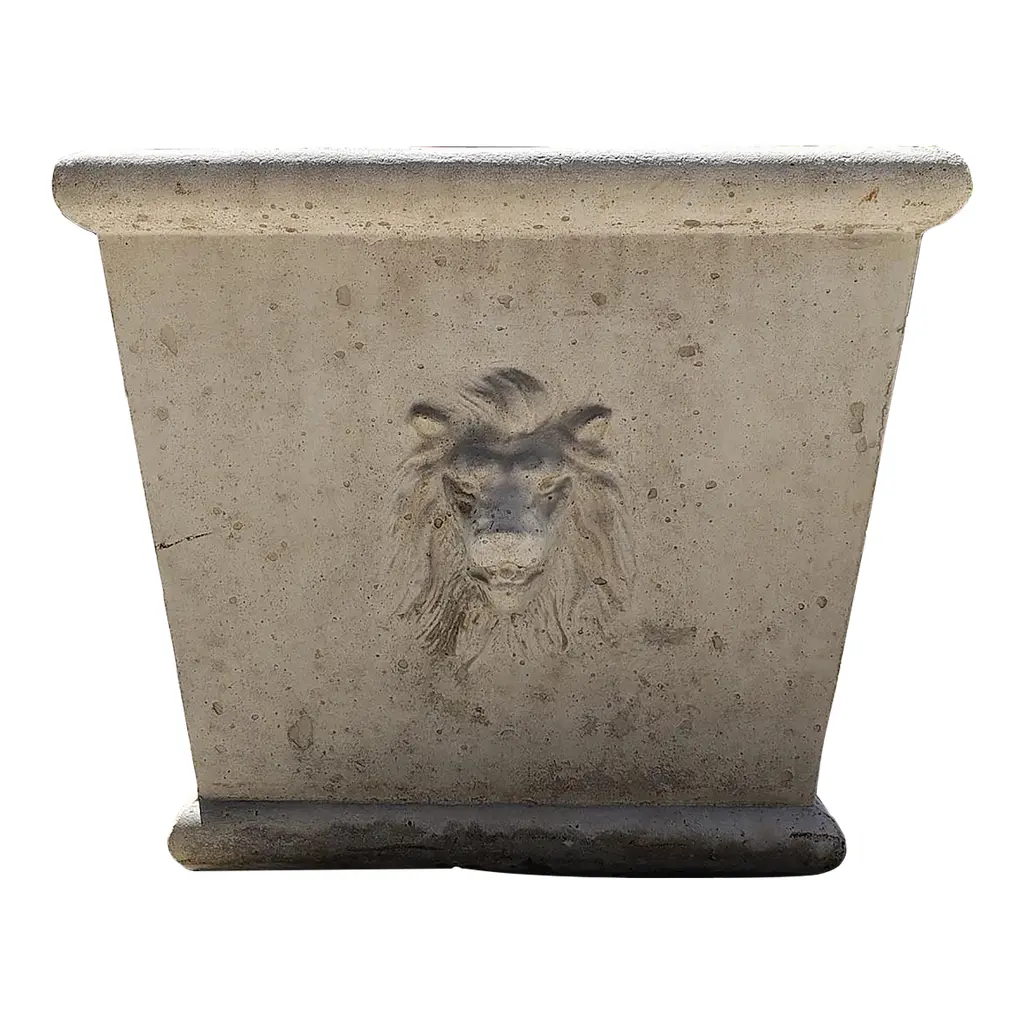
A substantial French lead and zinc garden planter or architectural jardinière, likely dating to circa 1920 or earlier, designed with the sober, sculptural presence associated with early 20th-century French garden and conservatory furnishings. The piece is of square tapered form, with a heavy molded upper rim, broad flat top, and two removable sliding panels that lift away to reveal the interior. The front is centered by a modeled ram’s head in relief, used as a functional spout. This classical animal-head motif recalls the vocabulary of French architectural ornament, garden sculpture, and neoclassical design, where ram’s heads, masks, and bucrania were often used to lend objects a sense of antique gravity and pastoral symbolism. The exterior surface retains an attractive aged gray patina, with the quiet variation, scuffs, and softened wear expected of lead and zinc garden objects. The later zinc lining makes the piece practical for present use as a planter, jardinière, decorative basin, or interior garden vessel, while preserving the architectural character of the original form. The removable two-part top gives the object unusual flexibility: it may be displayed closed as a sculptural pedestal-like form with a central circular aperture, or open as a functional lined planter. Its compact square scale, strong molded rim, and ram’s-head ornament make it especially effective in a garden room, conservatory, entry hall, courtyard, or gallery interior. With its combination of lead construction, later zinc lining, neoclassical ram’s-head relief, and restrained French architectural character, the piece stands between garden ornament and decorative furniture. It has the presence of an estate garden vessel while remaining highly usable in a contemporary interior, particularly as a planter for topiary, palms, orchids, or architectural greenery. Measurements: 25" h x 27.25" w x 27.25" d.
Similar products