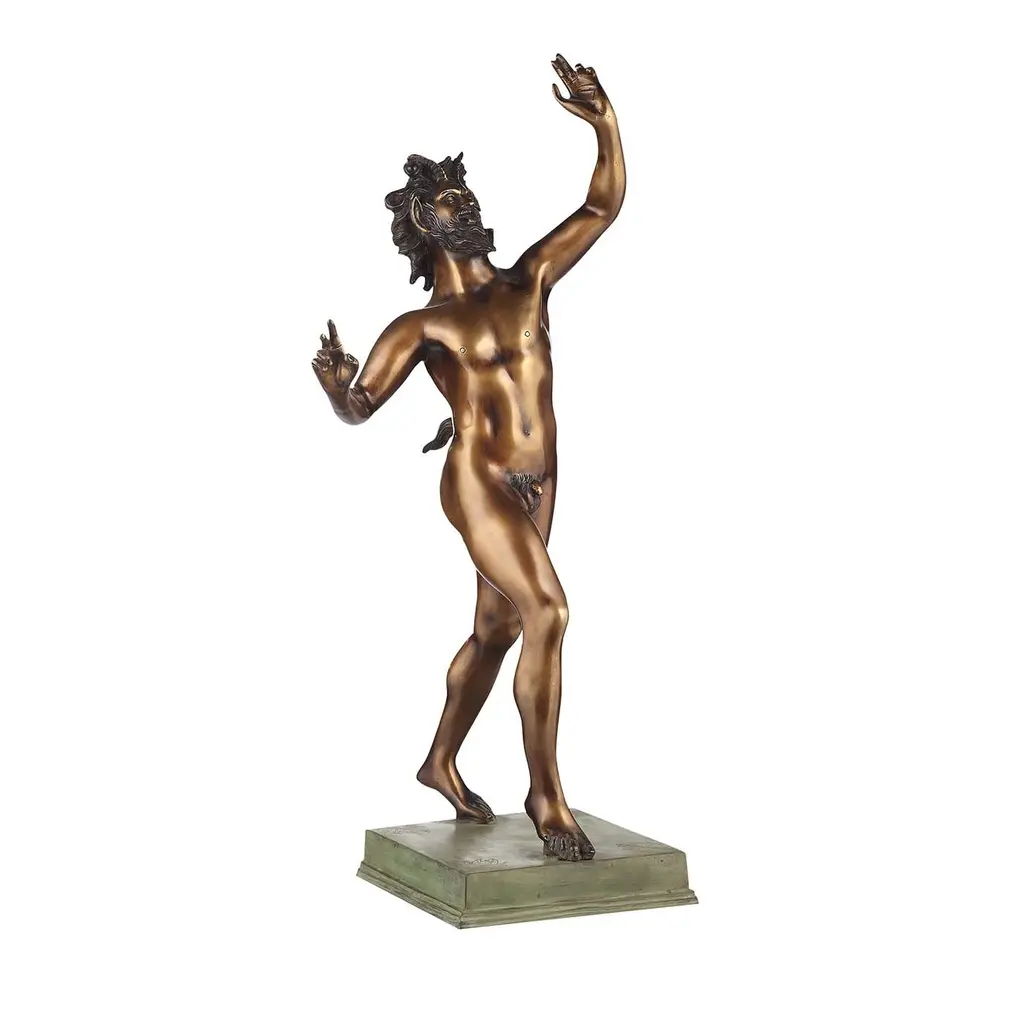
24.5 cm with the stand.Provenance- Galerie Nina Borowski, Paris.- Private collection, Mr. Fleischman, New York, acquired from the previous owner in November 1985.- Inherited from the previous owner and sold in 2024.Roman sculpture cast in bronze using lost wax, a piece of special finesse and exquisite modelling. Also noteworthy is the great beauty of the material itself, a dark green bronze with a beautiful patina with turquoise and orange tones. It represents the god Apollo naked, holding a plectrum in his right hand, his left arm bent at the elbow and extended forward, with his hand open and relaxed, resting on a zither that is now lost and which would have served as a support for the figure. The statuette is not designed to be viewed strictly frontally, since the body rotates gently around its own axis: the left shoulder moves back while the right one moves forward, and the hip rotates to the right, allowing the left leg to move forward. The youthful anatomy, with soft and realistic modelling, is endowed with a graceful movement, almost like a dance step; The elegant contrapposto of classical Greek heritage is combined with the head turning to the right and the torso in the opposite direction, and the legs are crossed, the left bent in front of the right, which in turn supports the weight of the body. This position of the legs is a departure from classical models to accentuate both the dynamism and the realism of the figure, something very characteristic of Greek Hellenism and which will also have its echo in the times of Imperial Rome.The god has his hair gathered at the nape of his neck and forming a bow on his head, with two locks falling over his shoulders. This is a hairstyle characteristic of the ancient Greek iconography of Apollo and Aphrodite, which is why it is common in Roman images of these gods derived from Hellenistic models. The face is particularly fine, with features modelled with delicacy and attention to detail; The statuette is oval in shape, with a rounded jaw and full cheeks, typical of the almost adolescent image of the god, a relaxed, half-open mouth and large almond-shaped eyes, with raised eyelids and hollow pupils, probably to embed a material of a different colour, such as silver or enamel, which would highlight the god's gaze and add liveliness to the image. The piece has a rectangular recess made in the back, above the left shoulder blade, which would function as an anchoring point for the statuette to another element, perhaps a support or a second figure with which it would compose a sculptural group.The statuette follows the iconography of Apollo Citaredo or Kitharoidos, the representation of the god playing or holding the zither, a plucked string instrument similar to the lyre, although with a larger sound box. The zither was closely linked to the figure of Apollo, associated with his cult and therefore considered a musical instrument of special nobility. It was given to him by Hermes, who had invented it using a tortoise shell. The iconographic model of Apollo Cytaredus represents him in his role as god of music and leader of the Muses, and was developed in Greece from the second half of the 2nd century BC as an adaptation of Praxiteles' Lycian Apollo. At the beginning, Apollo Cytaredus was represented half-naked, with a chlamys covering his legs, resting his left arm on the zither and with the right arm bent over his head, as in Praxiteles' model. The type would then evolve to show the god completely naked, in the style of late Hellenism. The right arm is held over the head, and the left arm, which carries the zither, rests on a pillar that would become increasingly ornate, and which remains attached to the left leg for greater stability. The model was transferred to Rome and, in the middle of the imperial period, when the decorative taste of Hellenism had been exhausted, there was a tendency to reduce the ornamental elements and the last significant change took place: the right arm would be extended along the body, with the hand on the hip or holding the plectrum.Apollo is one of the main gods of Greek and Roman mythology. The second generation Olympian, son of Zeus and Leto and twin brother of Artemis-Diana, he was the god of the arts, the sun, reason and harmony, an oracular deity and also related to medicine through his son Asclepius. His cult originated in Delphi and Delos, in Greece, around the 8th century BC. In ancient Greece he was the prophetic god par excellence, although in classical times he was mainly venerated in his role as god of light and music. However, in popular religion it always maintained a strong apotropaic character, of protection against evil.Little by little Apollo became the god of the Orphic religion, a mystery cult that guided its initiates towards eternal life through a system that was both religious and moral. He was represented reigning over the Islands of the Blessed, a sort of equivalent of the Christian Paradise in the Orphic religion, first, and later in Greco-Roman neo-Pythagoreanism. At the end of the 1st century BC, Horace would present Apollo and his sister Diana in his Secular Song as protectors of the Roman people and intermediaries between them and Jupiter, king of the gods.Lost wax casting is a very difficult procedure for making metal pieces, which requires careful planning and coordination between the sculptor, the moulder and the caster. The first step consists of making the prototype of the object in wax, perfectly finished in all its details, including polishing. Channels, vents and an inlet cone are added to this model and it is covered with refractory clay. Once the clay dries, heat is applied and the wax is melted, evacuating the ceramic container that has taken its negative form through the channels. This creates a mould that is filled with molten metal through the inlet cone, spreading it evenly thanks to the vents. Finally, once the metal has solidified, the ceramic coating is broken to release the finished piece. It is, therefore, a technique that only allows for the creation of unique pieces.
Similar products