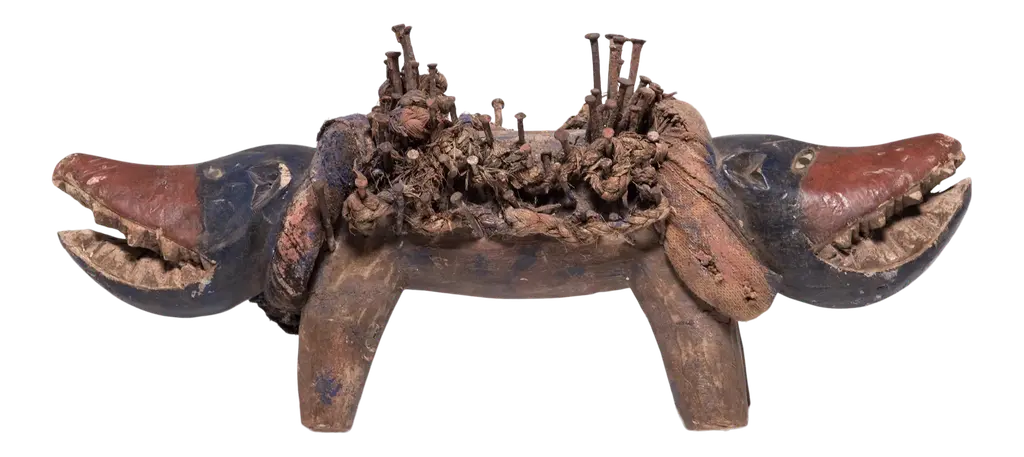
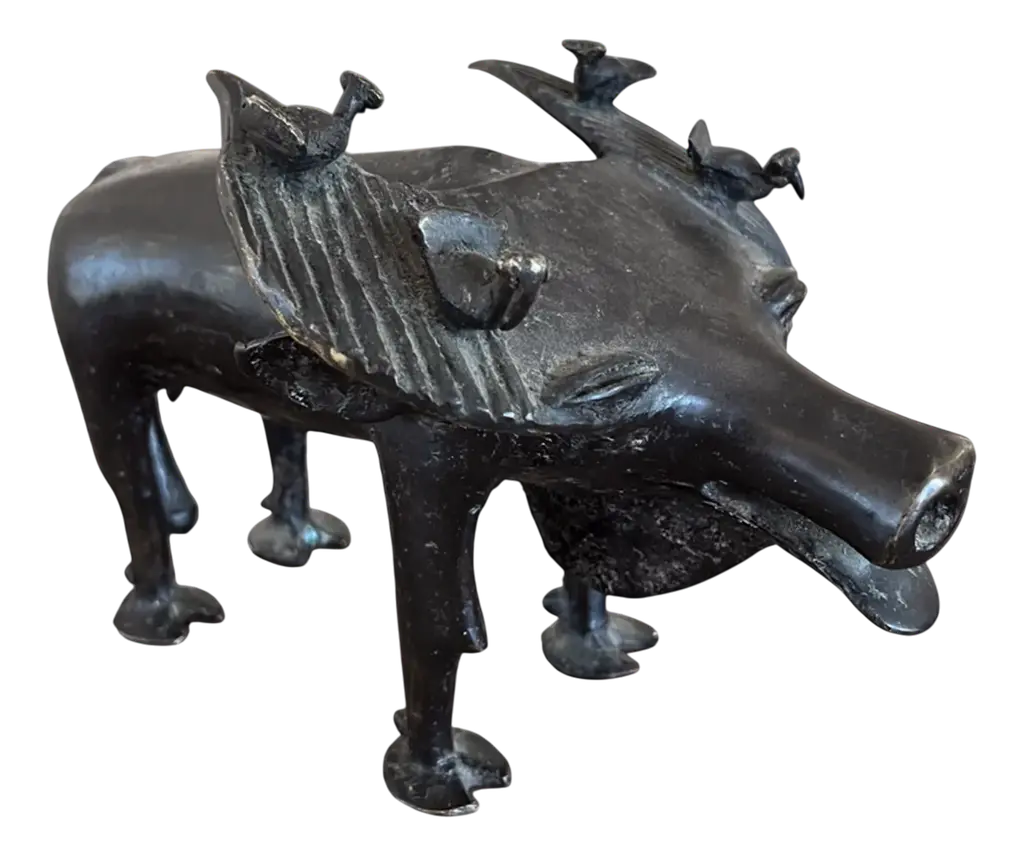
A powerful and ethnographically significant example of Central African ritual sculpture, this nail-studded zoomorphic figure is a Kozo — a Janus-headed dog nkisi (power object) of the Bakongo peoples of the Democratic Republic of Congo. The double-headed canine form is among the most iconic and symbolically charged objects in the Bakongo ritual canon. The dog, prized in thought for its ability to hunt by night as well as by day and to move between the visible and invisible worlds, was considered uniquely capable of tracking wrongdoers and enforcing oaths across both the living and ancestral realms. The Janus configuration — a head at each end of the body — amplifies this power, enabling the spirit to look simultaneously into the world of the living and the world of the dead. The figure stands on four sturdy legs with a broad, flattened body, incised facial features including almond-shaped eyes, and upturned open snouts at both terminals. The dorsal surface is densely studded with hand-forged iron nails, blades, and metal fragments of varying ages — the cumulative material record of successive ritual activations. In Bakongo practice, each nail driven into a nkisi kozo represented a sworn oath, a legal dispute, a healing petition, or an invoked curse. The density of ironwork here attests to sustained ceremonial use across generations. The body retains its dark pigmented resin surface treatment, evidence of repeated ritual handling and consecration. Nkisi kozo figures are held in the permanent collections of the Metropolitan Museum of Art, the Musée du quai Branly, and the British Museum, affirming the category's preeminence within African art scholarship and the international collecting market. Circa 19th–Early 20th Century
Similar products