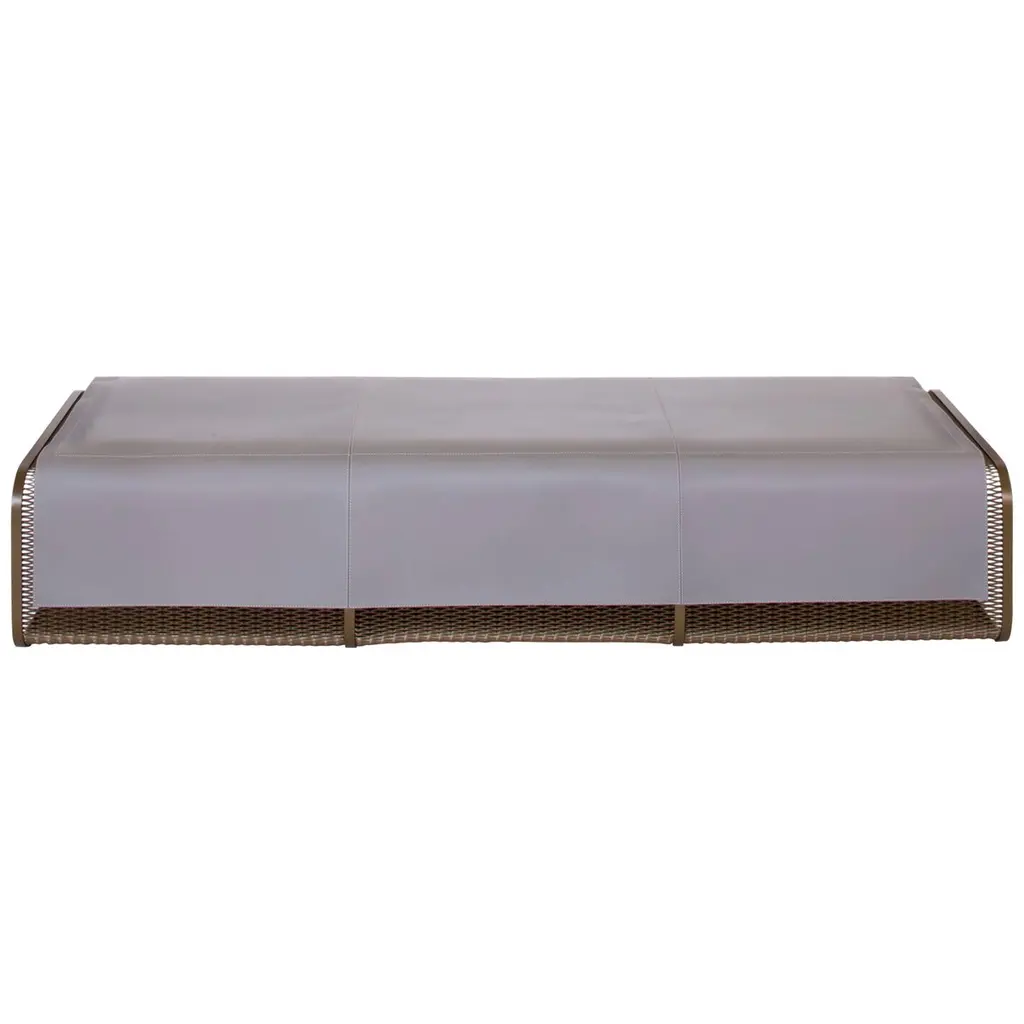
"Caballito Chaise Longue" Designed By Nestor Perkal For Oscar Maschera
$7,620
1st Dibs
"Caballito Chaise Longue", designed by Nestor Perkal and manufactured by Oscar Maschera, features a structure in bronze colored steel mesh with high-integrity thermoset epoxy powder coating, padding in fireproof polyurethane foam and lining in genuine Italian vegetable-tanned leather available in the following colors: tan, sienna, orange, red, red-purple, dark brown, khaki, blue and black.DIMENSIONS (structure): D. 25.59", W. 72.83", H. 13.77"DIMENSIONS (leather): D. 41.33", W. 68.5"Nestor Perkal’s inspiration rides the White Horse. With the bridle loose and reins held tight, he has illustrated and narrated the story of that image, seen as a child in a neighborhood shop window, which he imagines in the countryside but encounters as he strolls through the streets of Buenos Aires and which evoke in him the Argentina of his dreams.With the rigor of true gentleness, without loosing sight of the magic, without forgetting the wooden toy. The mane flows free in the wind, in the same wind that accompanied the indigenous people and the gaucho on their adventures. The Argentinean men, who crossed the landscape in search of food, land and family, made use of the horse on that epic crossing. The saddle was a useful contrivance until it became the norm.The verb to mount declines with the noun Mount.Perkal’s metaphor symbolizes concern, support, friendship and repose. His poetic memory is humanistic. It is that sensitive passion that becomes a real image. To this concept he adds the weave of the fabric, hand crafted in the north of Argentina. The loom reveals its cloth, brandished by guards and flags, identity and tradition.“Come quickly little White Horse,take me to the land where I was born…I have, have, have………..three sheep in a shed.One gives me milkanother gives me wool,the third gives me butterthe whole week through”.NESTOR PERKAL, born in Buenos Aires, lives and works in Paris. Though he trained as an architect, his work has always been oriented to design and interior architecture. In 1985, he founded an international design gallery in Paris, l’Espace Nestor Perkal, where he was among the first in Europe to show and sell pieces from the “New International Design” movement: Memphis Milano, Mariscal and many others.From 1987-1994, he was the artistic director of the goldsmith’s company Algorithme, where he invited many designers to work on edition projects that were highly successful in France and abroad. As a designer, he has collaborated with Drimmer, Lou Fagotin, Artcodif, Veronese, etc. At CIRVA (International Research Centre on Glass and Plastic Arts), he created the Miroirs collection in 1994-1996.As an interior architect, he has furnished the “café” of the Maison Européenne de la Photographie in Paris, different areas for Cartier and the Cartier Foundation for Contemporary Art, as well as many private apartments and houses. He has been the curator and scenographer of exhibitions held at the Cartier Foundation (La vie en Roses, 1998), at the Galerie Chez Valentin, Paris (“chez Valentin 2000”), at the Passage de Retz (Paris, 2000), at the Museum of Contemporary Art of Rochechouart and at the Grand Hornu in Belgium for the exhibition Désirs d’Objets (2003-2004) and at the Museum des Arts Décoratifs, Paris for the exhibition Editer le design (2006) and 100% Finlandia (2008).He has been the director of the Research Centre on the Arts of Fire and Earth (CRAFT) of Limoges (1993 – 2009), developing strong and lively projects aimed at creating an experimental and artistic connection between industrialists and designers, architects and artists.
Similar Items