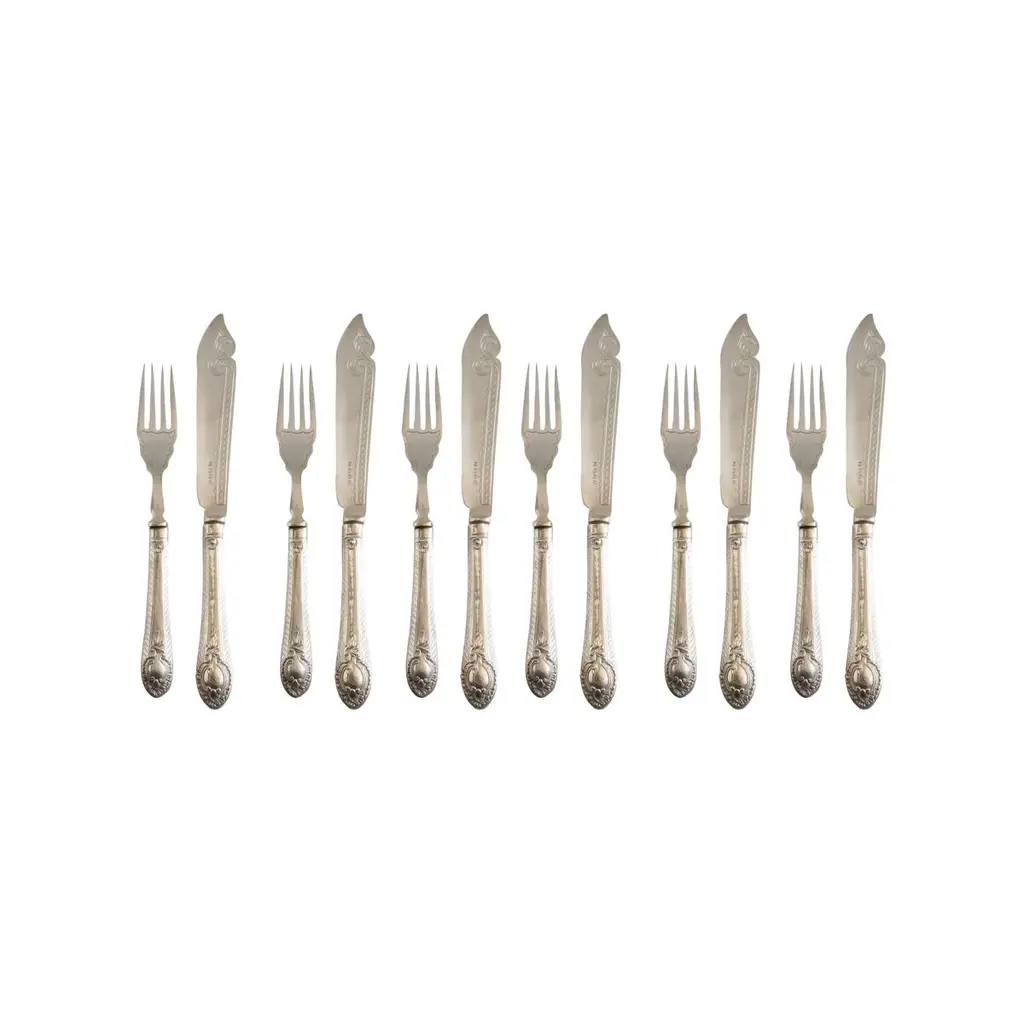
Austrian Empire Neoclassical Sterling Silver And Steel Cutlery Set 1830s
$1,048
1st Dibs
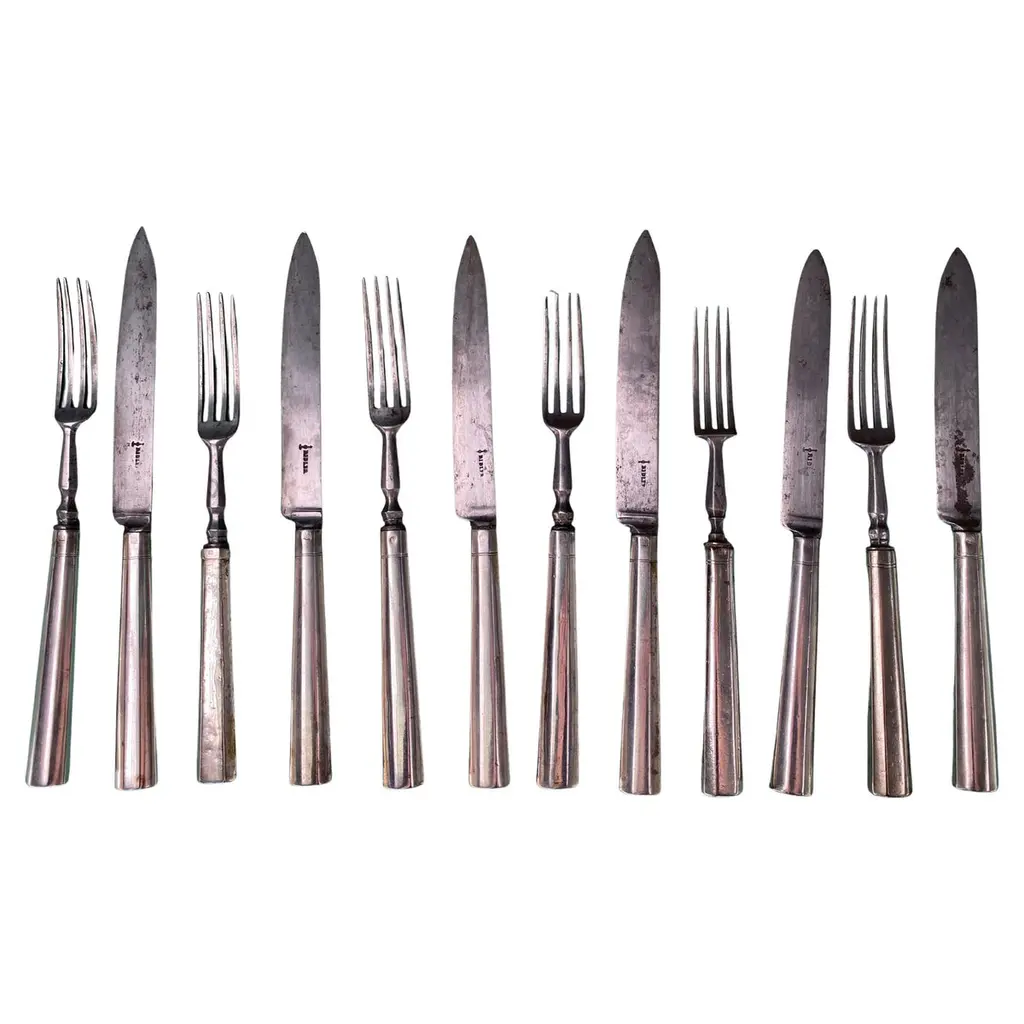
An impressive set of twelve early nineteenth century Neoclassical knives and forks with Austrian Empire sterling silver handles and original early 19th century steel blades. Original or appropriate-to-period box included. The blades stamped with an arrow and the cutler's trade name clearly marked, 'Ridler'. They are 13 loth standard (81.2% silver), with indistinct but just legible city marks and makers mark 'IR', 'JR' or perhaps 'PR'.The handles are hollow silver with an octagonal profile, in a simple Neoclassical style. Well used over their nearly two hundred year life, they were an inheritance, which, to the best of the heir's knowledge had been in his family since manufacture. The line of succession, whether maternal or paternal, has been lost. Well worn Austrian silver marks show the Viennese shield and number 13 (for loth silver quality) with city marks and dates indistinct. Carefully magnified examination shows dates around 1830-1838 on those still legible, however this could be debated as they are very well worn. Three fork handles are later replacements with indistinct or unidentified silver marks but in the same style, well aged and used, but of the same quality. Most tellingly, the cartouche or surround of the city mark is still clearly visible and, when compared to known marks, this shape is only represented in the city marks that of E (Hall), F (Brno) or H (Graz), Austria. A makers mark 'JR', 'PR' or 'IR' is discernible by comparing the visible parts of the markings on several of the knives.In addition to this wonderful, storied set of cutlery, the box appears to be original or is at least period appropriate. It certainly has the restrained neoclassical style and quality of construction of the early 19th century. It is made of timber, covered in a fine Morocco leather. Both sides of the box, lid and base, have reacted to humid conditions by curling back and cannot be fully closed, however, the lovely russet satin and velvet lining are in pretty good condition and make a fitting storage place for the cutlery. Therefore we are selling the box with the cutlery, as is. You may want to consult a book binder or other restorer to have the box brought back to it's former shape and condition. The steel of the forks and knives is in remarkably good condition considering its age and use. There are signs of sharpening on a stone wheel, probably by a traveling knife sharpener. In many European countries, traveling knife sharpeners were commonly known as "arrotini" (Italian for "sharpeners"), or "moletas" (also Italian, referring to the portable grindstone). In English, they might also be referred to as "itinerant sharpeners" or "knife grinders". In any case, the blades have been kept sharp and ready for use. The well-used condition of this whole set is a large part of it's charm. It suggests it's been brought out for dinners frequently over the last nearly 200 years. A fork handle has succumbed and been replaced here and there. There are many small dents and dings. It is a rag-tag collection and why would it not be? After what must be hundreds of meals and many house-moves, in the grander arc of European wars, long sea voyages and the ups and downs of family fortunes, there have been weddings, birthdays, Christmases, graduations, successes and celebrations. All the larger moments of life have been marked by meals with these knives and forks. We suggest you continue their use and enjoyment, adding your own stories and conversations over wonderful meals with interesting people. These knives and forks have absorbed and exude some of the bonhomie, the geniality, of nearly two hundred years of shared dining. Long may they continue to delight.
Similar Items