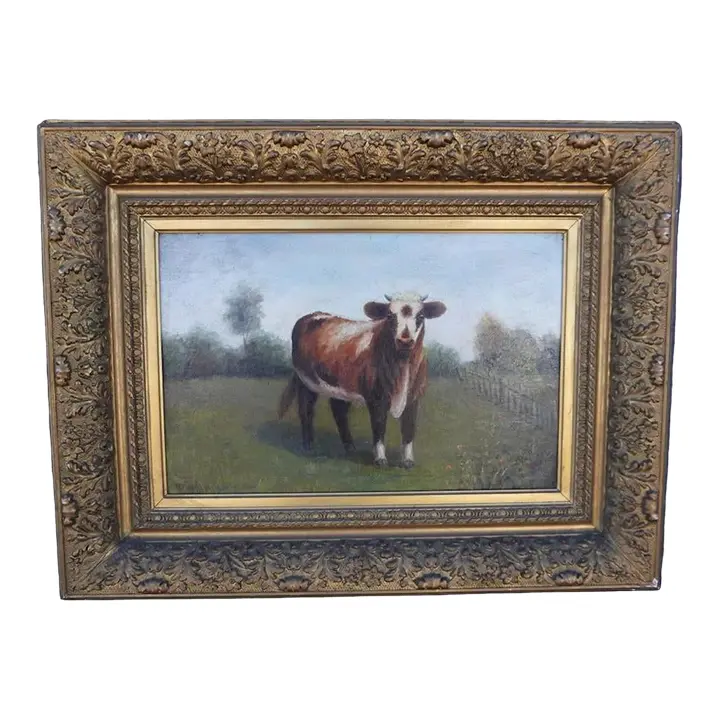
Livestock paintings such as this often depicted a person's most prized animals shown at their best - and it's easy to see why this bull was chosen! He is a solid, well-built bull with a thick, heavily wrinkled neck and short forward-curving horns, physique on full display with his pristine white coat, pink skin, and white hooves. He may represent a Cumberland White, a variety of Shorthorn that gained popularity in the early 1900s. These all-white bulls were highly desirable at the time as, when crossed with a black Galloway cow, they produce a Blue Grey, a vigorous, easily recognized, and in-demand roan-colored cow sought for its abilities as a suckler cow in areas with poor grazing. Since the color does not breed true, a white bull as pretty as this one would have been something to be proud of! This painting is dated and signed in the corner, 1913. E.S. Reeser. Eugene Reeser (1862-1922) was a painter based in Reading, Pennsylvania, known for landscapes, portraiture, and paintings of animals such as this. The bull is painted on a thin board approximately 14 inches wide and 10 inches tall, backed with a piece of paperboard and framed in an ornate wood and gesso frame to 17 7/8 inches wide and 14 inches tall with wire to hang.
Similar products