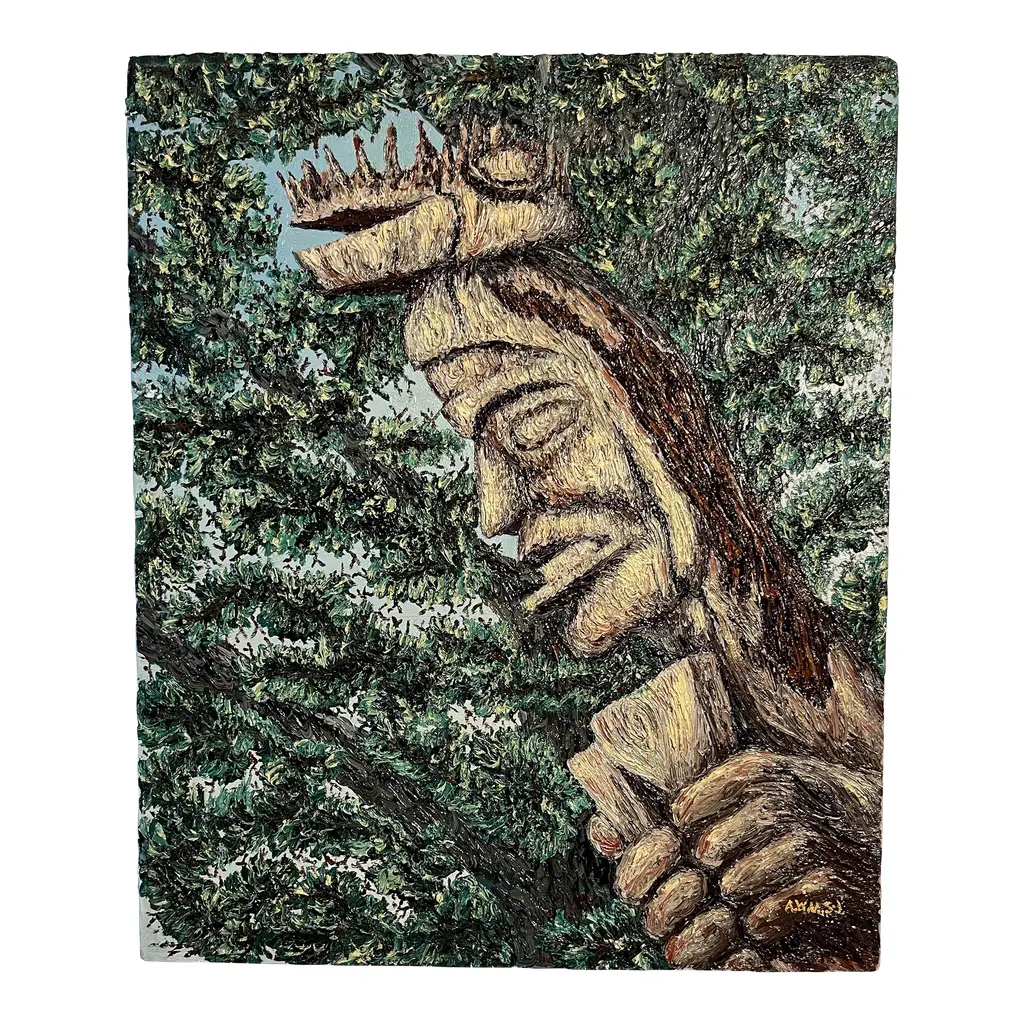
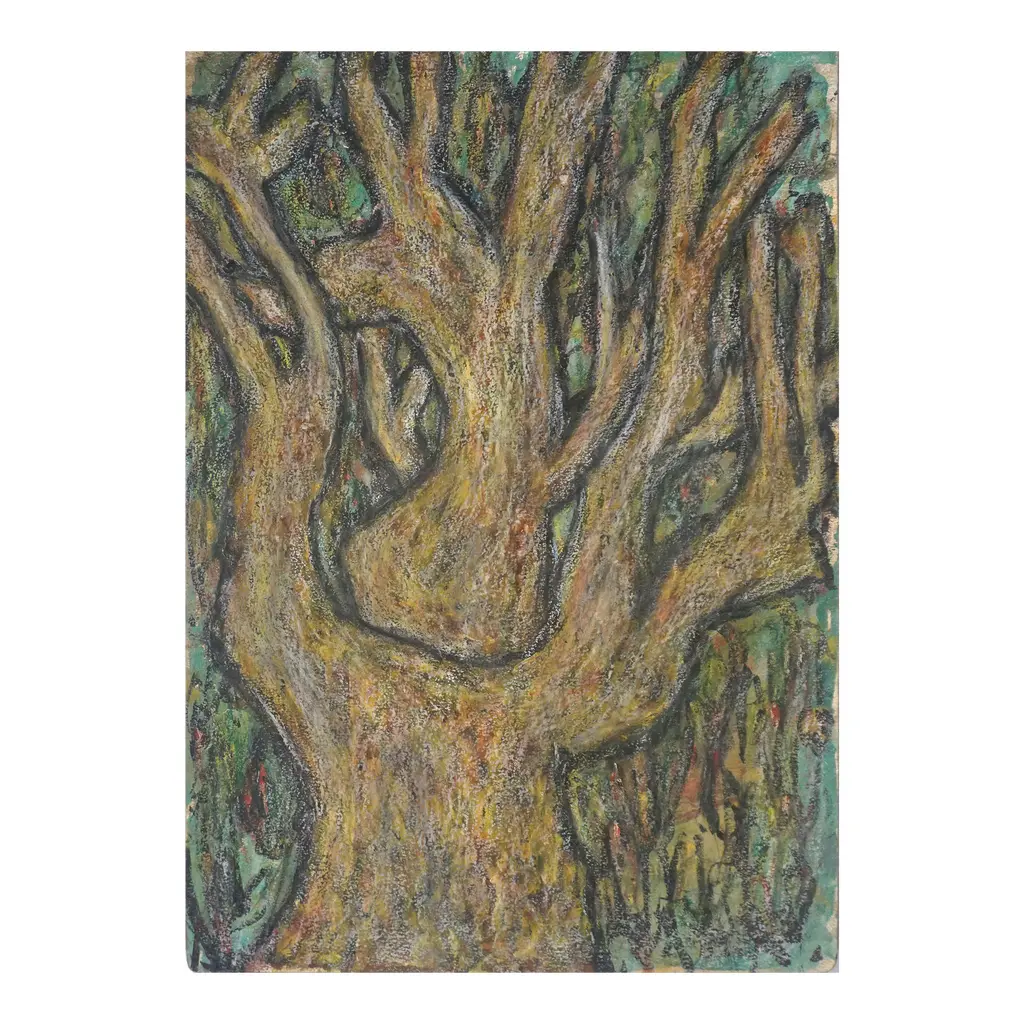
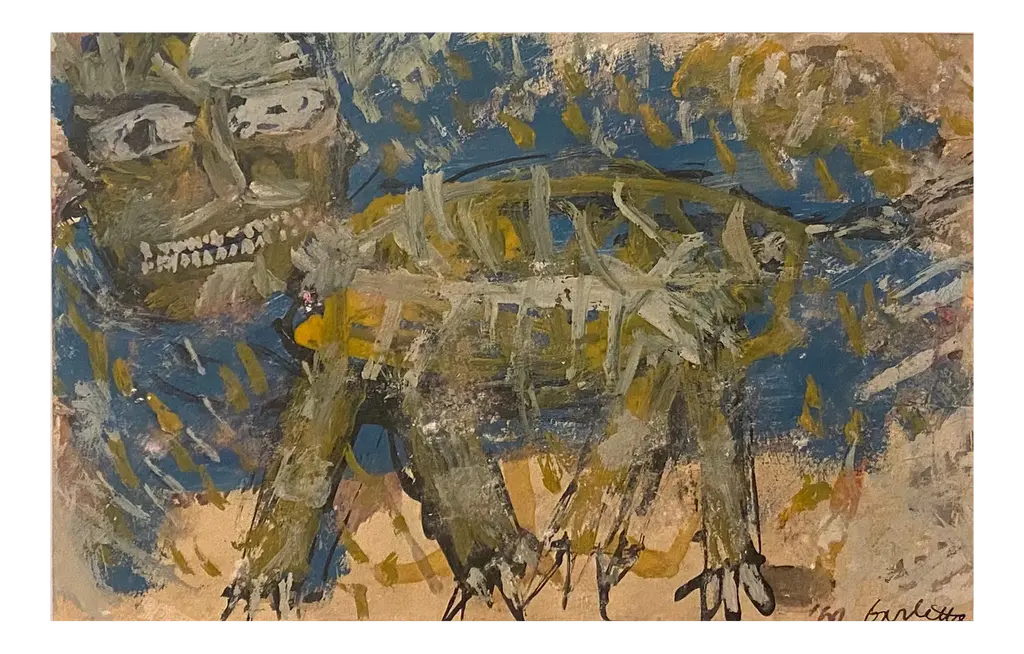
Andrew William Vachon, S.J. (American, 1910–1979) “The Fog Woman” – January 1962 Original Heavy Impasto Oil on Canvas Dimensions: 24” x 20” (Unframed) Striking original oil on canvas by noted artist and Jesuit priest Andrew William Vachon, S.J., painted in January 1962 while in Marymount, Village W., Alaska. Titled “The Fog Woman,” the work depicts the celebrated Fog Woman Totem Pole of Ketchikan, Alaska, rendered in Vachon’s distinctive, highly textured impasto technique. Executed with exceptionally thick applications of oil paint, the surface is richly sculptural, creating a dramatic three-dimensional effect. Bold palette-knife work and expressive brushstrokes bring the weathered totem figure to life amid dense evergreen foliage, capturing both the physical presence and spiritual significance of Alaska’s Indigenous cultural heritage. The painting displays Vachon’s characteristic fascination with nature, symbolism, and texture. The reverse is fully inscribed by the artist with the title, date, location, and signature: “The Fog Woman” Andrew Wm. Vachon SJ Marymount January 1962 Village W., Alaska A compelling and highly tactile mid-century Alaska subject by an artist whose works are increasingly sought after by collectors of American regional art, Alaskan art, and religiously inspired modernist painting. Condition: Very good original condition. The canvas is unframed and retains its original heavy impasto surface. No apparent repairs or restoration observed. Minor age-related wear consistent with age. Please review all photographs carefully as they form part of the description. Dimensions: Canvas: 24” x 20” Unframed An outstanding example of Andrew William Vachon’s celebrated impasto style and an important early Alaskan subject from 1962. Artist Biography – Andrew William Vachon Andrew William Vachon (1910–1979) was an American Jesuit priest, artist, and educator whose work bridged spirituality, philosophy, and visual art. He pursued his academic studies at Gonzaga University, earning both a bachelor’s degree and a master’s degree in philosophy in the mid-1930s. Vachon later returned to Gonzaga in 1965, where he taught photography and served as the university’s artist-in-residence. Over the course of his career, he produced a diverse body of work including paintings, drawings, and prints, often inspired by landscape, memory, and theological reflection. His artistic style is characterized by a deeply personal and “visionary” approach, blending observed reality with imaginative interpretation. His works frequently explore themes of place, spirituality, and the presence of the divine in everyday environments. Vachon remained active as both an artist and educator until his death on June 1, 1979, at Gonzaga University. His legacy includes decades of creative output and a lasting influence within the Jesuit and Pacific Northwest artistic communities. Andrew William Vachon’s work was notably exhibited in the “Vivid in My Mind” show at the Jundt Art Museum at Gonzaga University in Spokane, Washington, from September to December 2015. The exhibition featured about 70 paintings and drawings spanning four decades of his career. Additionally, some of his prints are held in the Whitman College and Northwest Archives in Walla Walla, Washington, and one of his oil paintings is in the collection of the Ketchikan Museums in Alaska.
Similar products