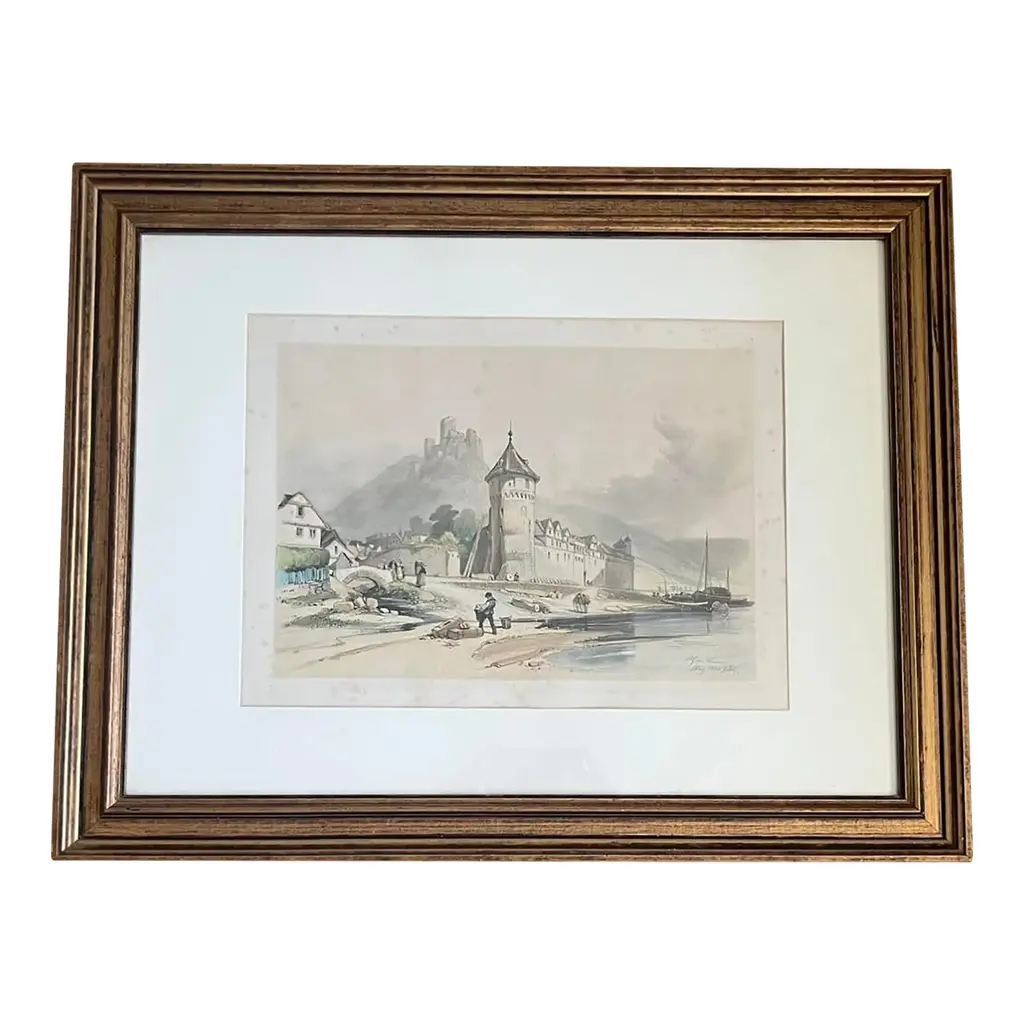
St Goar & Rheinfels Rhine View, Romantic Landscape Engraving, 1824 This atmospheric early 19th-century engraving depicts the town of St. Goar on the Rhine River, with the imposing Rheinfels Castle rising above the riverbank. The composition captures one of the most celebrated stretches of the Rhine, long admired for its dramatic landscapes, medieval ruins, and picturesque river life. The plate is dated April 1st, 1824 and published in London by R. Ackermann, 101 Strand, one of the most influential publishers of the Romantic period, known for high-quality topographical and travel prints. The view is after a drawing by S. Prout (or a similar artist of the period), with engraving credited to a skilled printmaker typical of Ackermann’s circle. In the foreground, a boatman tends to his cargo while another figure stands at the water’s edge, adding a human scale to the monumental architecture. The tall riverside tower and fortified walls of Rheinfels anchor the composition, while the distant town and riverbanks fade into a soft atmospheric perspective. This balance between detail and mood is characteristic of the Romantic movement, which sought to evoke emotion through landscape. During the early 19th century, the Rhine became a major destination for Grand Tour travelers, and views such as this were highly sought after as souvenirs and collector’s items. Ackermann’s publications played a key role in popularizing these scenic European landscapes among British audiences. Note: Interior mockups shown are for visual inspiration only and do not represent the exact scale. We do not sell reproductions, only original works of art over 100 years old. Condition: Good antique condition with even age toning and light scattered foxing. Strong impression with fine detail. Wide margins present. Framing tips: This print lends itself beautifully to a classic or travel-inspired interior. Pair with a warm ivory mount and a dark walnut or gilt frame to enhance the depth and contrast of the composition. Technique: Engraving Maker: Published by R. Ackermann, London, dated 1824
Similar products