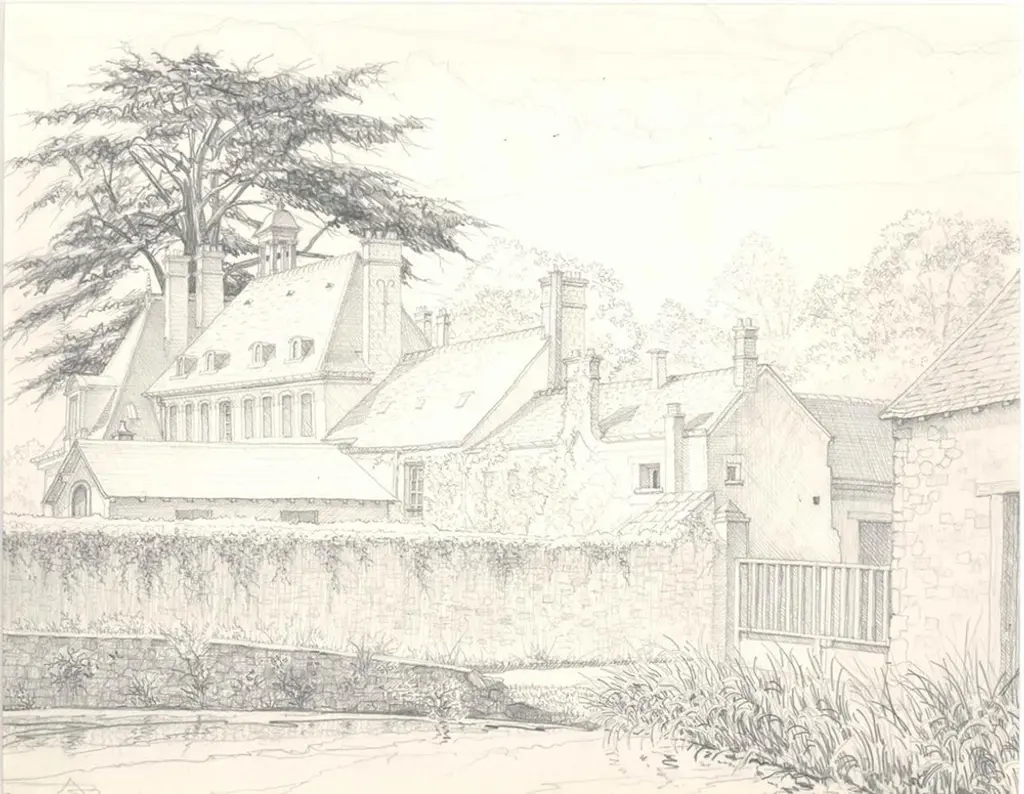
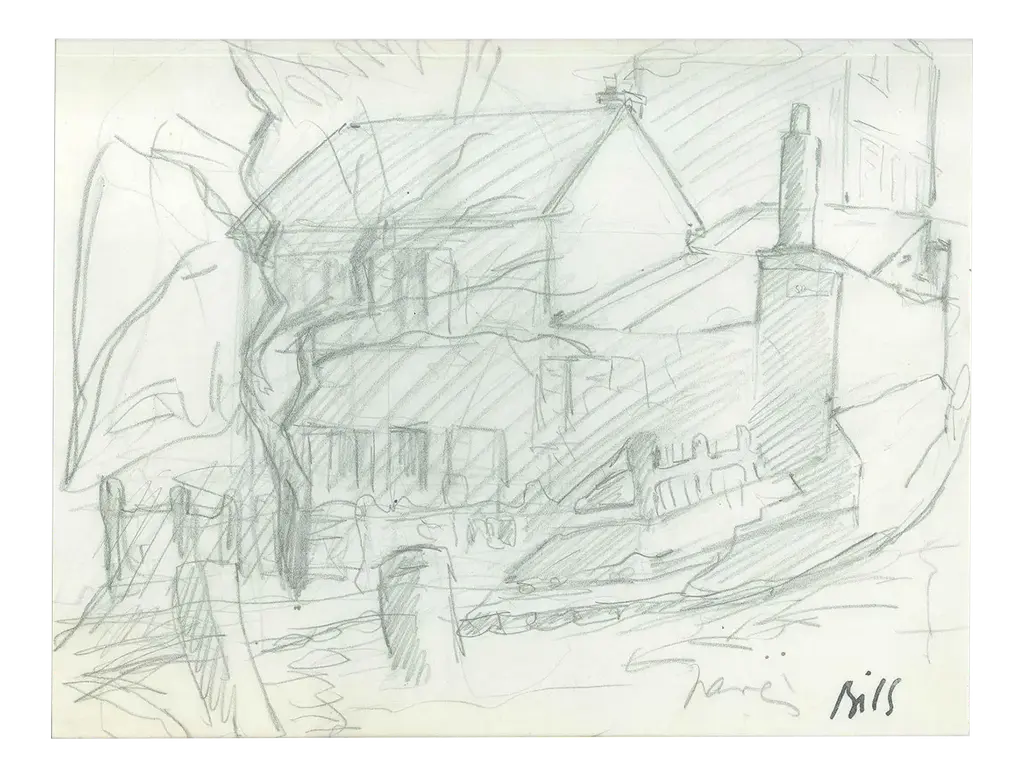
Château-Guillaume is a original pencil drawing on paper, realized around 1960s by the French artist André Roland Brudieux (1921-1999). Monogrammed in pencil ''ARB“ on the lower left margin. This is how Brudieux represents the Guillaume Castle in the French town of Lignac: the medieval castle, the ancient fortress of Duke William X of Aquitaine is sketched with a rapid and talented sign, a photographic cud and delicate nuances. This modern artwork is in very good conditions, including a cardboard passepartout (cm 34 x 49). On the back, ''Château-Guillaume'' written in pencil, as usual the artist-traveler reports on the sheet the place where he stopped to draw. André Roland Brudieux (Saint-Moreil, Creuse, France, 1921 – Paris, 1999) The French artist spent his youth in Vendôme, in the department of Loire-et-Cher, where he worked as a wallpaper stenciller. In 1939 he began to engrave and, in 1941, moved to Paris, studing at the École du Louvre between 1945-1957. Talented draftsman and sensitive artist, André Roland Brudieux was a member of Surrealist mouvement, gravitating around André Breton and participating in Surrealist exhibitions in 1950. He also began to experiment the woodcut technique in 1997. Best-known as engraver or draftsman of natural landscapes, he was also a writer, who attended the great Parisian salons, and a collector of old wallpapers and artwork. This piece is attributed to the mentioned designer/maker. It has no attribution mark and no official proof of authenticity, however it is well documented in design history. I take full responsibility for any authenticity issues arising from misattribution
More options
For up-to-date info on options, pricing, and availability, please visit the retailer.
Visit siteSimilar products