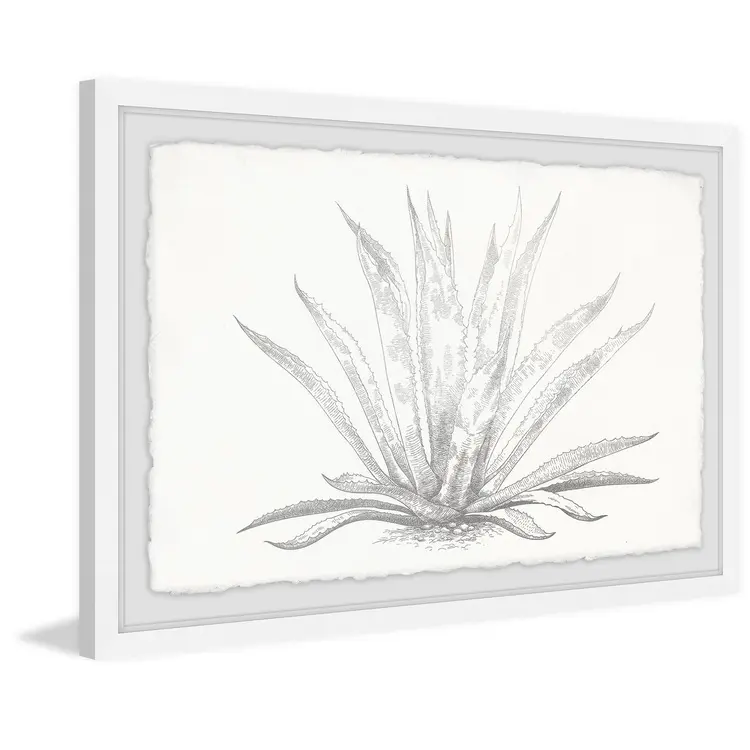
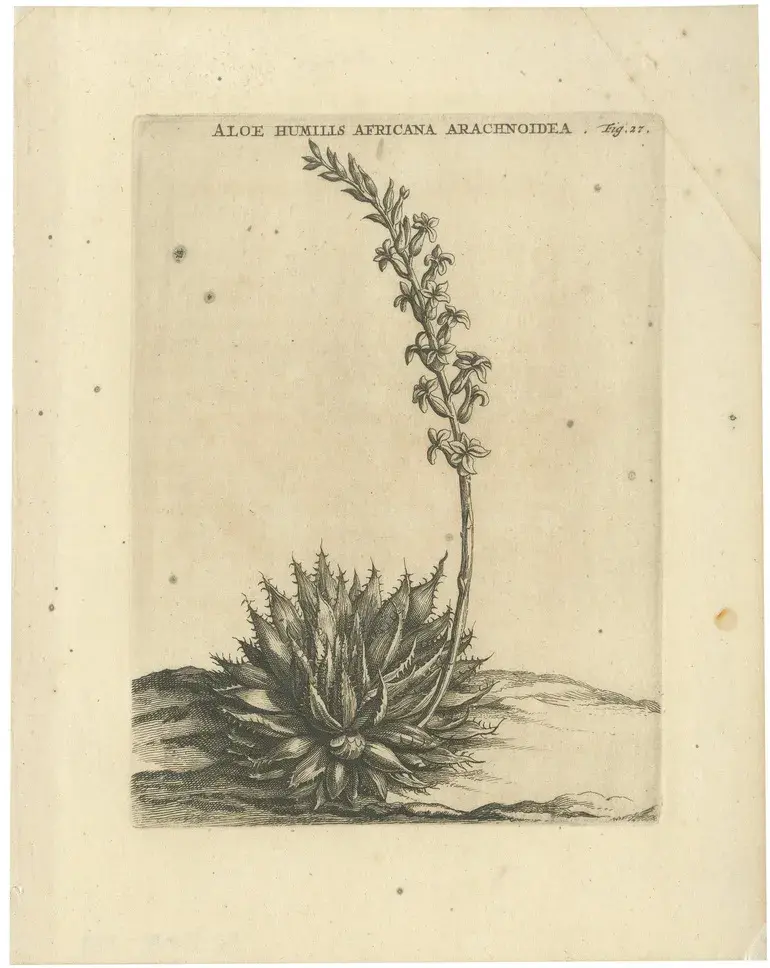
African Aloe Botanical Engraving from Caspar Commelin’s "Horti Medici Amstelaedamensis," 1706 This engraving is possibly a botanical illustration from Caspar Commelin's "Praeludia Botanica," published in 1703. It depicts another species of Aloe, likely a variant of Aloe ferox or a closely related African aloe, as indicated by the spiny, elongated leaves. The title in Latin reads "Aloe Afric: Glab: Folio Minutissim Cavitatib Notato," which can be interpreted as "African Aloe, with smooth leaves marked by fine cavities." This engraving is potentially a proof print (proefdruk) of Caspar Commelin's work, "Horti Medici Amstelaedamensis Plantæ Rariores et Exoticæ ad Vivum Æri Incisæ," published in 1706 by Fredericum Haringh in Leiden (Lugduni Batavorum). The style, botanical detail, and Latin labeling in the engraving are consistent with the scientific and illustrative approach typical of the Commelins' botanical works, which aimed to document exotic and rare plants, often received from the expanding Dutch colonial trade networks. These illustrations were engraved directly from life ("ad vivum"), ensuring botanical accuracy. Given that proof prints were commonly produced to ensure the quality and accuracy of engravings before being included in a published work, this piece could be part of the preparatory stages for Commelin’s botanical publications. It matches the s and layout found in the 1706 edition of Caspar Commelin's work, which followed Jan Commelin’s earlier efforts to document over 360 species from Africa, the Americas, and Asia. : The engraving shows a fully grown aloe plant with long, pointed leaves that radiate outward in a rosette pattern. The leaves are marked by subtle, fine details that indicate the surface texture and are arranged in a more elongated, angular fashion compared to the broader-leafed Aloe ferox. - Leaf Texture: The engraving carefully captures the smooth texture of the leaves, with fine details that highlight subtle indentations or markings. The tips of the leaves are pointed, typical of aloe species. - Growth Pattern: The illustration shows the aloe's base in a natural setting, with the leaves growing from the central axis, extending outward in a naturalistic manner. The rosette shape, typical of aloe plants, is clearly emphasized. The engraving does not appear to be hand-colored, unlike other works from this period, which suggests it may be a proof print rather than the final, colored version. Maker: This engraving belongs to the series produced under the supervision of Caspar Commelin for his botanical works. Caspar, nephew of Jan Commelin, was responsible for completing and expanding upon his uncle's work after Jan’s death. Their collaborative contributions to botany, especially through publications like "Horti Medici Amstelaedamensis," played a significant role in early scientific efforts to classify and describe exotic plants in Europe. What It Shows: The engraving is a detailed depiction of an African aloe species, possibly a variant of Aloe ferox. Aloe species like this were highly valued for their medicinal properties, with aloe sap being used for its soothing and laxative effects. The illustration would have served as both an educational tool and a scientific reference for European botanists and herbalists, providing them with accurate visual representations of exotic plants collected from the colonies and distant regions. This piece contributed to European efforts in the 18th century to classify and catalog exotic species, with particular attention to their medicinal uses and economic potential.
Similar products