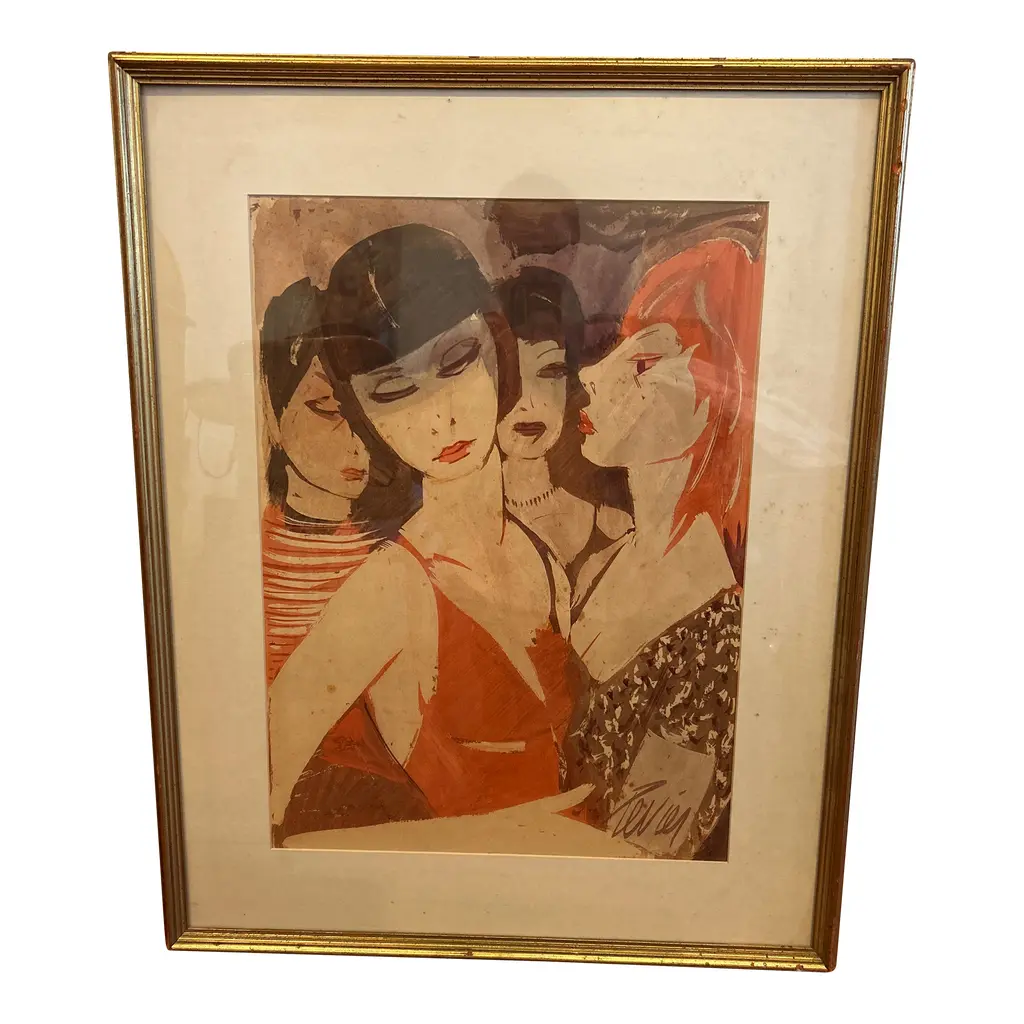
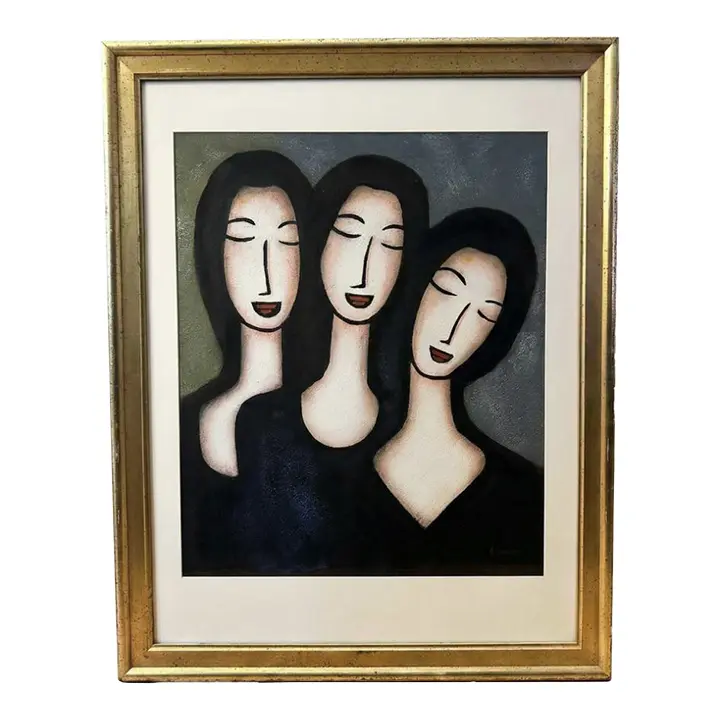
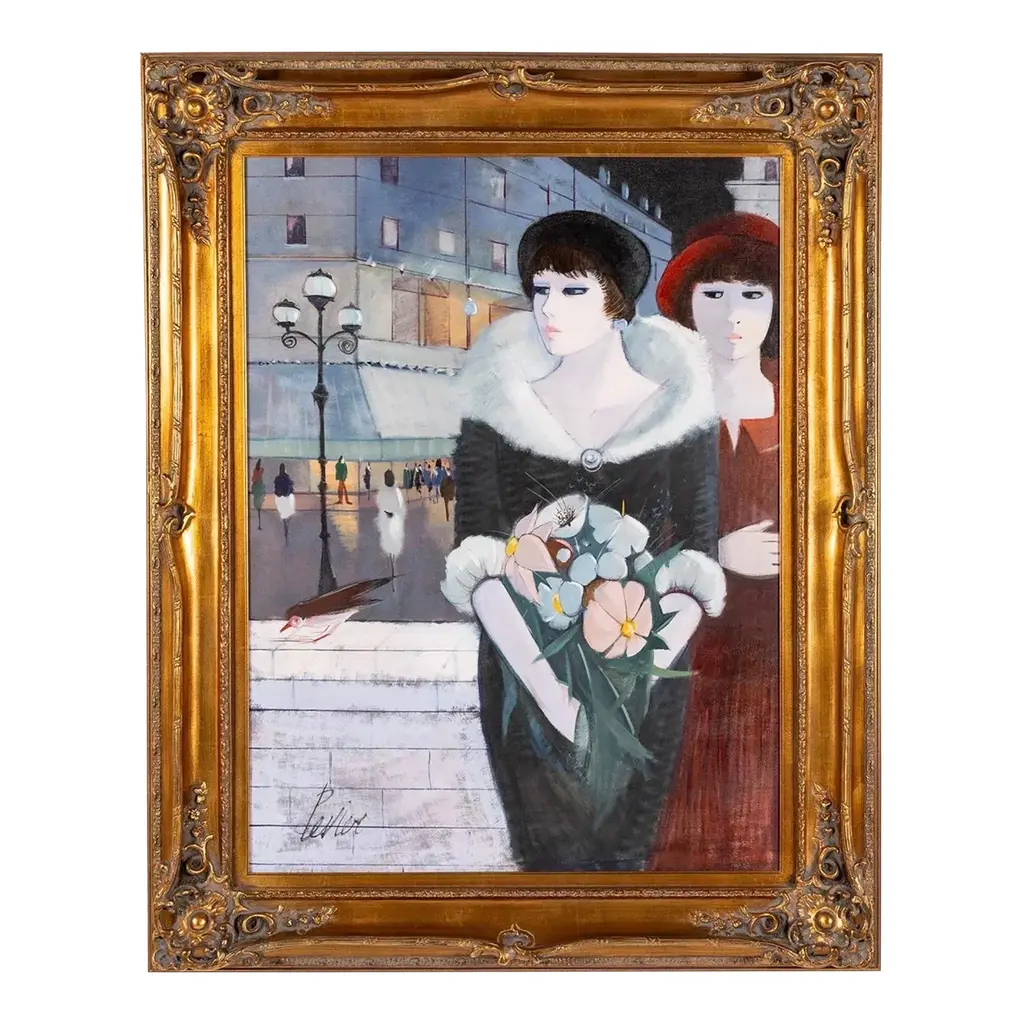
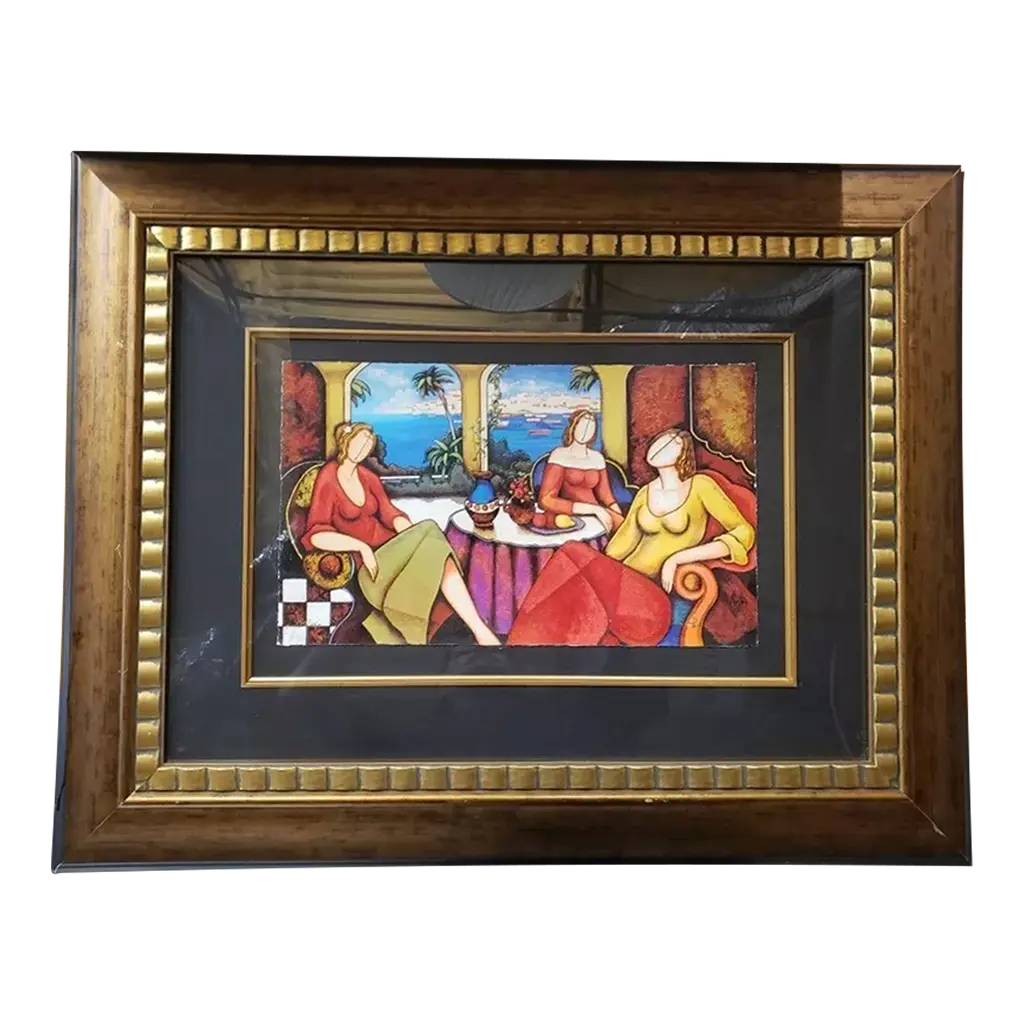
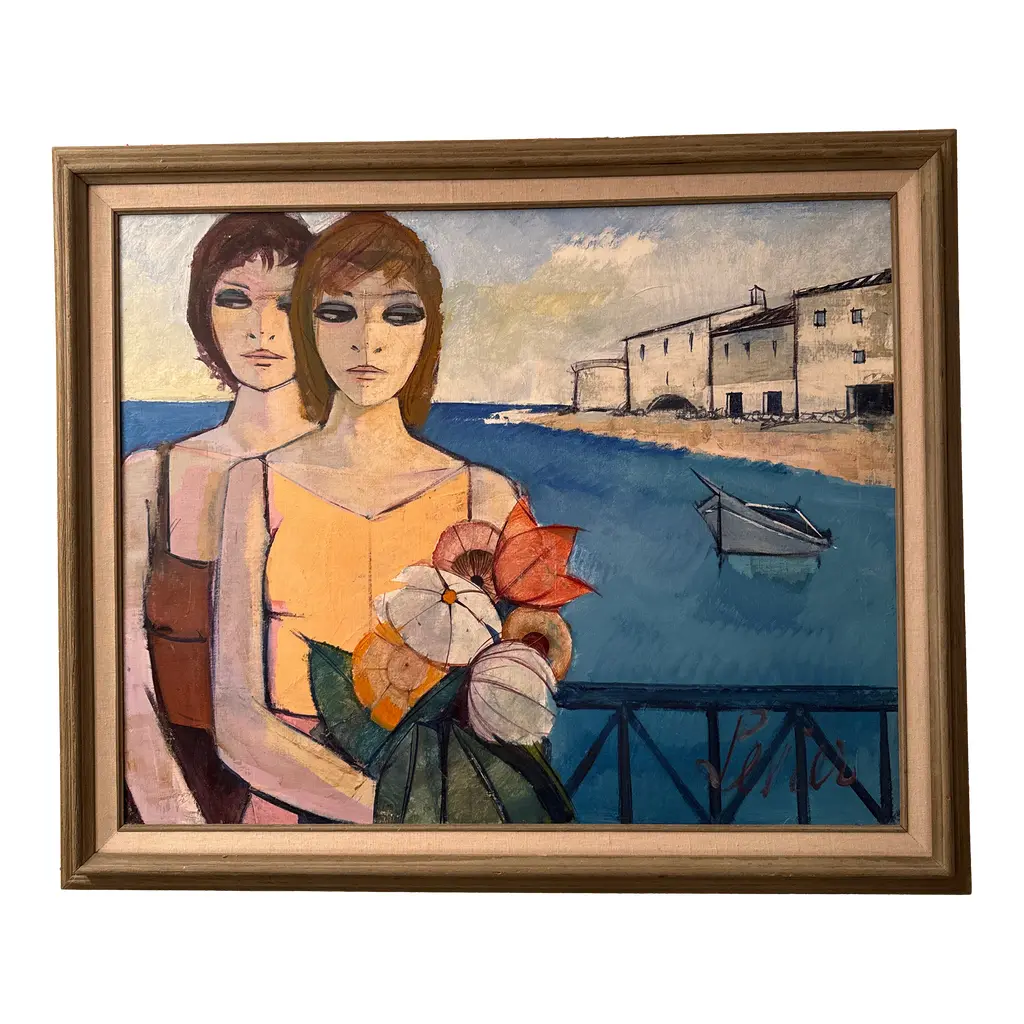
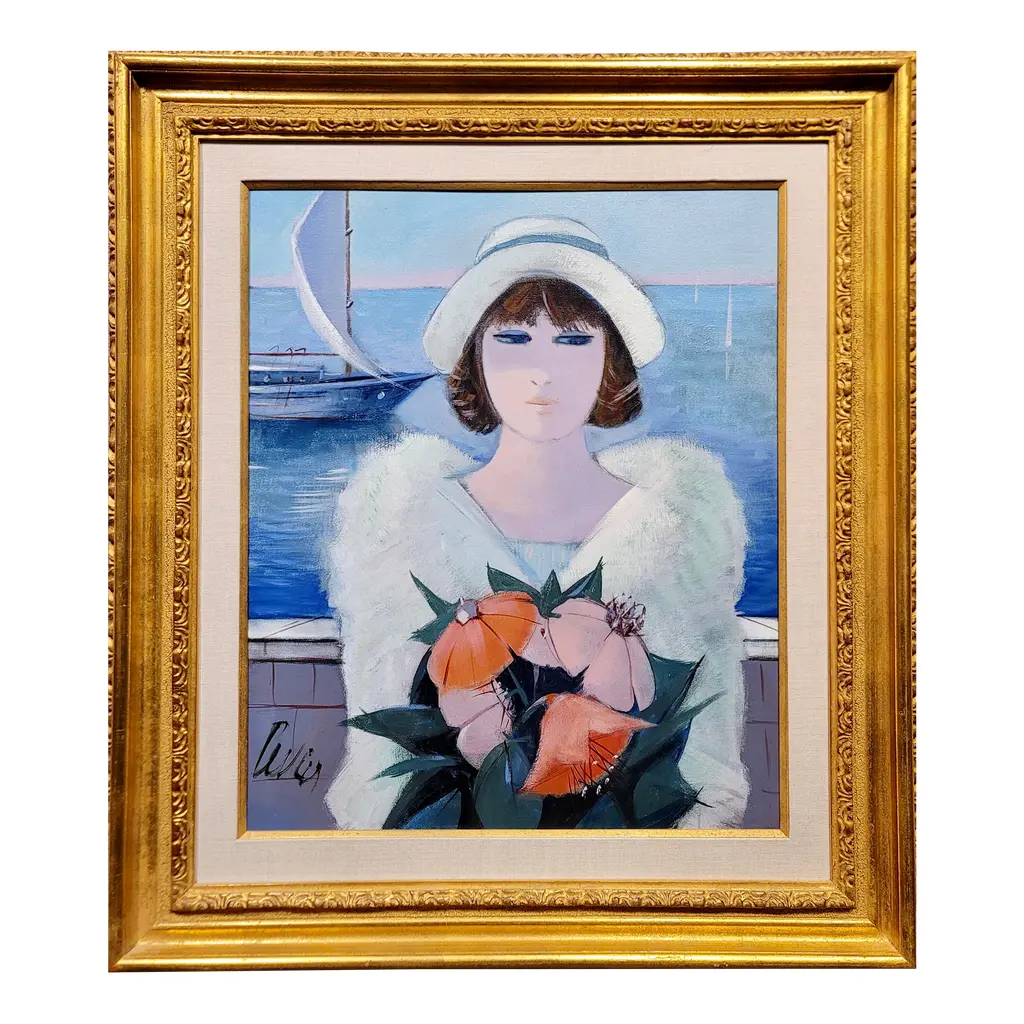
Charles Levier "Three Parisian Women by the beach"1960s Oil Painting French Expressionist - Oil painting on canvas - signed canvas size : 29x39" Frame size 41x51"x2" Description An exceptionally captivating mid-century modern oil painting on canvas by the highly listed French artist Charles Levier (1920–2003). This masterwork captures Levier’s celebrated thematic interplay of feminine elegance and coastal serenity. It features three stylized young women—often referred to as his "Parisiennes"—gathered by a seaside promenade. The central figure balances a vibrant, architectural bouquet of stylized multi-colored sunflowers and foliage. Behind them, a tranquil harbor unfolds, punctuated by traditional white beached rowboats and stone coastal villas under a soft blue sky.Levier’s signature style shines through the geometric structure of the figures, their dramatically elongated necks, heavy-lidded blue eyeshadow, and bold, graphic contours. The palette masterfully balances cool maritime blues and warm earthen shades with pops of brilliant orange and yellow in the bouquet. The painting is signed "Levier" in the lower left corner. It arrives beautifully housed in its original, heavy mid-century carved giltwood frame, featuring a natural linen liner that adds excellent depth and historical context to the piece. Art Historical Significance & Allegory While this masterwork epitomizes the sleek, graphic romanticism of mid-century French Modernism, its structural core is a deeply sophisticated engagement with classical Western mythology and allegory. The tight, tripartite framing of the three stylized figures directly modernizes the classical motif of The Three Graces (the Charites of Greek myth: Aglaea, Euphrosyne, and Thalia), who traditionally personified radiance, joy, and the flowering bloom of springtime. Historically depicted by masters from Sandro Botticelli to Peter Paul Rubens as the constant attendants of Venus, Levier translates these mythological guardians of earthly beauty into chic, contemporary Parisiennes along a sun-drenched Mediterranean coast. Simultaneously, the composition brilliantly activates the iconography of The Judgement of Paris. In classical art history, three rival goddesses are presented to a mortal judge to determine who reigns supreme in beauty, a choice traditionally rewarded with a single golden apple. Levier ingeniously subverts and modernizes this patriarchal dynamic; there is no male judge present. Instead, the narrative is completely self-contained within the feminine sphere, and the "golden apple" is transformed into an architectural, soaring bouquet of golden sunflowers held proudly by the central figure. By intertwining these dual allegories, Levier elevates a secular coastal scene into a timeless, intellectual meditation on the nature of beauty, female camaraderie, and the abundant vitality of the natural world Details & Dimensions Artist: Charles Levier (French, 1920–2003) Medium: Oil on Canvas Period: Circa 1960s Styles: Mid-Century Modern, Expressionism, Post-Impressionism Subject: Women, Botanical/Flowers, Maritime/Seascape Condition: Excellent vintage condition. The canvas is taut with vibrant colors and light, stable age-appropriate craquelure. The vintage frame shows minor, authentic wear to the gilt finish, adding to its period charm. Artist Biography: Charles Levier (1920–2003) Early Life and Academic Foundations Charles Levier (born Maurice Verrier) was born in Corsica, France in 1920 to a French father and an American mother. This dual heritage profoundly shaped his worldview and laid the groundwork for his later success navigating both European and American art markets. From early childhood, Levier possessed an innate fascination with form and color. At just 17 years old, his talent earned him a spot at the prestigious École Nationale Supérieure des Arts Décoratifs in Paris, where he engaged in rigorous classical and decorative training. World War II and Intelligence Service Levier's academic trajectory was abruptly interrupted by the outbreak of World War II. He relocated to North Africa to serve with the French Army. Following the arrival of Allied forces in the region, Levier’s fluent English and bicultural background made him an invaluable asset. He was appointed as a Liaison Officer to the U.S. Office of Strategic Services (OSS)—the wartime intelligence agency that preceded the CIA. This intense period exposed Levier to global political dynamics and deepened his connections to American institutions, prompting him to divide his life between both continents after the war. Mid-Century Breakthrough & Continental Success Rather than returning to formal art school at the war's end, Levier fully committed to establishing his independent studio practice. He began exhibiting across Europe, earning his critical breakthrough with a highly successful debut solo exhibition at the Galerie Constantine in Lyons, France, in 1949. Recognizing a post-war American appetite for modern European art, Levier made his U.S. debut in Los Angeles in 1950. Throughout the 1950s and 1960s, he maintained dual studios in Paris and New York, followed by a move to California in the 1970s, where the dramatic light of the desert and coast influenced his shifting atmospheric textures. He frequently exhibited at high-profile American spaces like the Van-Diemen Lilienfeld Gallery in New York. Artistic Philosophy, Style, and Influence Levier is celebrated as a vital figure of the post-war mid-century figurative movement. While many of his peers shifted toward pure abstraction, Levier defended the human figure, modernizing it through an intersection of Cubist geometry, Post-Impressionist color theory, and Expressionist emotion. F.M. Hinkhouse, the former director of the Phoenix Art Museum, famously praised Levier as a "master of art," noting that his paintings are executed with an innate "good taste, and formidable creative energy... definitive yet seductive, yet always subtle with carefully considered colors." His most coveted subjects are his "Parisiennes"—stylized, elongated female figures characterized by deep, heavy-lidded, almond-shaped eyes and bold black outlines reminiscent of stained glass or fashion illustration. These figures are frequently juxtaposed against sparse, geometric harbor towns, minimalist interiors, and structural floral bouquets. Hollywood Patrons and Legacy During the golden age of Mid-Century Modern design, Levier's artwork became a symbol of sophisticated cosmopolitan taste. His paintings became highly fashionable status symbols among Hollywood elite and political figures, appearing in the private homes and collections of: Frank Sinatra Dean Martin Peter Lawford Adlai Stevenson (prominent diplomat and politician) Baron Edmond de Rothschild Prince and Princess Poniatowsk
Similar products