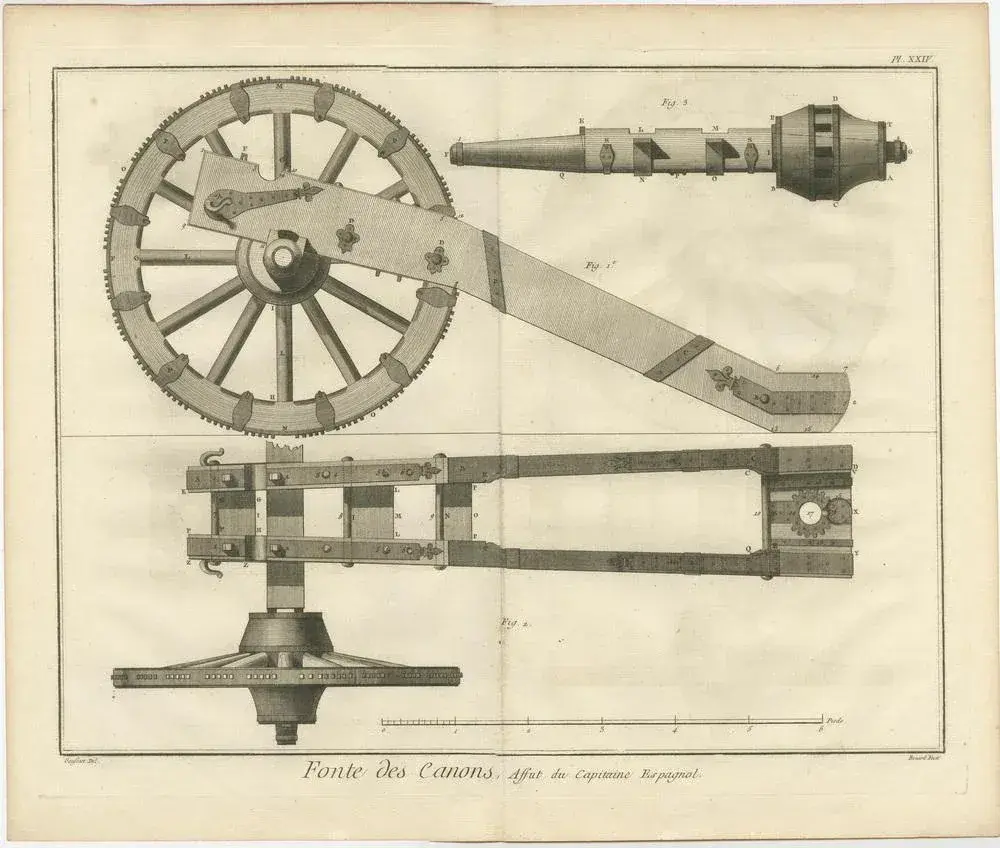
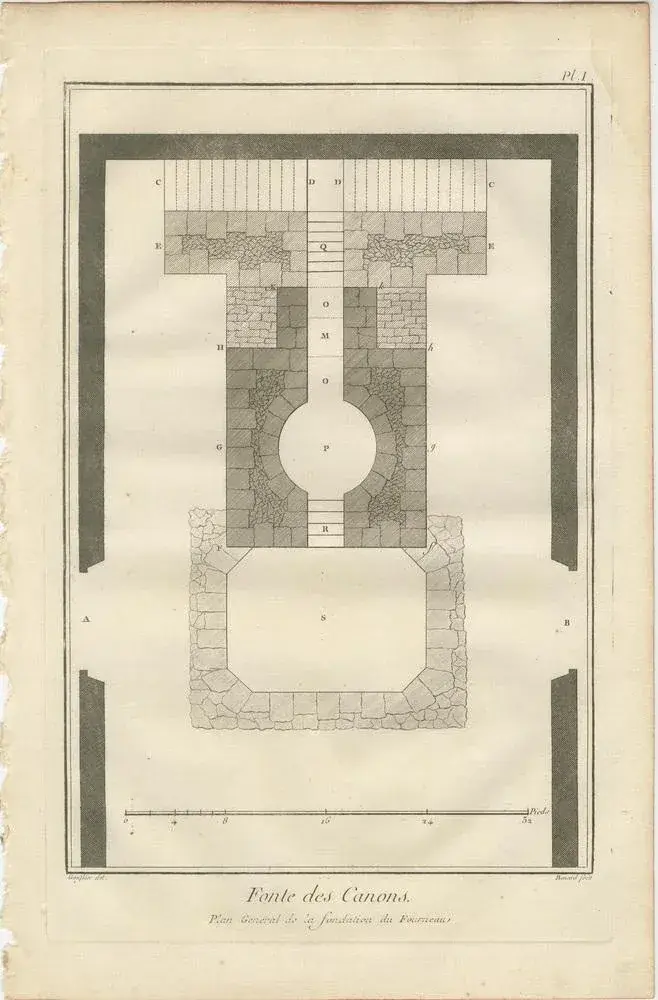
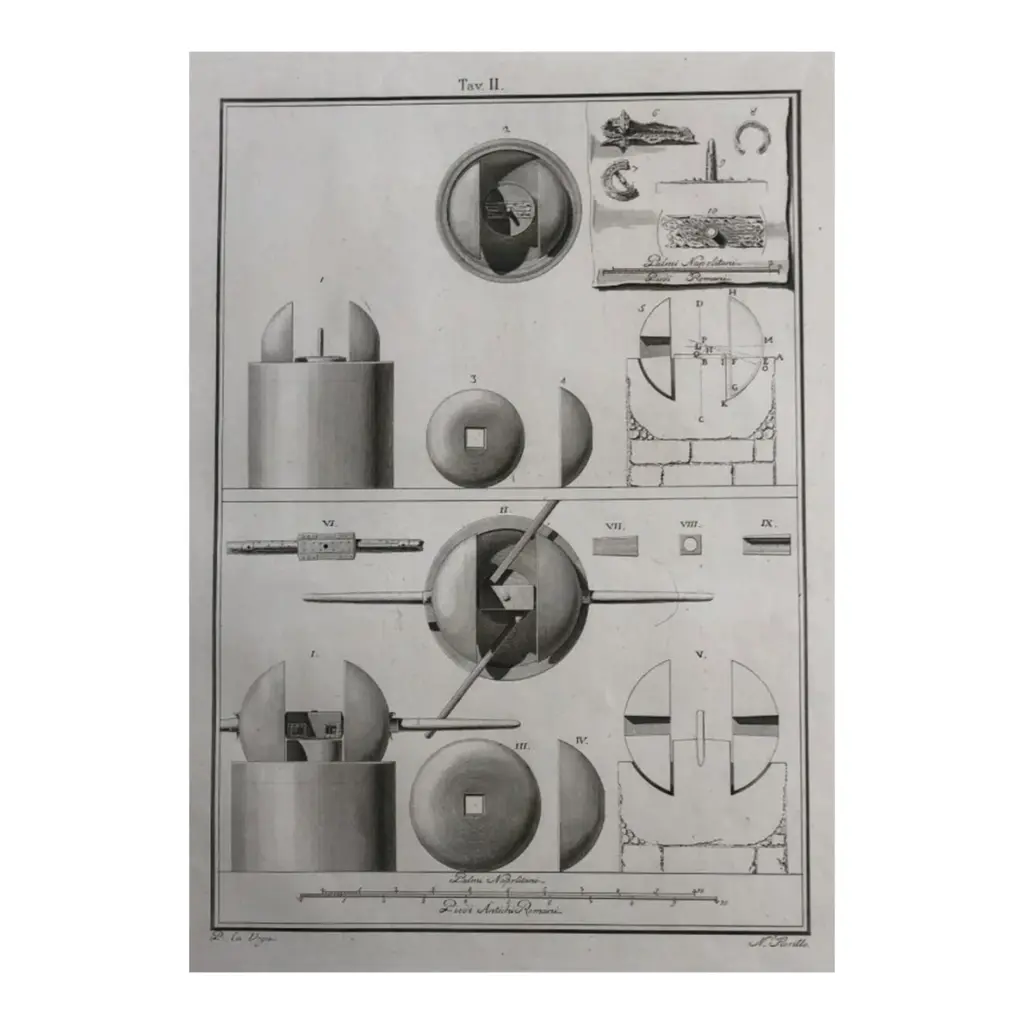
Title: Antique 18th Century Engraving of Cannon Designs and Cross-Sections from Diderot : This original 18th-century engraving presents highly detailed technical illustrations of cannon designs, including precise cross-sections and schematics, meticulously drawn for Diderot's famous Encyclopédie, ou Dictionnaire raisonné des sciences, des arts et des métiers. This set of engravings showcases the artistic and scientific advancements in artillery manufacturing during the Age of Enlightenment. These plates were executed by skilled engravers under the guidance of Denis Diderot and Jean-Baptiste Le Rond d'Alembert, and were intended to document the most sophisticated foundry techniques and cannon designs of the period. The engraving consists of two large plates, carefully arranged in a horizontal composition. The first plate illustrates the longitudinal sections of five different calibers of cannons, highlighting the internal structure and bore diameter, crucial for understanding the precision of artillery production in the 18th century. Each cannon is meticulously labeled with numerical values indicating scale, proportions, and mechanical specifications. The second plate presents schematic elevations of the same five calibers, including precise dimensional annotations and intricate decorative elements found on the breech and muzzle. The engravings feature elaborate embellishments, such as royal insignia, intricate floral motifs, and ornate cartouches, which were characteristic of high-status artillery pieces cast for European monarchies. These plates serve as an important historical record of 18th-century metallurgy, engineering, and military technology. Cannon design was not only a matter of warfare but also a demonstration of national prestige and technological superiority. The detailed line work and shading techniques used in these engravings reflect the exceptional skill of the engraver and the commitment to scientific accuracy. These images were invaluable resources for craftsmen, military engineers, and scholars of the period, offering a visual guide to the principles of cannon casting and the intricacies of foundry work. Condition Report: The engravings are in very good condition considering their age, with only minimal foxing and light toning visible around the margins. The paper has retained its integrity, with no significant tears or creases affecting the printed area. The impressions are crisp and well-defined, with excellent contrast that preserves the fine detailing of the original plates. Some slight discoloration is present along the edges, which is consistent with the natural aging of antique paper. Framing Tips: To properly display and protect this engraving, it is recommended to use archival-quality materials. A museum-grade mat with an acid-free backing will help preserve the paper and prevent further aging. A simple yet elegant black or dark wood frame will complement the engraving's historical and technical nature without overshadowing its intricate details. For additional protection, consider UV-resistant glass or acrylic to prevent fading from light exposure. This engraving would be an excellent addition to a study, library, or collection focused on military history, engineering, or 18th-century scientific advancements.
Similar products