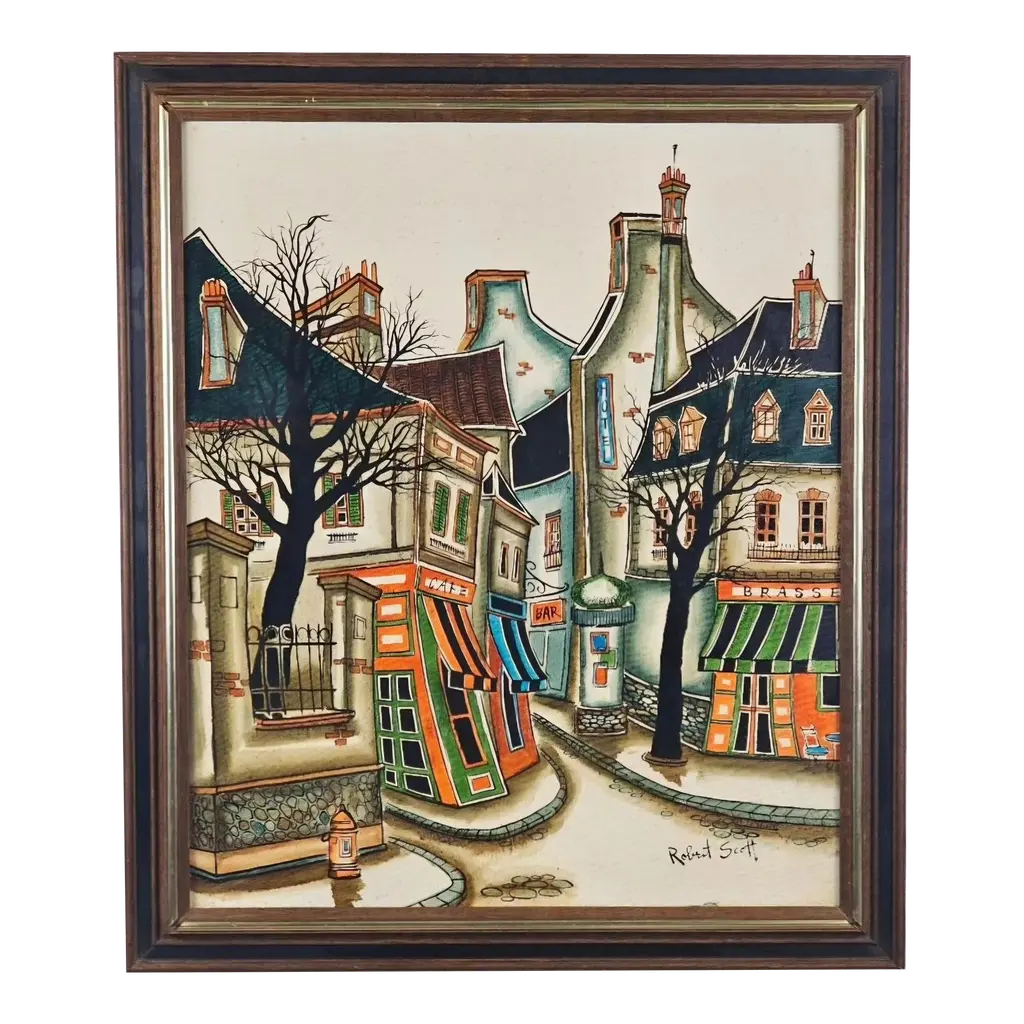
Early 20th Century "To Market To Market" Figurative Brooklyn Cityscape Painting By Frank Simon Herrmann, Framed
Chairish$2,650
Early 20th Century "To Market To Market" Figurative Brooklyn Cityscape Painting By Frank Simon Herrmann, Framed
Chairish$2,650
"To Market To Market", a whimsical early 20th century modern figurative village landscape by Frank Simon Herrmann (American, 1866-1942). In this charming scene of a downtown village street, small figures can be found strolling around, sitting on a bench, and fishing in a small pond. Herrmann fills the scene with expressive details and fun patterns. Titled "To Market To Market" and signed "Herrmann" lower left. Displayed in a new white mat and rustic wood frame. Image size: 17.5"H x 21.5"W. An American who was best known in Germany where he spent most of his career, Frank Herrmann created work that embraced Beaux-Arts Academic Realism to Impressionism to the New Objectivity. He was a founding member of two important groups of the German avant-garde centered in Munich: the Munich Secessionist Group , SEMA, that included his friend, Paul Klee, and the New Secession of German Artists, led by Wassilj Kandinsky. Herrmann was also closely associated with Alfred Stieglitz, with whom he had gone to school including college, and who became a leading avant-garde art influence in New York City. They traveled together in Paris during the 1890s in Europe. In Germany, Herrmann early painted in the style of Lyric Abstraction, using primarily gouache. In 1895, Herrmann settled in Munich and remained there for the next 24 years. There he earned a reputation for his impressionist landscape paintings and was dubbed "the tulip field painter". He became a central figure among German expressionist painters and other intellectuals, holding weekly meetings of these people at his mansion. Having been one of the few Americans to remain in Germany during World War I, he returned to the United States in 1919 and lived the last part of his life in his family mansion in Elberon, New Jersey. He also traveled including to Lake George at the invitation of Steiglitz and O'Keeffe, and west where he visited California, Arizona and New Mexico. He allowed his work only limited exposure in the United States, but at age 61 had a solo exhibition in New York City at Babcock Galleries. His primary representative was J.B. Neumann's New Art Circle, and his work was usually grouped with New Objective painters that included Max Beckmann. Herrmann had a daughter, Eve Herrmann, who was an expatriate caricaturist. Very prolific, producing thousands of works, he often signed his work J.S. Herrmann. Many of his paintings were destroyed during the World Wars.
Similar products