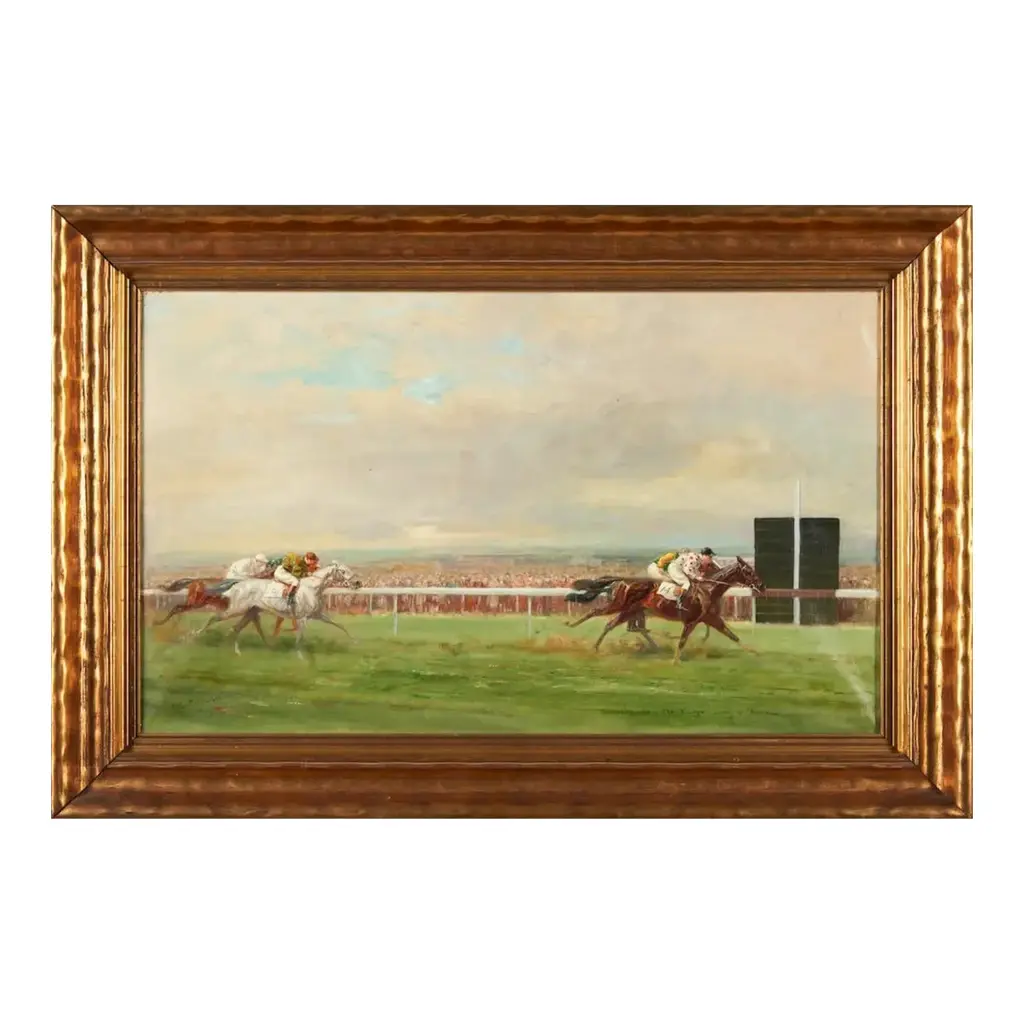
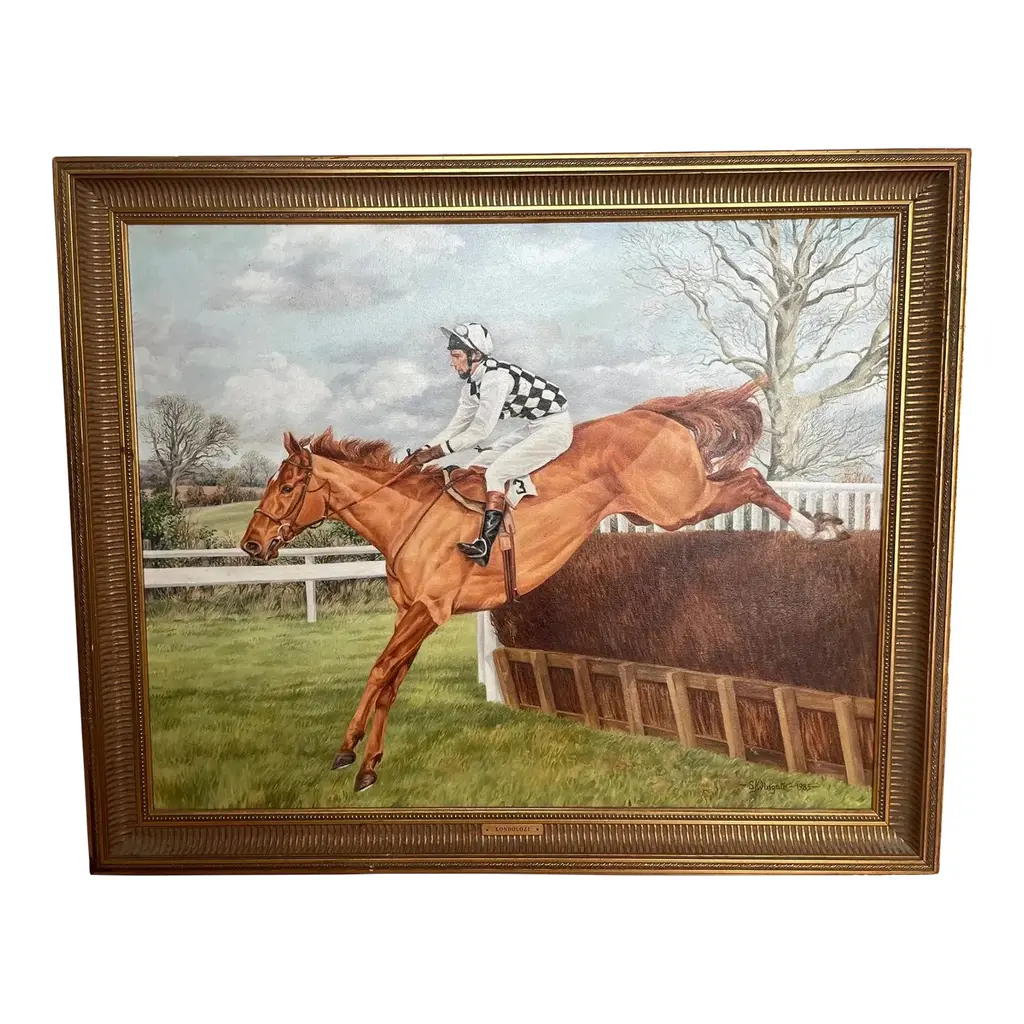
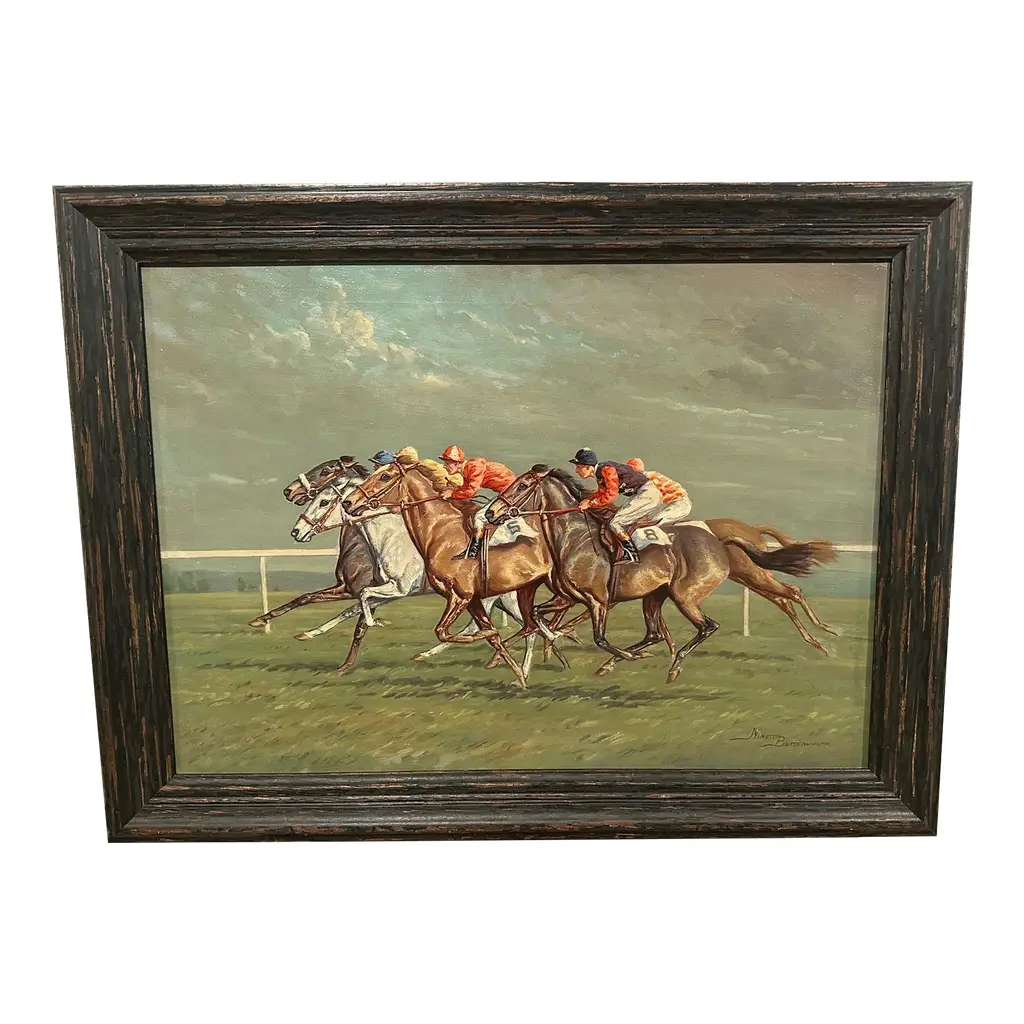
Edwardian Sporting Watercolour By Isaac James Cullin (1859–1942) The 1910 Two Thousand Guineas, Newmarket Neil Gow’s Classic Victory – Signed & Dated
Chairish$19,000
Edwardian Sporting Watercolour By Isaac James Cullin (1859–1942) The 1910 Two Thousand Guineas, Newmarket Neil Gow’s Classic Victory – Signed & Dated
Chairish$19,000
Isaac James Cullin (1859–1942) The 1910 Two Thousand Guineas, Newmarket Neil Gow’s Classic Victory – Signed & Dated Edwardian Sporting Watercolour Subject & Medium A rare and historically significant Edwardian original watercolour on paper titled “Two Thousand Guineas 1910” by British sporting artist Isaac James Cullin (1859–1942). This finely executed equestrian racing painting captures the decisive finish of the 1910 Two Thousand Guineas Stakes at Newmarket, one of the most prestigious events in the British flat racing calendar. Depicted at full stretch is Lord Rosebery’s celebrated colt Neil Gow, ridden by champion jockey Danny Maher, defeating Lemberg, who would later win the Derby at Epsom that same year. The handwritten inscription “Two Thousand Guineas 1910” confirms the work as a commemorative and contemporaneous record of this historic Classic race. This is not a decorative sporting scene, but a documented Edwardian racing event painted with historical specificity. Historical Context – The 1910 2,000 Guineas The Two Thousand Guineas Stakes, run over the Rowley Mile at Newmarket, is the first of the five British Classics and a defining test for elite three-year-old colts. The 1910 race holds particular historical importance: Neil Gow was owned by Archibald Primrose, 5th Earl of Rosebery, former Prime Minister of the United Kingdom and one of the great aristocratic patrons of British racing. Danny Maher was among the most accomplished jockeys of the Edwardian era. Lemberg, visible just behind Neil Gow in this composition, went on to win the Derby at Epsom later in 1910. Cullin captures the precise moment when Neil Gow’s acceleration secured Classic victory — forelegs fully extended, musculature taut, the jockey crouched low in aerodynamic balance. The scene conveys both athletic power and the social spectacle of Edwardian race meetings. Given the dated inscription and detailed specificity, the painting was likely created either as a commemorative commission for a racing patron or for exhibition following the Classic victory — a common practice among aristocratic owners celebrating major wins. Composition & Technique Cullin’s composition is dynamic yet meticulously observed. Neil Gow dominates the foreground, his chestnut coat rendered in layered tonal washes that articulate muscle and movement with anatomical precision. Danny Maher’s silks are crisply defined, reins taut, posture forward and balanced. Behind, Lemberg presses forward, creating narrative tension and depth. The wider setting situates the race within Edwardian society: A densely assembled crowd of top-hatted gentlemen A contrasting female figure in lighter dress The Newmarket grandstand rising to the right White running rails guiding the eye across the Heath A brooding grey-blue sky suggestive of English spring light Cullin’s use of controlled watercolour washes combined with sharper detailing in the horses elevates the work beyond illustration into historical storytelling. The composition reflects both documentary clarity and painterly atmosphere. Signed & Inscribed Signed lower right: Isaac Cullin, 1910 Inscribed lower centre: “Two Thousand Guineas 1910” Original watercolour on paper, mounted on board and professionally framed under museum-grade AR70 UV-protective glazing. The presence of both signature and dated inscription significantly enhances collectability. About the Artist – Isaac James Cullin (1859–1942) Isaac James Cullin was a respected British sporting and equestrian painter active in the late Victorian and Edwardian periods. Born in New York; later established career in Britain Exhibited at the Royal Academy Known for commissioned equestrian portraits and racecourse scenes Collaborated with sporting artist John Alfred Wheeler Recognised for anatomical accuracy and atmospheric racing compositions Cullin forms part of the distinguished lineage of British sporting art descending from George Stubbs and refined through Victorian and Edwardian turf painters. His racing subjects are notably rarer than his equestrian portraits, and signed, dated examples tied to major Classic races are especially desirable. Provenance & Exhibition History Painted and dated 1910 From the estate of Richard “Dickie” Onslow, respected horse racing journalist, author, and historian Sold at Graham Budd Auctions, Auction GB84 – Race to History: Specialist Horse Racing Memorabilia Auction in partnership with Weatherbys, November 2024. Acquired through this specialist English racing auction Privately Loaned & Exhibited at the Famous Lord Hill Museum Held in the collection of Cheshire Antiques Consultant LTD Richard Onslow was known for assembling historically important racing material rather than decorative sporting art, adding scholarly credibility to the work. Exhibition at the Famous Lord Hill Museum further reinforces its recognition as a work of sporting heritage. Frame & Presentation Presented in a recently fitted Larson Juhl gold leaf moulded pine frame. Acid-free archival mount High-quality AR70 UV-protective glazing Conservation-grade presentation Ready to hang The classical gilt frame complements the Edwardian subject matter while ensuring long-term preservation. Framed Dimensions Height: 53.5 cm Width: 63 cm Depth: 4.5 cm Why This Work Matters This painting unites: A named British Classic race Aristocratic and political association A future Derby winner A Royal Academy exhibiting artist Exhibition history Documented specialist auction provenance It represents a rare intersection of Edwardian sporting art, British racing history, and aristocratic heritage.
Similar products