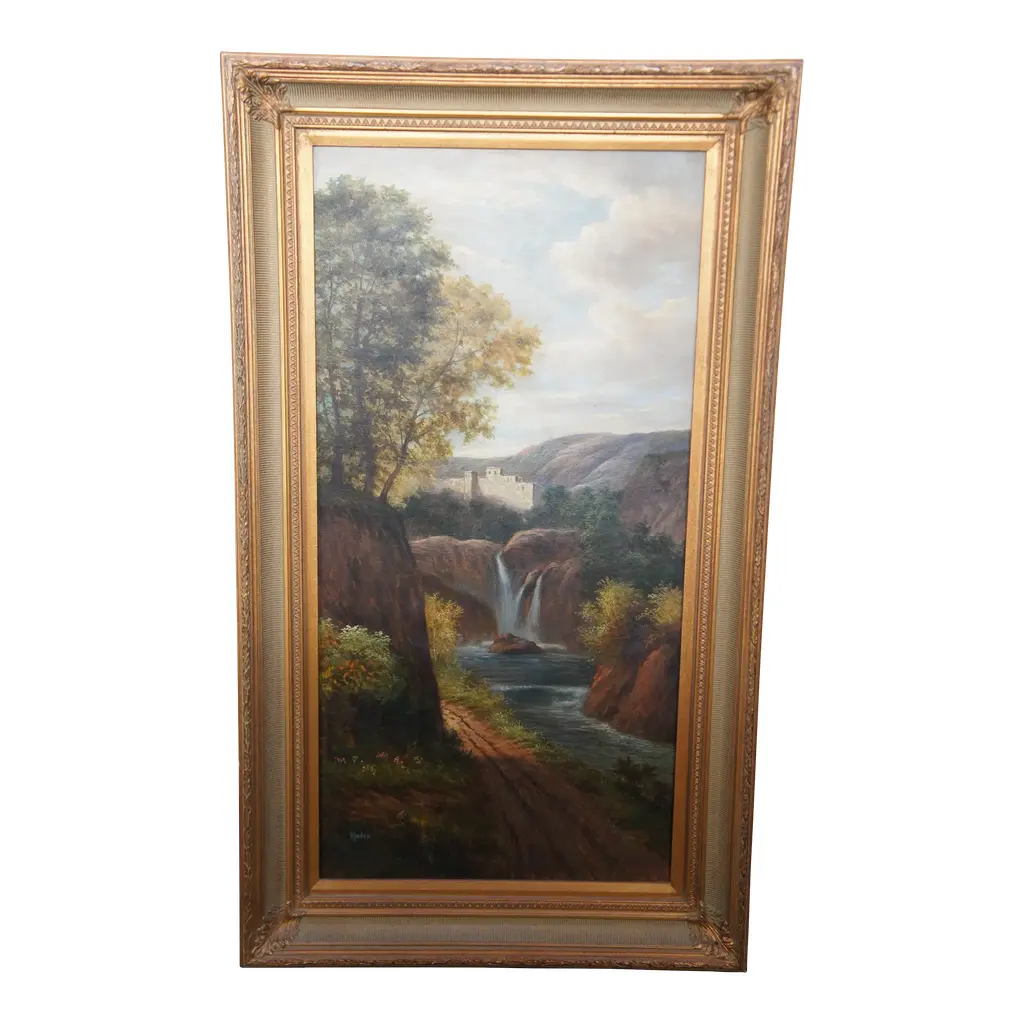
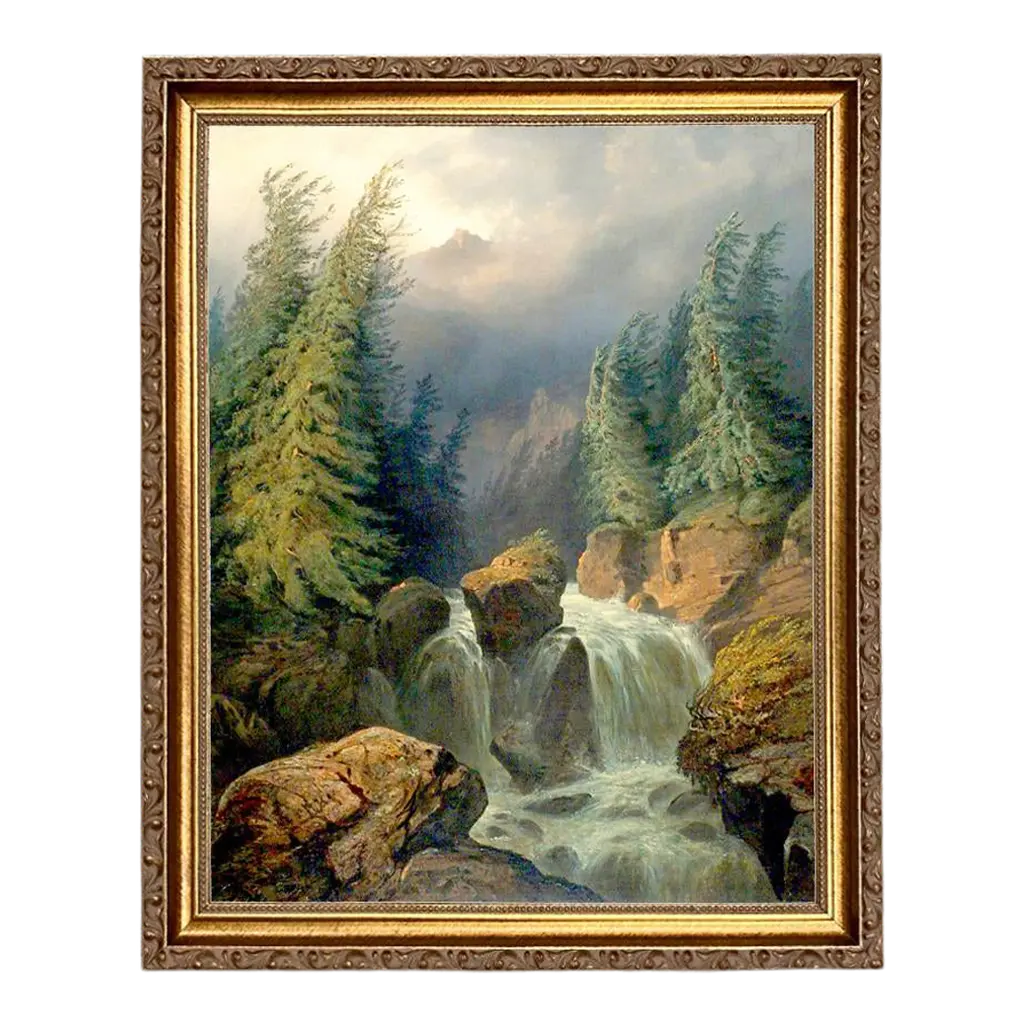
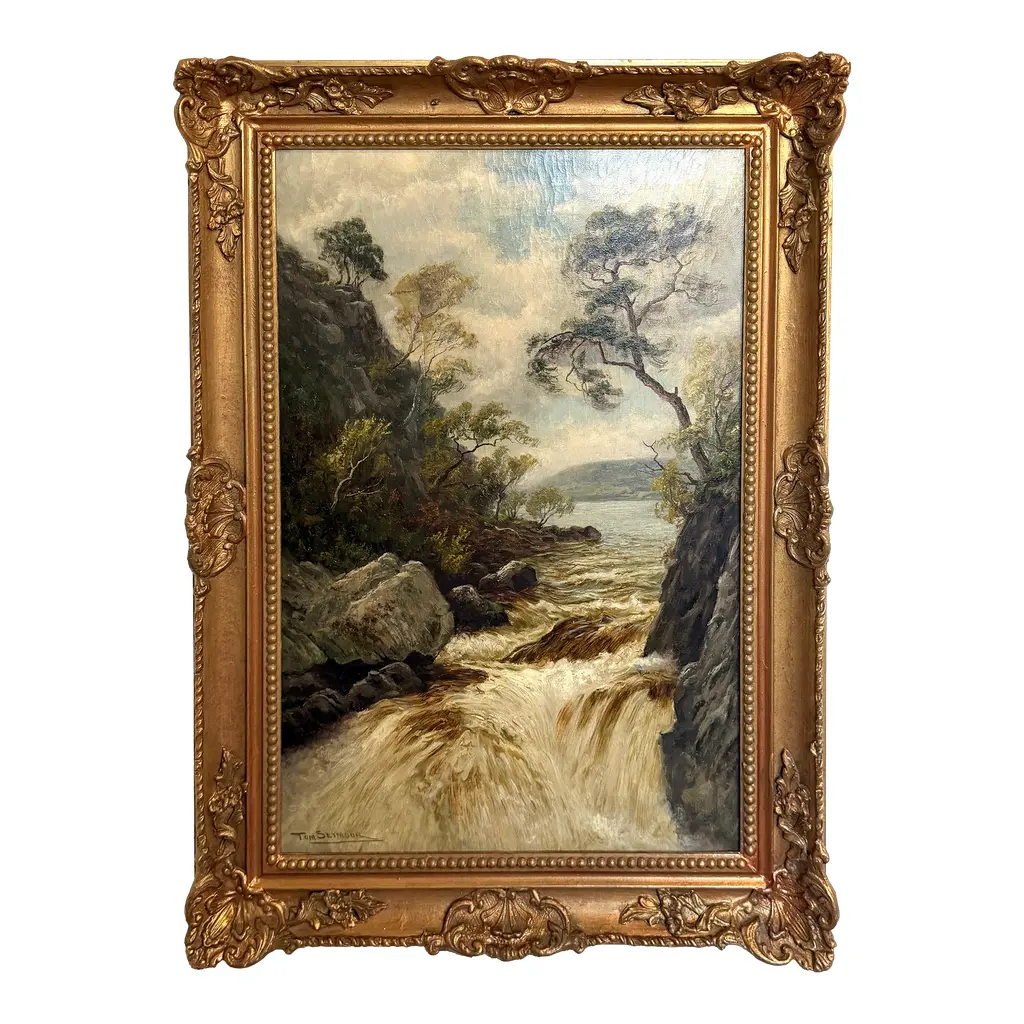
James Hope (Canadian-American, 1818–1892) “Castleton Falls, Castleton, Vermont,” 1856 Oil on Canvas A finely rendered Hudson River School landscape by James Hope, signed and dated lower right: “J. Hope / 1856 / Prov.” This sweeping view captures the dramatic cascade of Castleton Falls in Castleton, Vermont, framed by dense forest and sheer rock formations under a theatrically lit sky. The composition typifies the romantic naturalism of mid-19th-century American landscape painting, with Hope’s characteristic blend of topographical precision and poetic atmosphere. The waterfall plunges from a rocky ledge into a misty basin below, flanked by richly painted evergreens and distant hills receding into atmospheric haze. A faint figure near the crest of the falls adds human scale to the scene, enhancing the sense of sublime immersion in the wilderness. The artist's inscription on the stretcher reads: "Castleton Falls, Castleton Vermont, by James Hope." Painted in 1856, the work belongs to Hope's productive Vermont period, before his later studio activity in New York and his wartime sketching during the American Civil War. Born in Scotland and emigrating to North America, Hope was both a landscape and historical painter, known for his intimate knowledge of the Vermont and Adirondack regions. Works by Hope are held in major institutions including the Metropolitan Museum of Art and the Smithsonian American Art Museum. The canvas is housed in a later but compatible giltwood frame with corner shell motifs. Measurements: 31.75" wide x 25.75" high (frame), 26" wide x 20" high (canvas).
Similar products