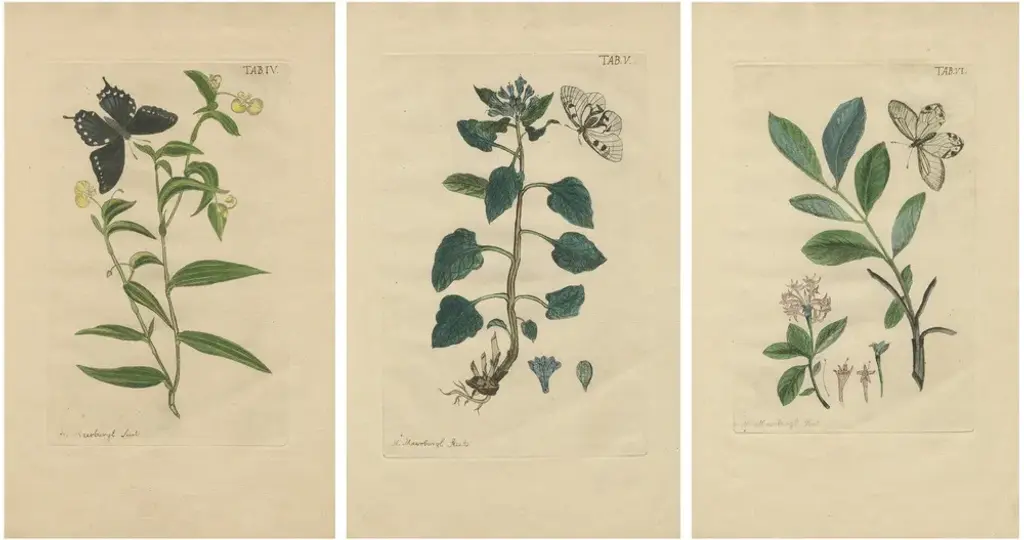
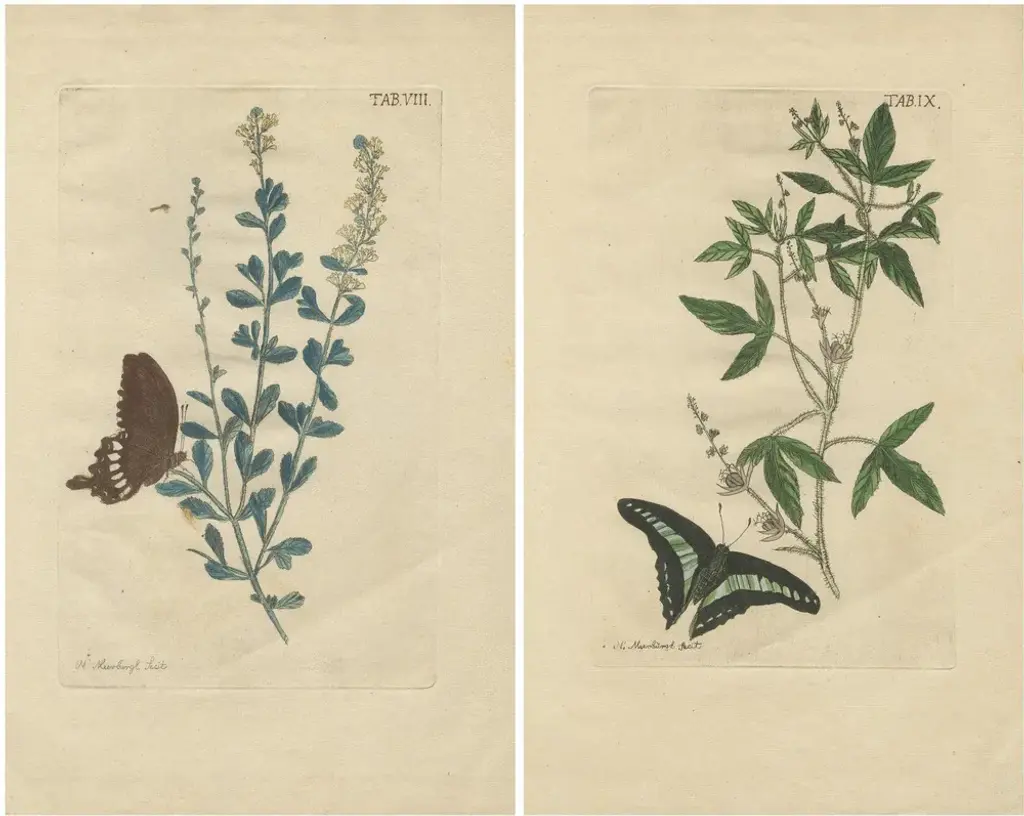
Botanical trio with butterflies – from nicolaas meerburgh’s 'afbeeldingen van zeldzaame gewassen' this elegant trio of hand-colored botanical prints, featuring delicately illustrated flowering plants accompanied by butterflies, originates from the celebrated dutch botanical work 'afbeeldingen van zeldzaame gewassen' by nicolaas meerburgh. First published in leiden in 1775 by johannes le mair, this scientifically significant and artistically refined series was produced under meerburgh’s direction as hortulanus (head gardener) of the leiden university hortus botanicus—one of europe’s oldest botanical gardens. Each of the three plates (tab. I, ii, and iii) exemplifies the enlightenment-era blending of scientific observation with aesthetic harmony. Meerburgh’s work stands out for its integration of entomological elements—such as butterflies—alongside the plants they frequented or were symbolically associated with. This approach gives the compositions a unique liveliness and appeal beyond pure botany. **tab. I** features a white-flowering herbaceous plant, possibly a species of jasmine, with lanceolate leaves and a richly colored black-and-orange butterfly resting on the lower stem. **tab. Ii** depicts a trailing vine with delicate green tendrils, accompanied by a symmetrical brown butterfly, rendered with careful attention to wing structure and pattern. **tab. Iii** shows a taller blue-flowering species—possibly a type of mint or legume—with another species of butterfly, this time with reddish-brown wings and subtle markings. All three plates are signed in the lower corner by the engraver, reinforcing their authenticity and connection to meerburgh’s leiden press edition. The calm backgrounds, naturalistic coloration, and fine linework make this grouping not only valuable as scientific documentation but also immensely decorative. Meerburgh’s contribution to botanical art is historically important, bridging the world of linnaean classification with dutch artistic refinement. Condition: very good condition considering age. Sheets show minimal foxing or toning. Hand coloring is delicately preserved with original pigments still fresh. Plate impressions are clear and margins intact. Slight age marks in the paper edges, typical for works from the late 18th century. Framing tips: frame the three plates side-by-side in a horizontal arrangement or as a vertical triptych. Use a soft cream or ivory mat to emphasize the botanical detailing. Light oak, maple, or muted gold frames will suit the 18th-century dutch aesthetic. Consider float mounting to show the plate marks and printed numbering. Uv-protective museum glass is strongly recommended to preserve the vibrancy of the hand-applied colors. This set is ideal for display in libraries, studies, conservatories, or interiors inspired by classical natural history.
Similar products