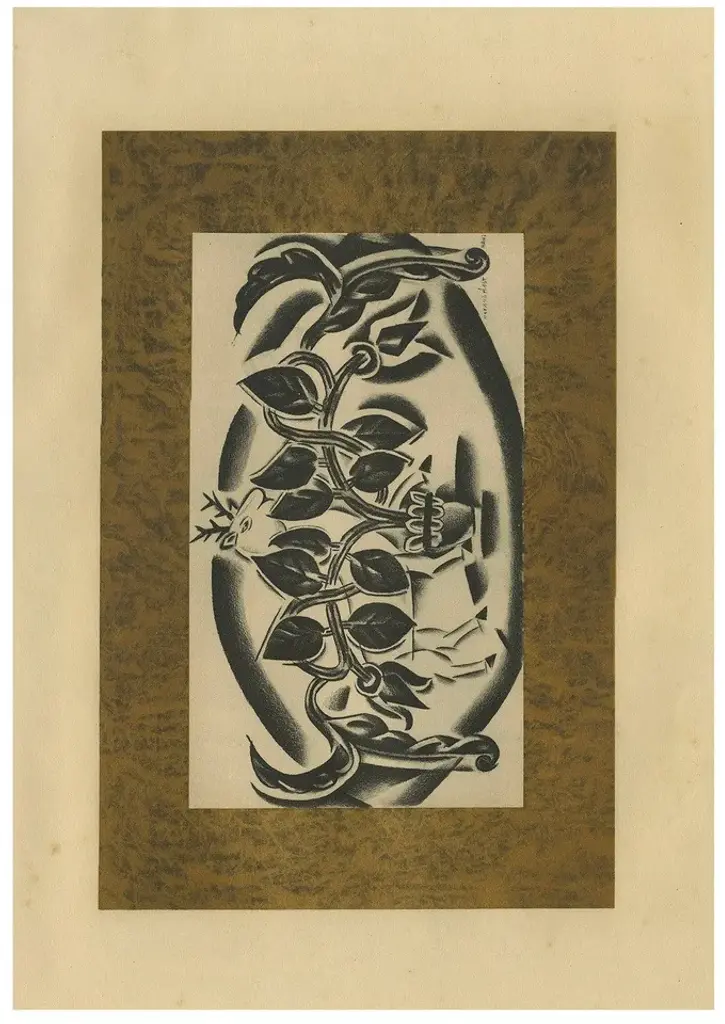
This artwork, presumably from Nathan Altman's "Jüdische Graphik" series, showcases a stunning lithograph of doves amongst foliage, rendered in black and white against a burnished gold background. The intricacy of the design, combined with the symbolic choice of doves—often representing peace or the Holy Spirit—suggests a layer of deep cultural or spiritual significance. The style retains Altman's avant-garde influences, merging cubist shapes and forms to create a dynamic and visually engaging composition. The print, possibly titled "Die Tauben" (The Doves), would be another example of Altman's ability to convey powerful themes through the medium of print, aligning with his other works from the 1923 series in terms of technique and thematic exploration. The limited edition nature of these prints adds to their rarity and desirability among collectors and scholars of both Jewish art and avant-garde movements of the early 20th century. As with the other prints from this series, the limited edition of only 250 copies increases its rarity and value. Altman's work not only captures significant biblical narratives but also reflects the broader themes of cultural identity and modernist experimentation in the early 20th century. Altmann’s choice of a burnished gold background not only enriches the visual impact but also elevates the symbolic elements, giving the artwork a solemn and revered quality. This specific piece, like others from the series, was produced in Berlin by the publisher "Petropolis," reflecting the vibrant Jewish artistic community that existed in pre-war Europe. Altmann’s work, especially given his background as a Jewish artist in Soviet Russia, often navigated between his cultural identity and the broader avant-garde movements, making each of his pieces historically and artistically significant. This print, considering its rarity and the mystery surrounding the number of surviving copies, is an exceptional representation of Jewish cultural history intertwined with early 20th-century art movements. Nathan Altman was an influential figure in the Russian and Soviet avant-garde movement. Born in 1889 in Vinnytsia, Ukraine, he studied at the Odessa Art School, later moving to Paris to further his education at the Academie de la Grande Chaumiere. Altman's style evolved over the years, showing strong influences from Cubism and Futurism, which are evident in his approach to stage design and book illustration as well. Altman's contributions extend beyond visual arts; he was also notable for his set designs for Jewish theaters in Petrograd and Moscow, bringing a modernist touch to traditional themes. His work remains a significant part of the Russian avant-garde legacy, influencing not only art but also the cultural interpretation and representation of Jewish identity in early 20th-century Russia.
Similar products