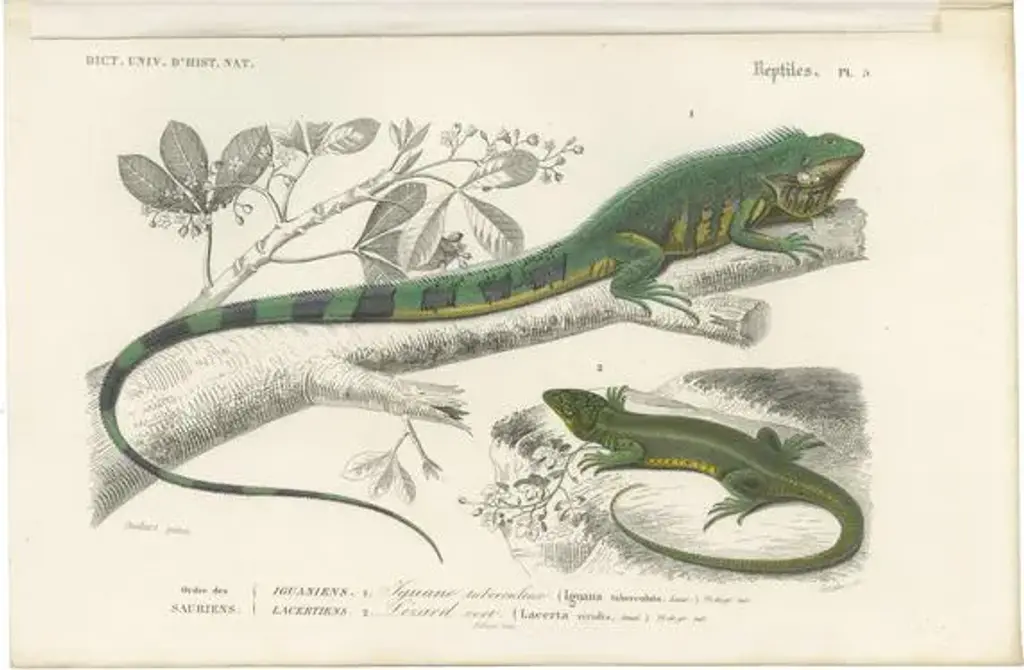
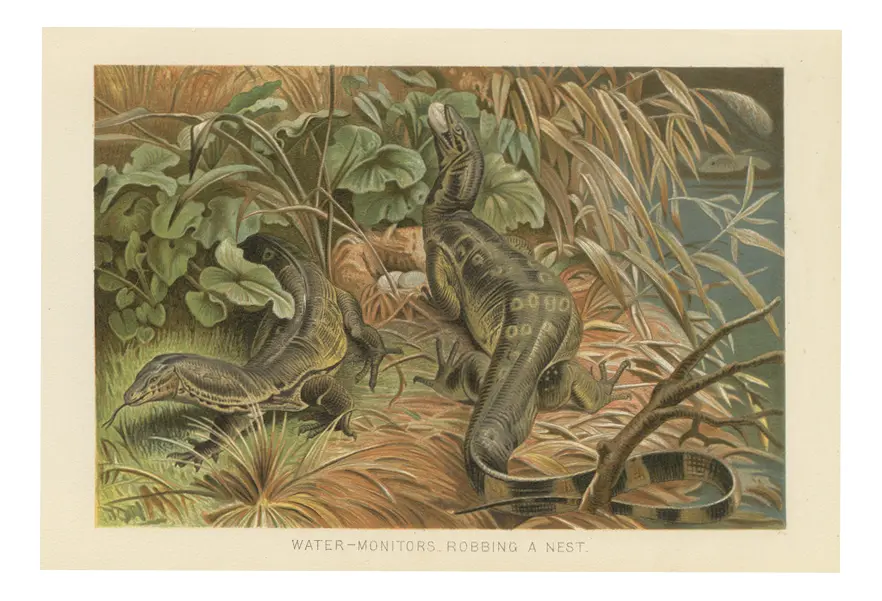
Lizard Print of Nose-Horned Chameleon and Banded Monitor, c.1850, Orbigny This finely executed hand-colored engraving, Reptiles Pl. 4, presents two striking reptilian species: the Nose-Horned Chameleon (*Chamaeleo bifidus*) and the Banded Monitor (*Varanus bivittatus*). The print originates from the *Dictionnaire Universel d’Histoire Naturelle*, a comprehensive mid-19th century French natural history encyclopedia edited by Charles Dessalines d'Orbigny and published in Paris around 1850. Figure 1, perched on a branch, shows the Nose-Horned Chameleon, *Chamaeleo bifidus*, distinguished by the prominent twin projections extending from its snout. Native to Madagascar, this species is known for its unique facial structure, prehensile tail, and independently rotating eyes, all of which are beautifully illustrated in this composition. The fine detailing captures the texture of the skin and the chameleon’s subtle coloration, while the background foliage enhances the natural setting. Figure 2 depicts the Banded Monitor, *Varanus bivittatus*, now known as the Komodo dragon's close relative, the Water Monitor. Rendered in shades of green and yellow, it is shown in motion across open terrain. Native to Southeast Asia, this large lizard is notable for its power, intelligence, and adaptability. The engraver skillfully conveys its muscular form, sharp claws, and distinctive banding. The monitor’s dynamic posture reflects the species’ agile, predatory nature. Both illustrations were drawn by Oudart and engraved by Forget, whose combined talents ensured scientific fidelity and aesthetic appeal. The hand coloring was applied with care, highlighting each species' individual markings and natural environment. This print is an excellent addition to a collection of zoological illustrations or antique natural history decor, especially for those with an interest in reptiles or the legacy of scientific exploration in the 19th century. Condition Summary: Slight age-related toning with a few faint foxing spots in the top margin. Central image sharp and vivid, colors well retained. No visible tears or repairs. A strong impression overall. Framing Tips: Frame in dark wood or black to enhance the deep greens and blues. Use a light beige or off-white mat for contrast. UV glass is recommended to preserve the subtle hand coloring and paper quality over time. Ideal for display in a study or library.
Similar products