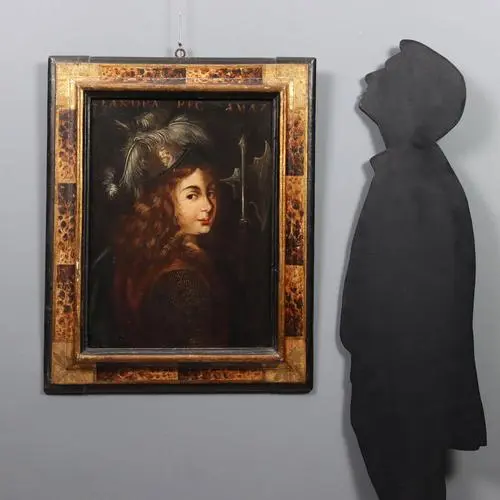
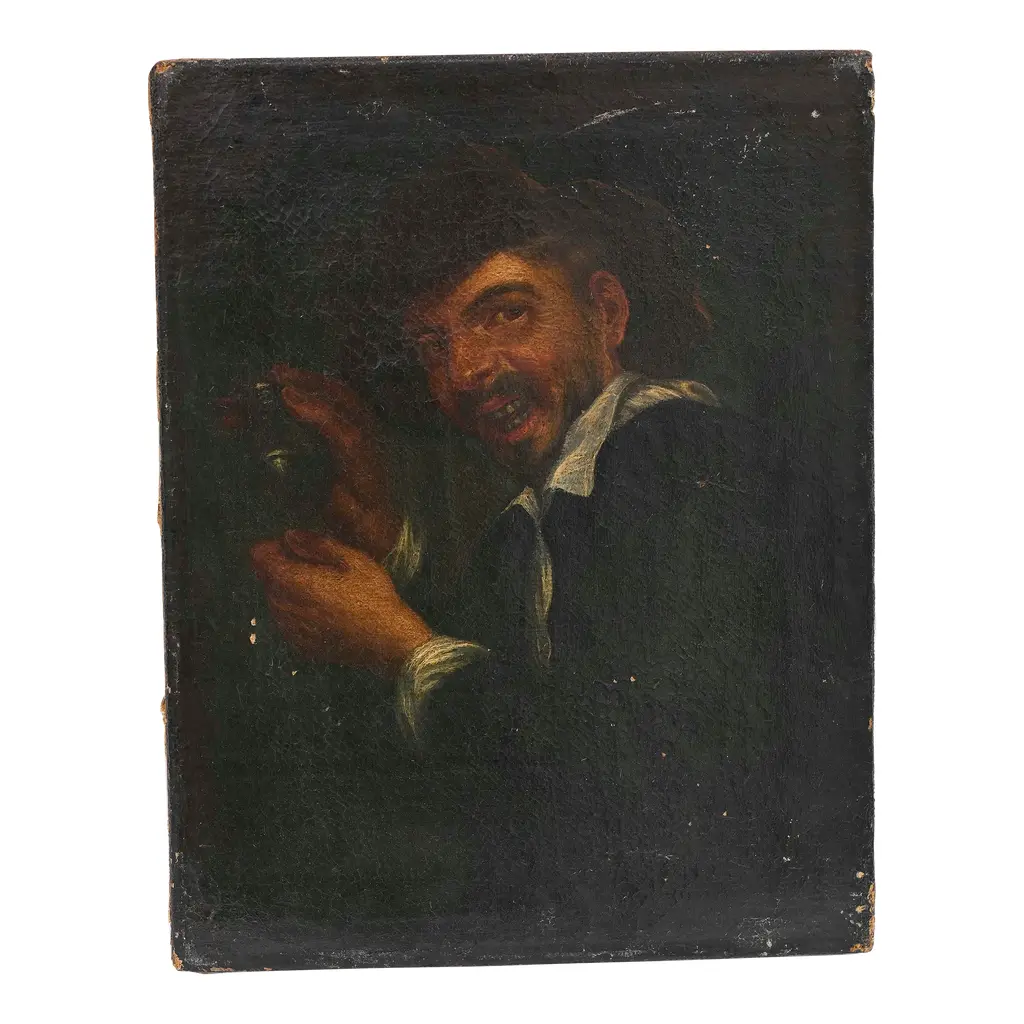
A curious and lively genre scene depicting a young mandressed as a picaro, with an ironic smile and a deliberately mocking expression, captured as he shows the viewer an object of asuggestive nature, resting on a scroll bearing the inscription “che ridere signori” (how funny, gentlemen). his attire, worn with ostentatious swagger and embellished with precious and theatrical elements, such as the feather on his hat and thegolden chain, transforms the protagonist into a figure suspended between popularreality and the mask of the commedia dell’arte, evoking that taste for theater, double entendres, and caricature that characterized figurative culture between the 17th and 18th centuries. The work fits into the tradition of burlesqueand allusive scenes that developed within lombard painting, continuing the legacy of vincenzo campi, bartolomeo passerotti, and annibale carracci, artists who introduced a popular narrative dimension into italian painting, often playing on double meanings and social satire. Particularly evident is the iconographic relationship with the famous "che ridete son’agli" by alessandro magnasco, whose general composition this work echoes, reinterpreting it with amore explicit and provocative variation. In this type of painting, the smile, the gesture, and the object displayed become tools of a subtle symbolic construction, intended not for the general public but for a cultured circle of connoisseurs capable of grasping its erudite and theatrical references. The pictorial quality, the expressive power of the face, and the taste for elegant caricature allow the painting to be placed within the circle of alessandro magnasco. dimensions: 96 x 80 cm (with frame) 71 x 55.5 cm (without frame)
Similar products