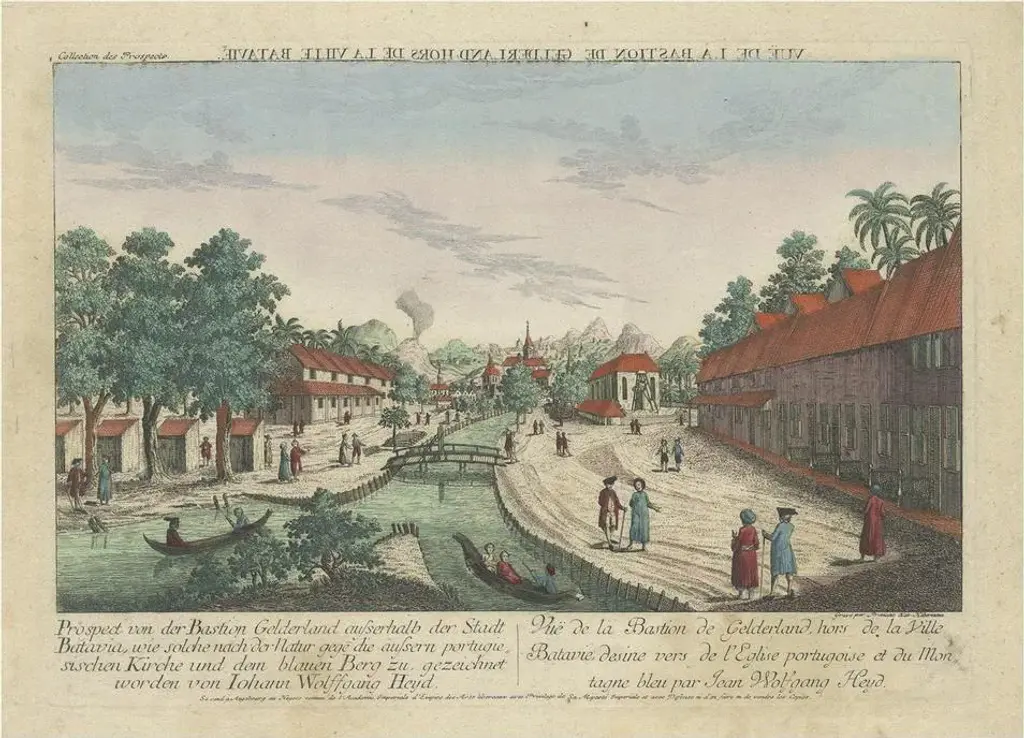
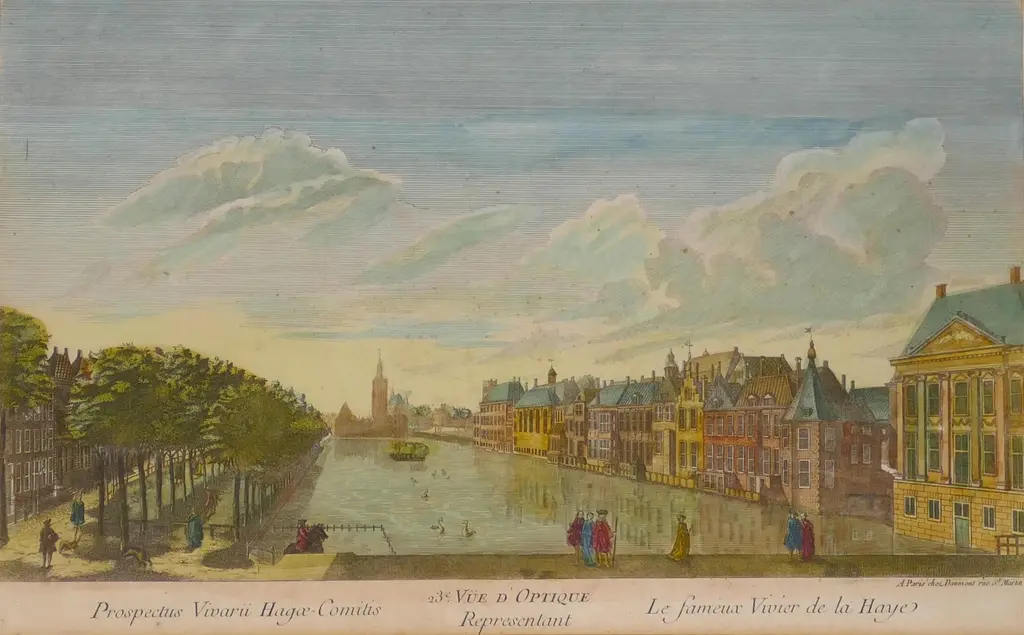
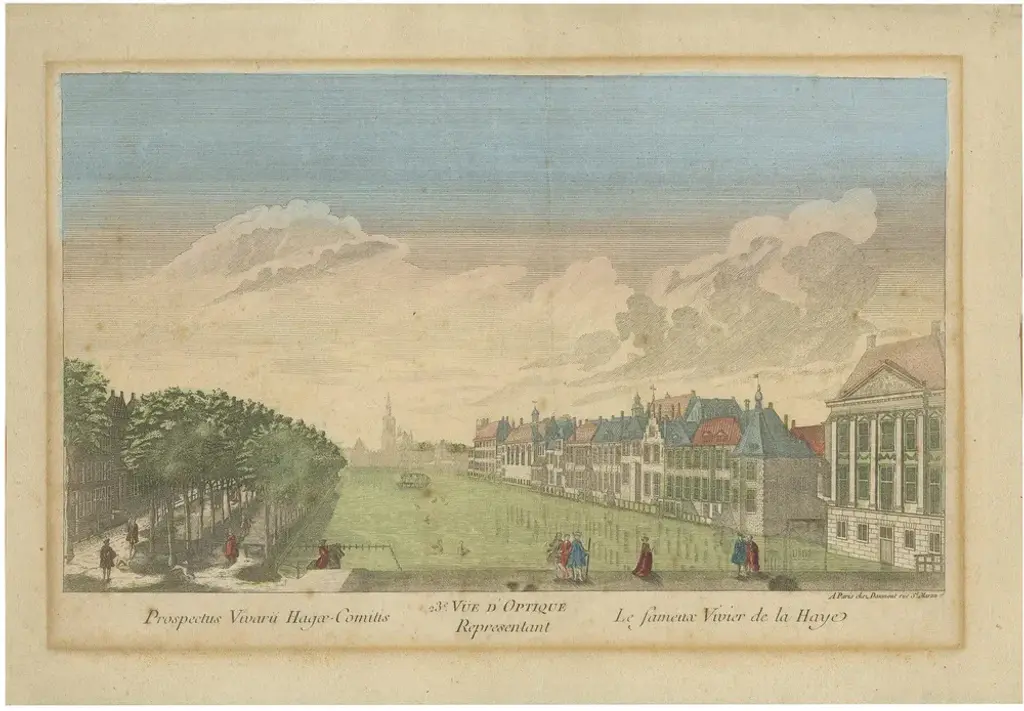
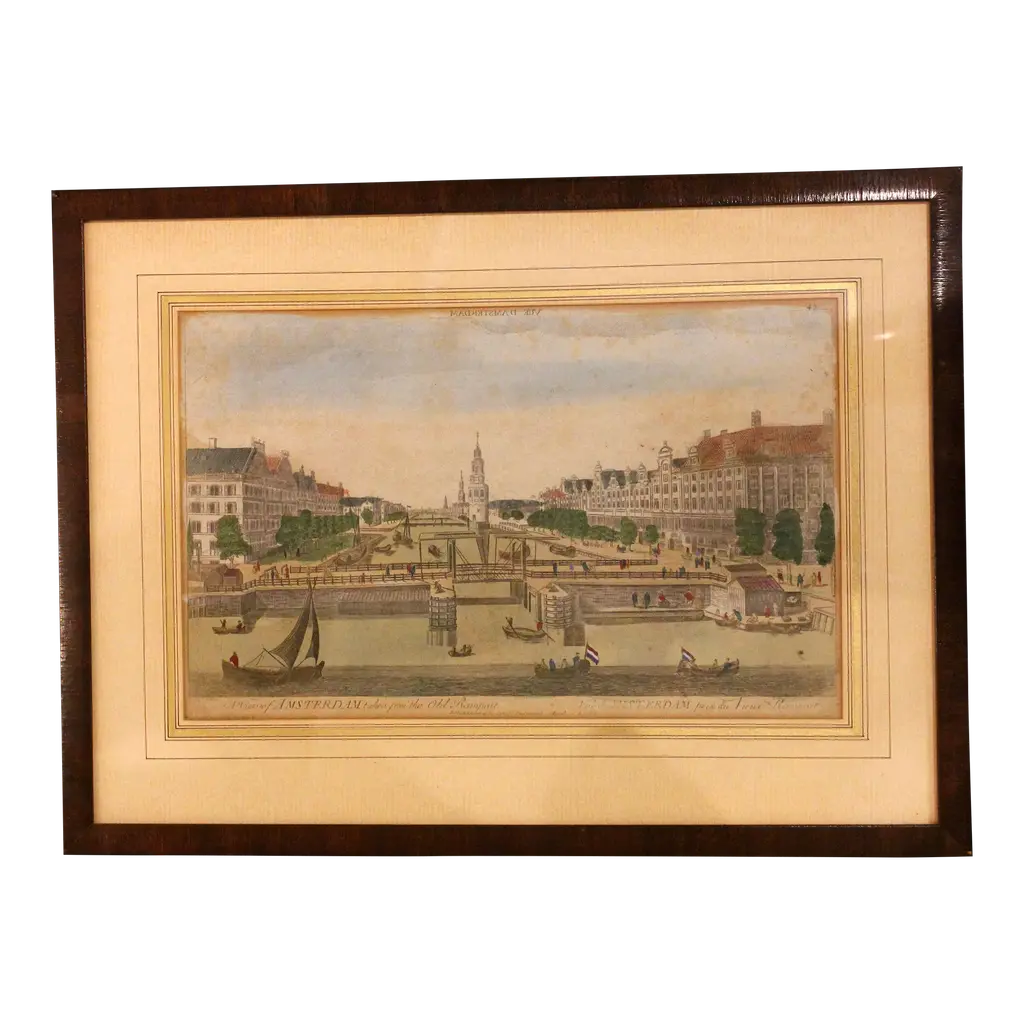
Optica View of Batavia Bastion Gelderland, Indonesia, circa 1770 This is an original 18th-century hand-coloured optical print depicting a view from the Bastion Gelderland outside the city walls of Batavia (present-day Jakarta, Indonesia). The engraving presents a lively street scene viewed from the fortifications towards the Portuguese Church and the Blue Mountain (Gunung Gede), capturing daily life in Dutch colonial Batavia. The foreground shows elegantly dressed VOC officials and Asian figures walking along the road bordered by canals, lined with colonial houses and shaded by tall trees. Several boats navigate the canal, adding depth and animation to the composition. The middle distance shows the Portuguese Church with its cross-topped bell tower, while in the background rise the distinctive jagged peaks of West Java’s volcanic mountains, a common backdrop in Batavia views. The German caption below reads: “Prospect von der Bastion Gelderland außerhalb der Stadt Batavia… gezeichnet worden von Johann Wolfgang Heyd,” attributing the original drawing to Johann Wolfgang Heydt, a German draftsman and engraver known for his illustrations of VOC Asia. The reversed French title at top margin, “Vüe de la Bastion de Gelderland… Batavie,” confirms its use as an optical print for viewing through a zograscope. This print was published circa 1770 as part of the European optica series produced for audiences fascinated by exotic colonial cities and architectural scenes. It combines cartographic accuracy with decorative artistry, illustrating Batavia as a thriving Asian-European trading hub under Dutch rule. Condition: Fair to good condition for its age. Clean strong impression with vibrant original hand colouring. Light overall age toning, faint foxing mainly in margins, small water stain bottom margin, and minor creasing and closed holes at bottom. Fully suitable for framing. Framing tips: Frame this optical print in a gilt or dark wood moulding to highlight its historic and decorative qualities. Use an off-white archival mat to protect the sheet edges and enhance colour contrasts. UV-protective glazing is recommended to maintain colour vibrancy and paper integrity over time.
Similar products