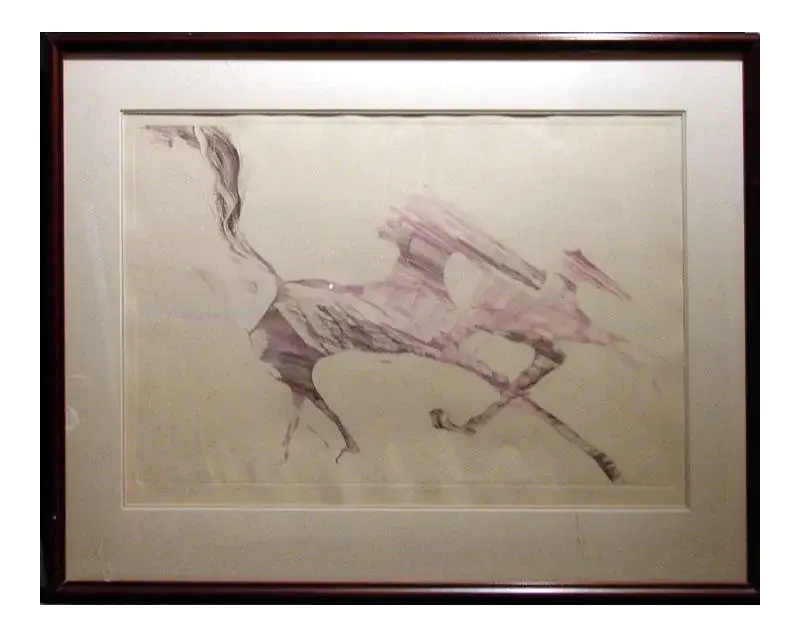
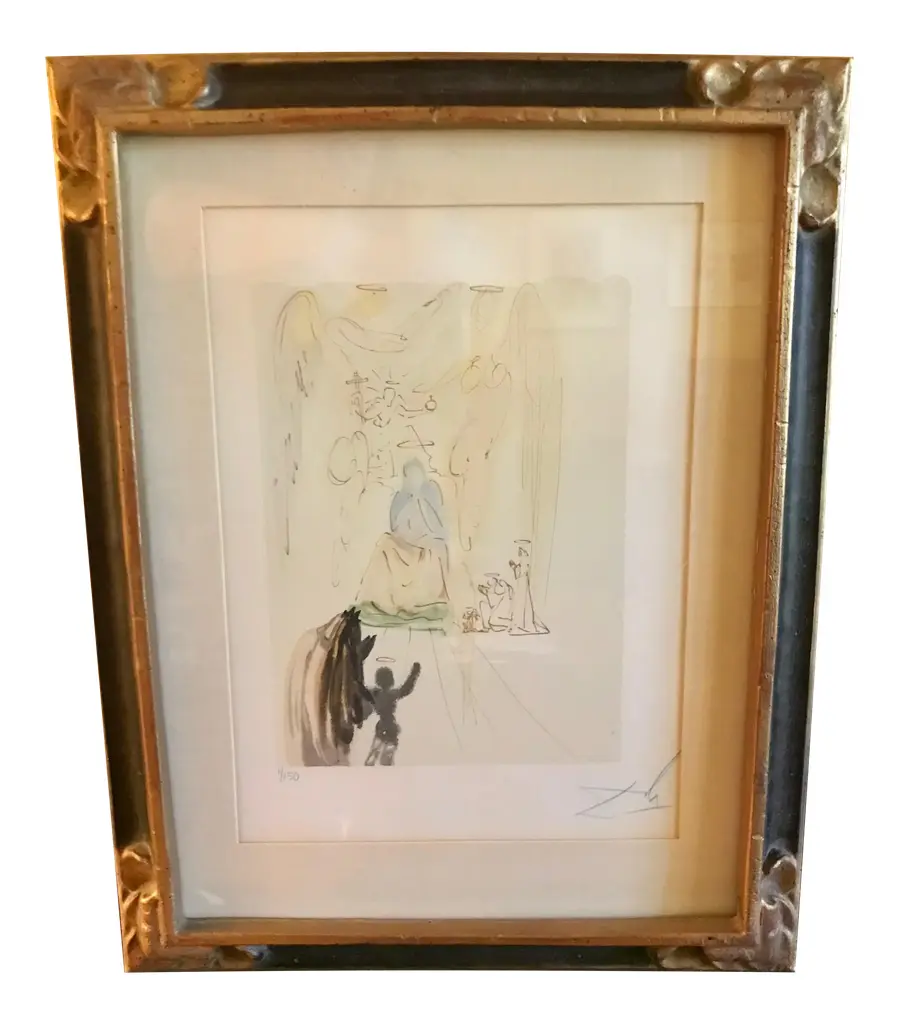
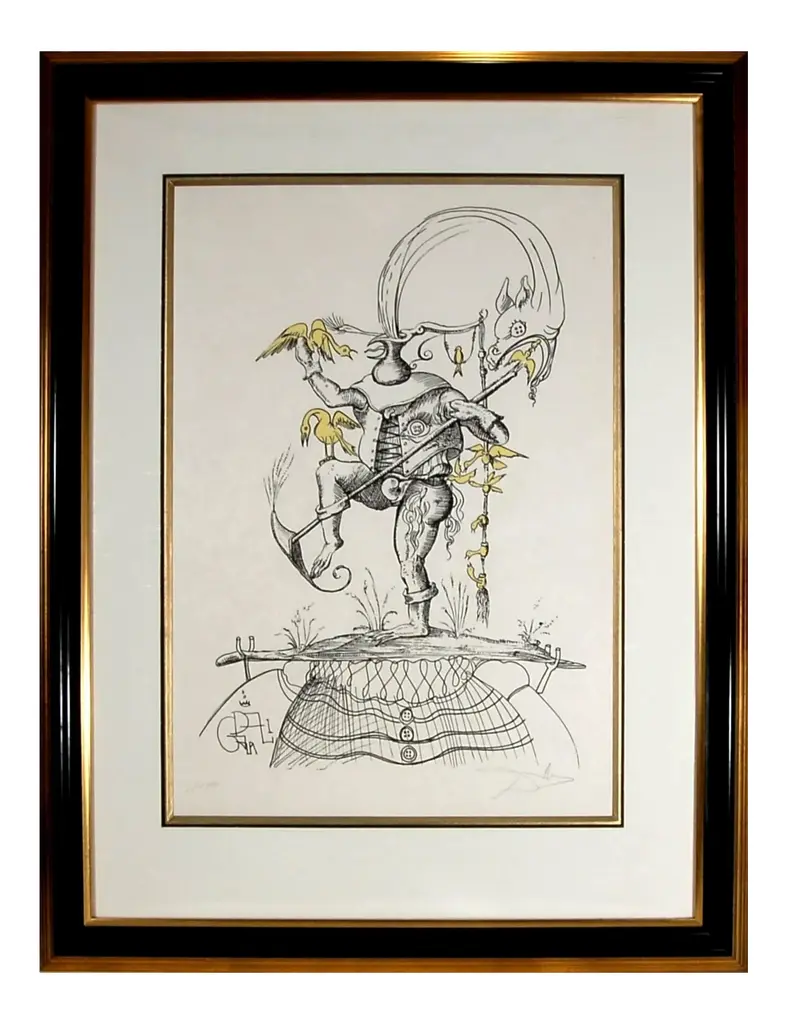
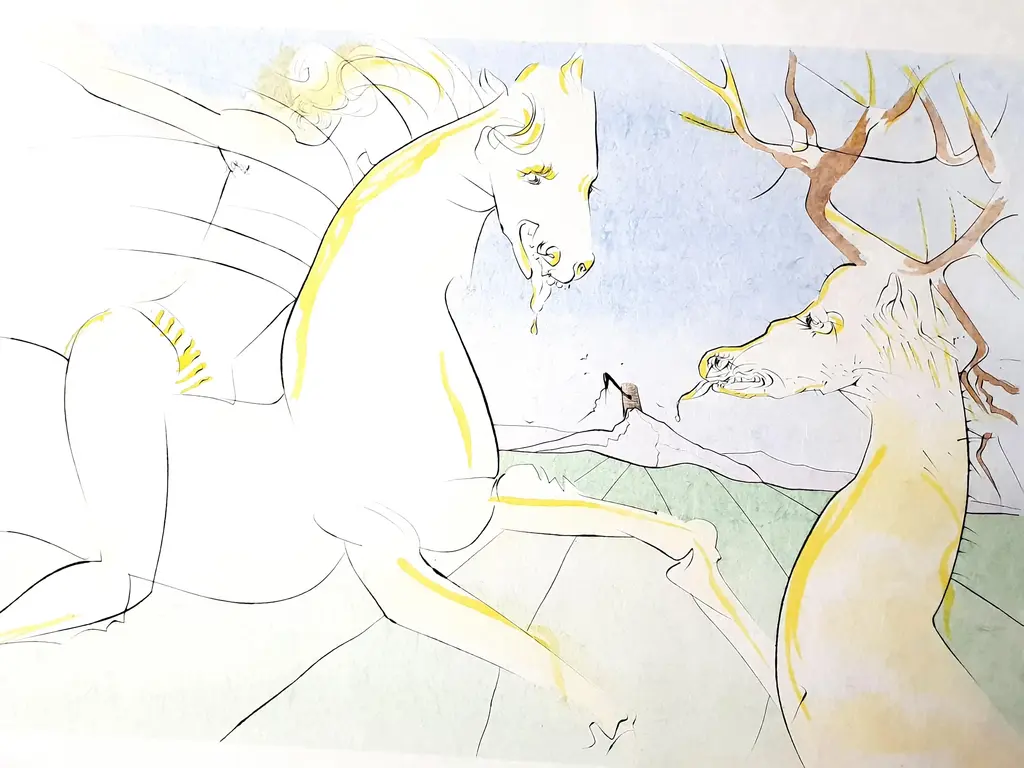
"Le Cavalier Et Le Cerf" by Salvador Dali Hand signed by Salvador Dali This piece can be found in "The Official Catalog of The Graphic Works of Salvador Dali" by Albert Field, on page 92-93 image 74-1E, and in the "Annual Print Price Guide To The Graphic Works of Salvador Dali" by Bruce Hochman 2016 edition, page 123. from the "Le Bestiaire De La Fontaine" suite Original Limited Edition Intaglio Engraving by Modern Master Salvador Dali. Museum mounted, acid-free matted, custom framed Hand signed by Salvador Dali Image Size: 22.25" x 15.50" Framed Size: 39" x 34" Edition Number: LXIII/CXX Condition : Excellent Certificate of Authenticity is included Salvador Dali 1904-1989, Spain. Dali attended the Academy of Fine Arts in Madrid.He devoured philosophical works and Freud, and he discovered Cubism, Futurism and Metaphysical Arts in magazines.He had one-man shows in Barcelona in 1925 and in Madrid in 1926.He harmonized the example of Gris, de Chirico and Carra with the refined methods of the Old Masters.Sometime during 1928 Dali made a brief excursion to Paris, where he met Picasso.Andre Breton, Surrealism's central figure, appointed him an official Surrealist.Within a short time Dali was to become the movement's most spectacular exponent.In his art he has succeeded in achieving the synthesis of what Andre Breton called a retrograde craft with the most extreme inventions of modern culture.His graphic oeuvre comprises etchings and lithographs, which have evolved parallel to his paintings. Dali illustrated Dante's Divine Comedy with 101 wood engravings.The poem recounts the tale of the poet's journey through Hell and Purgatory guided by Virgil.After repenting his faults, he is joined by Beatrice for the final leg of the journey through Paradise to receive a glimpse of God.Dali often equated Gala, his wife and inspiration, with Dante's Beatrice.Like Dali, Dante's symbolism is complex but highly rational.Both men had a keen knowledge of scientific studies in geology, optics and mathematics. Dali's Divine Comedy will go down in the history of art as a work of the artist's prime years, the early 1950's.
Similar products