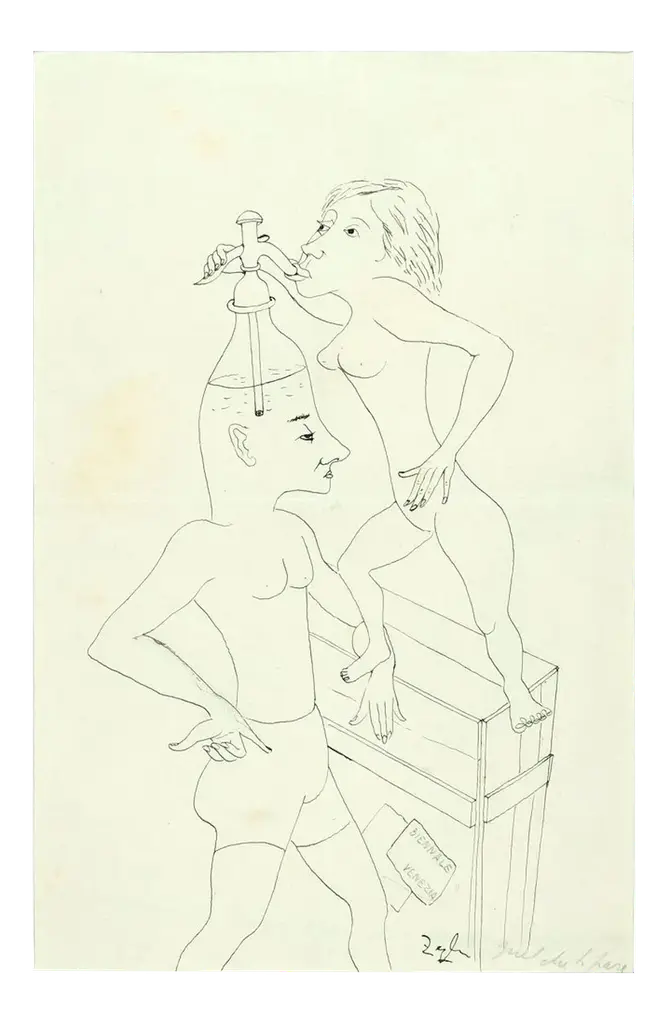
You have to love the irony in this etching’s unexpected title "Lovesick" (or Liebeskrank in German). The work was originally created by George Grosz in 1916 and is a quintessential example of his biting, satirical style from the Weimar Republic era. The image depicts a domestic, yet unsettling, interior common in Grosz's work. A stout man with a thick mustache and a cigar—often a stand-in for the "bourgeois profiteer"—stands behind a seated, naked woman. Grosz used such imagery to critique the moral decay and "vices" he saw in Berlin following World War I. The figures' exaggerated, almost grotesque features are meant to expose the "human depravity" of the time. The "jagged," thin line-work seen here is a hallmark of his pen-and-ink style, influenced by Dada and New Objectivity. This specific work was often included in his famous "Ecce Homo" portfolio (published 1922-1923), which featured 100 scenes of social satire This copy, numbered 84/100 bottom margin, center, identifies it as part of a limited edition of 100 prints. Original portfolios were often seized or destroyed by authorities due to their "offensive" nature, making surviving prints like this one historically significant.” The Berlin-born artist Georg Ehrenfried Gross later changed his name to George Grosz. Some consider him to be perhaps the most outstanding caricaturist and political satirist of the period following World War I. Signature/Maker’s mark: in graphite, (photo #06). Limited edition number 84/100 (photo #07). Provenance (photo #08).
Similar products