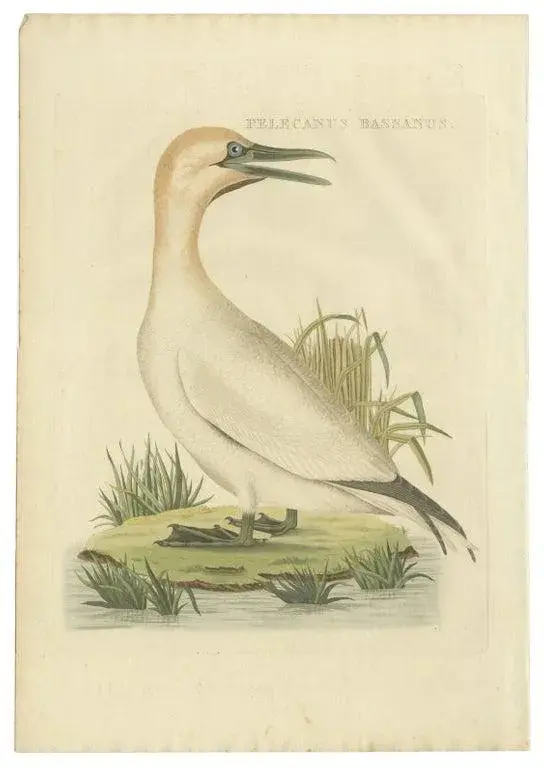
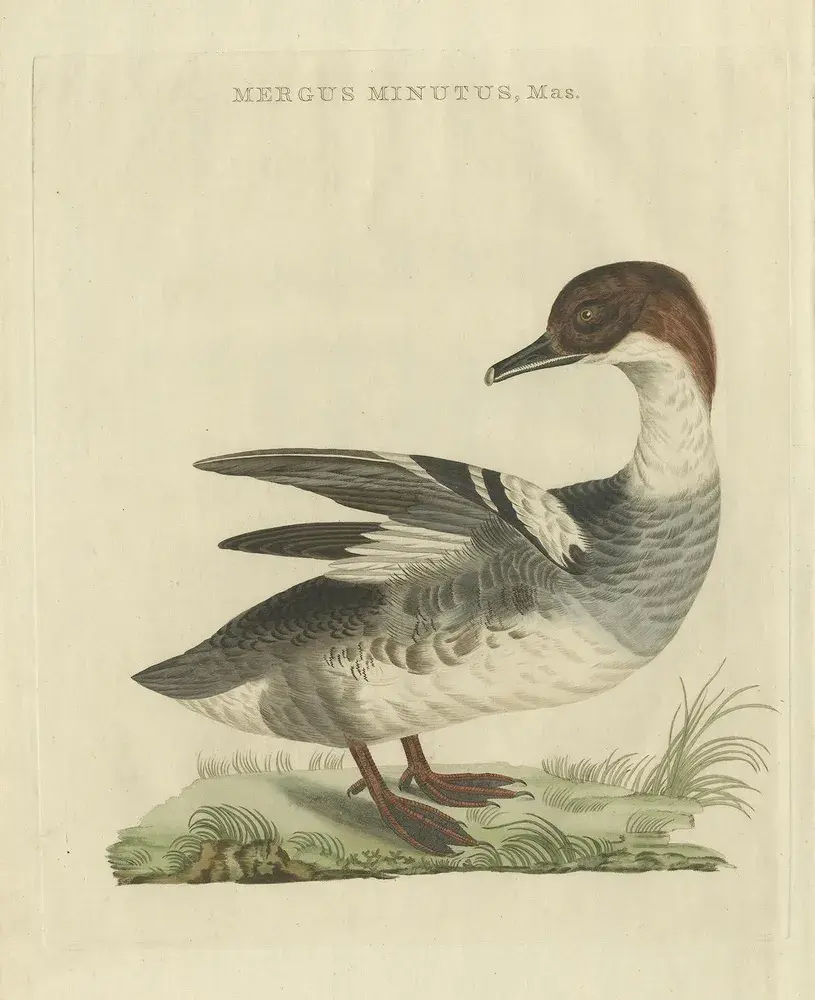
Smew Duck Antique Dutch Bird Print by Sepp & Nozeman, circa 1809 This exquisite antique bird print features the elegant Smew, scientifically known as Mergellus albellus, and historically titled here as Mergus Albellus. It is a strikingly detailed and beautifully hand-colored engraving originating from the monumental Dutch ornithological work Nederlandsche Vogelen, published in Amsterdam over a span of nearly six decades (1770–1829). This particular print likely dates to around 1809, during the middle period of the publication. The Smew, called "nonnetje" in Dutch, is a rare and charismatic diving duck that breeds in the taiga forests of northern Europe and Asia. The species is especially admired for its striking black-and-white plumage in males, a feature captured here with remarkable subtlety and precision. Set against a serene riverside scene with reeds and grassy mounds, the bird is shown in profile with careful attention to its streamlined form, webbed feet, and fine plumage markings. The restrained use of color enhances its natural elegance and scientific clarity, allowing viewers to appreciate both the bird’s aesthetic beauty and anatomical detail. 'Nederlandsche Vogelen' was a pioneering ornithological publication, combining rigorous scientific observation with artistic mastery. Its creators—Cornelis Nozeman, Christiaan Sepp, Jan Christiaan Sepp, Martinus Houttuyn, and Coenraad Jacob Temminck—were among the foremost naturalists and illustrators of their era. Their collaboration resulted in one of the earliest comprehensive studies of birds native to the Netherlands, bridging the Enlightenment’s thirst for knowledge with a deep appreciation for the natural world. Condition: Very good condition for its age. Strong impression with rich original hand coloring. Wide margins. Slight toning in the outer edges consistent with age. No tears or significant blemishes. Plate mark clearly visible. Framing tips: This print would look especially refined in a dark wood or ebonized frame with an off-white, archival-quality mat. A narrow gold inner liner could subtly echo the elegance of the composition and enhance its presence on the wall, whether as a single highlight or as part of a collection of natural history works.
Similar products