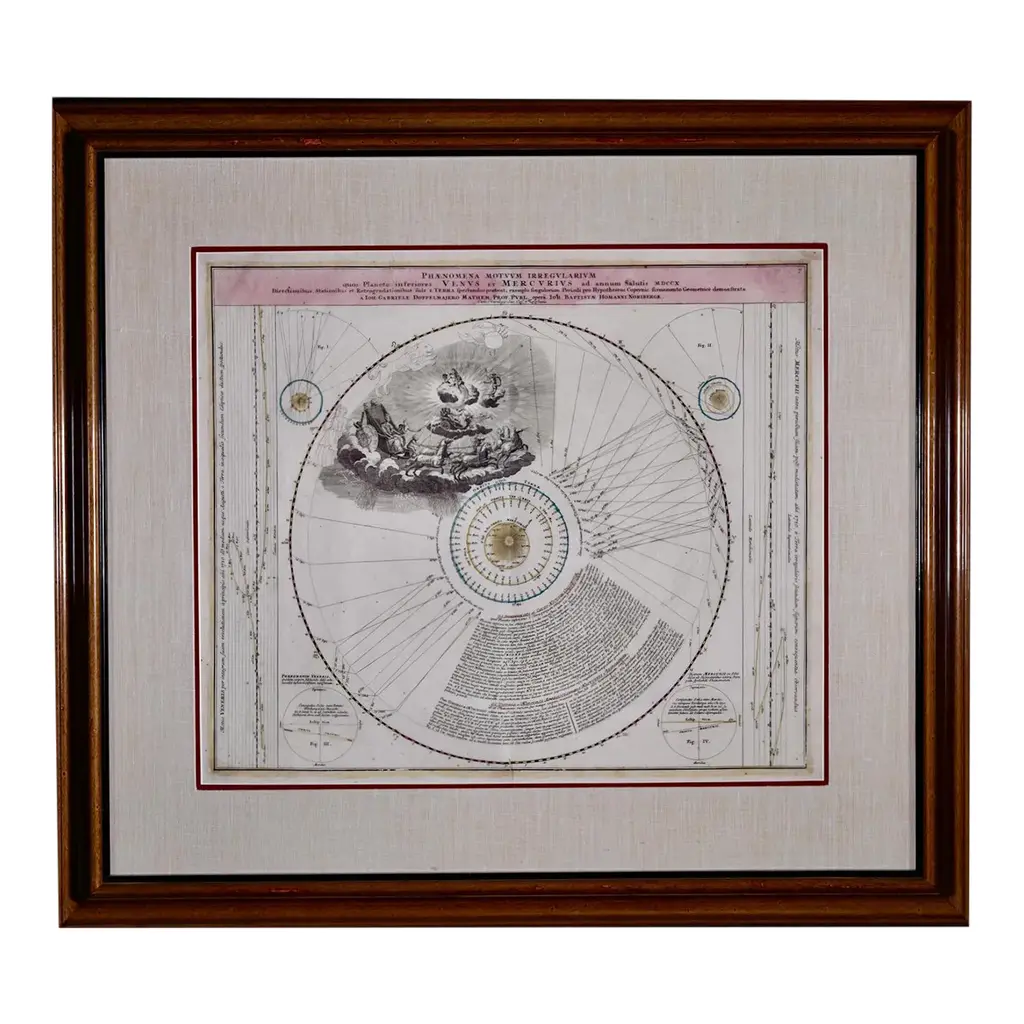
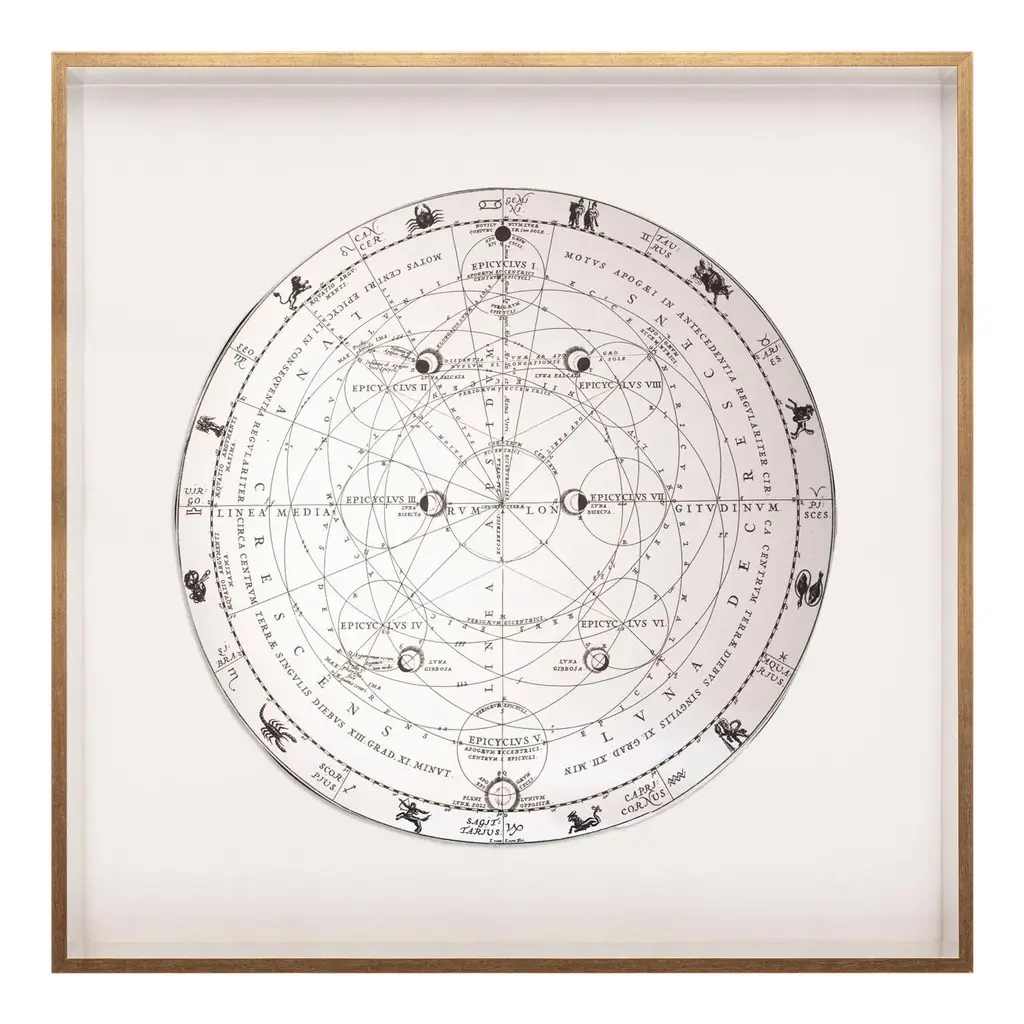
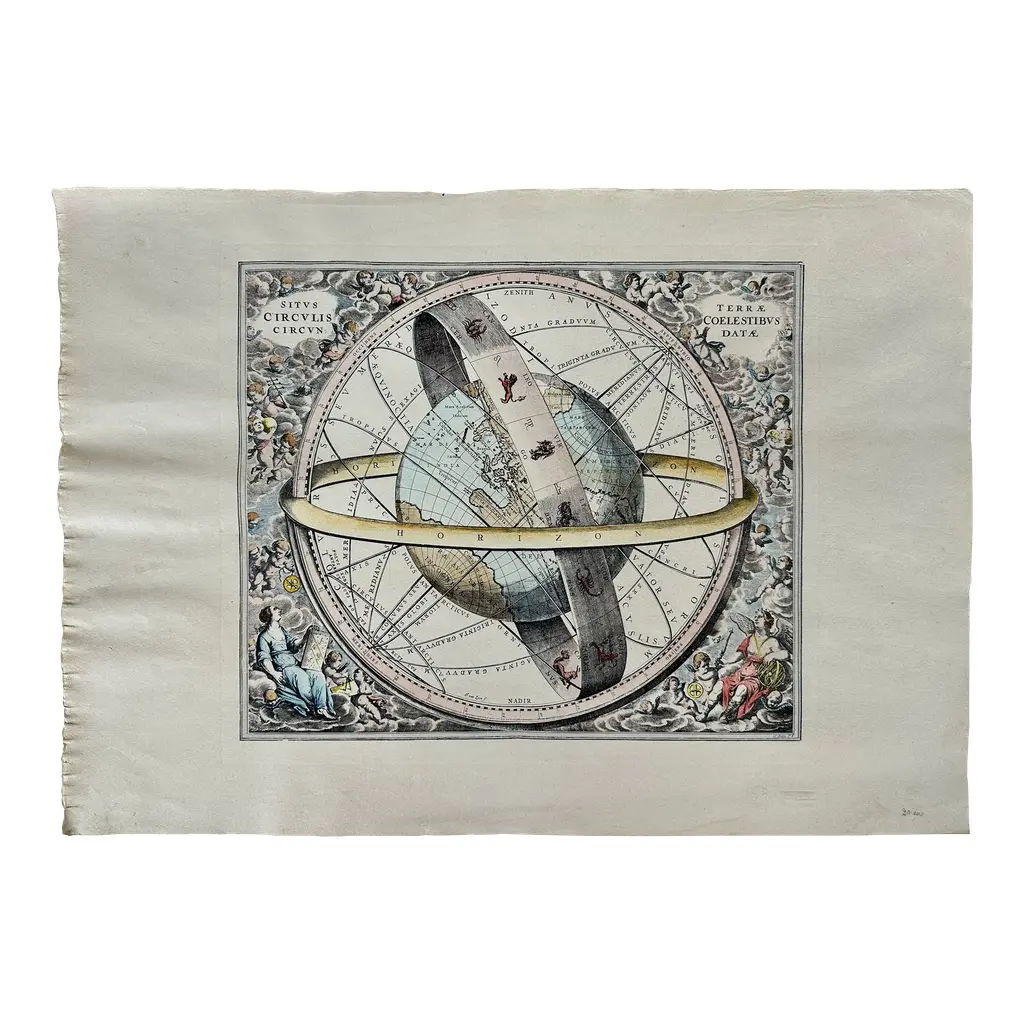
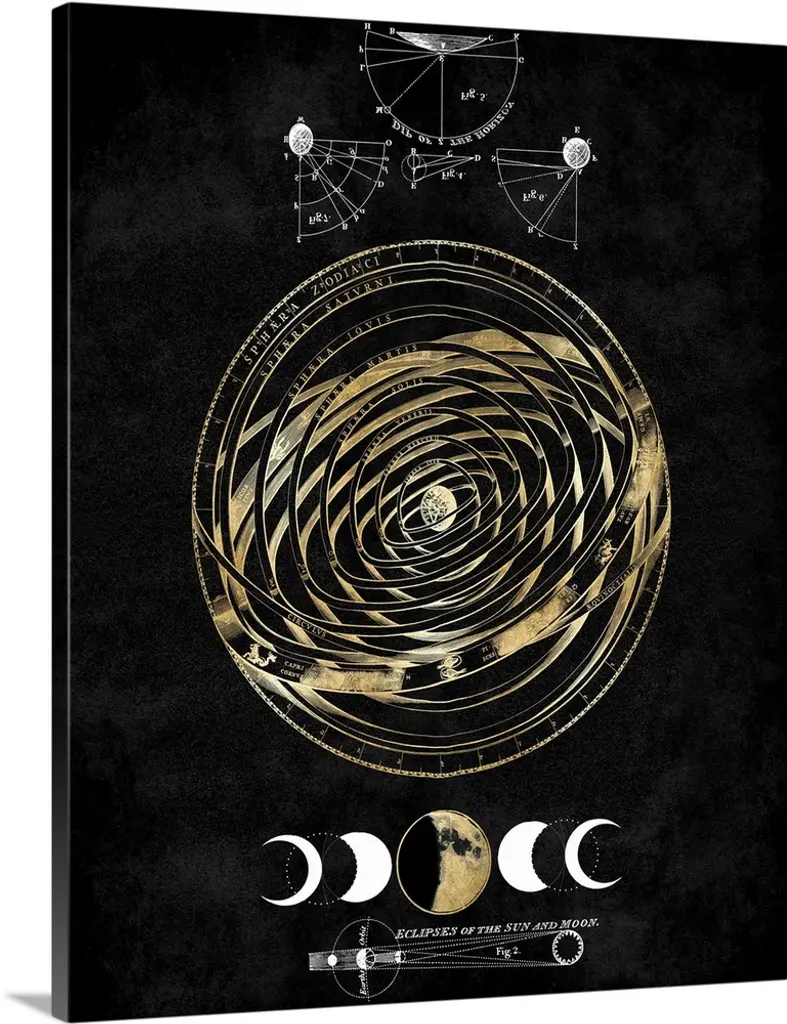
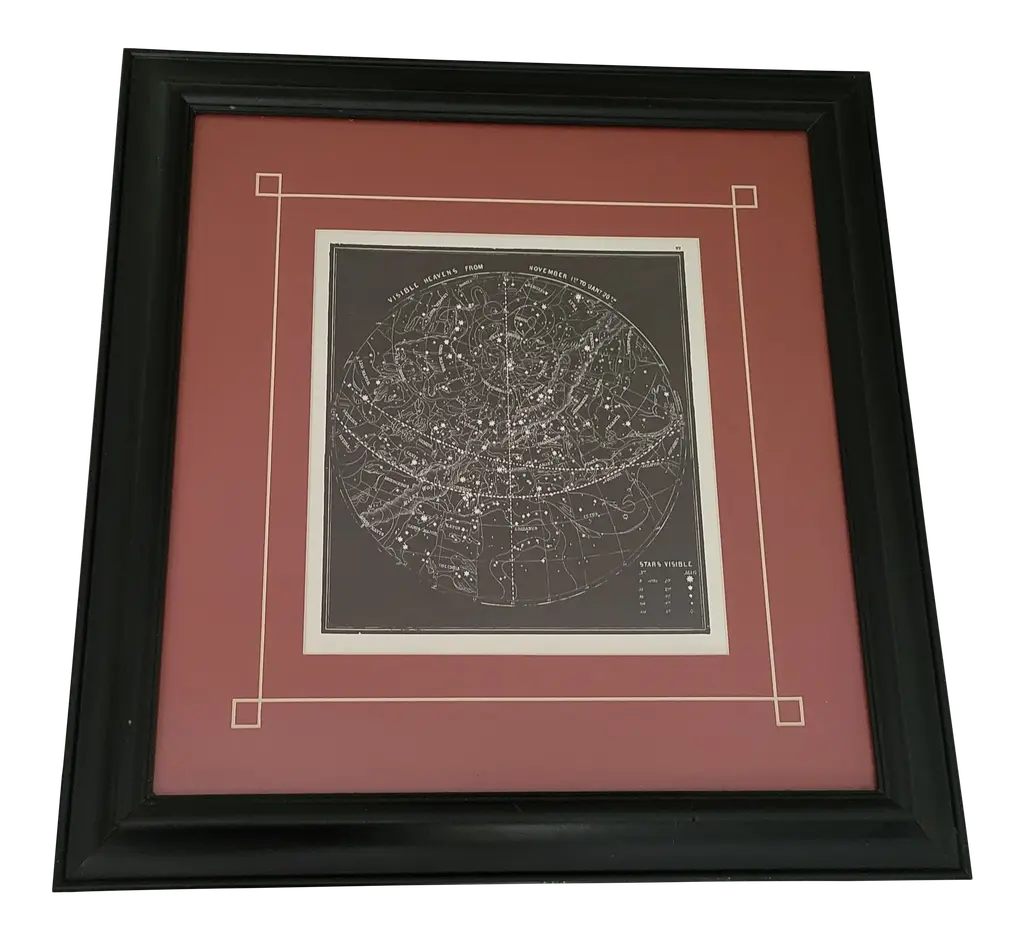
This 18th century hand-colored copperplate celestial map by Johann Doppelmayr entitled "Astronomia Comparativa in qua Planetarum Primaria Phaenomena" (Comparative Astronomy in which the Primary Phenomena of the Planets) was incorporated as plate 30 in 'Atlas Novus Coelestis in quo Mundus Spectabilis', first published in Nuremberg, Germany in 1735 in association with the famous and prolific cartographer and printer Johann Baptist Homann. 'Atlas Novus Coelestis in Quo Mundus spectabilis, et in Eodem Tam Errantium Quam Inerrantium Stellarum Phoenomena notabilia, Circa Ipsarum lumen, figuram, faciem, motum, Eclipses.secundum Nic. Copernici, et Ex Parte Tychonis De Brahe, Hypothesin' (The New Atlas of the Celestial World in which the World is to be Looked at, and the Phenomena Notable in the Same of the Errants and the Inerrant Stars, with respect to their light, shape, face, motion, and eclipses according to Nic. Copernicus and Tycho De Brahe: Hypothesis) includes diagrams illustrating the planetery systems of Copernicus, Tycho, and Riccioli; the elliptic theories of Kepler, Boulliau, Seth Ward, and Mercator; the lunar theories of Tycho, Horrocks, and Newton; and Halley's cometary theory. This plate and others were originally created by Doppelmayr for scientific publication by the academic society Academiae Caesareae Leopoldino-Carolinae Naturae Curiosorum to show the movements of Mars, Saturn, Jupiter, Mercury, Venus and Earth according to Tycho Brahe (1546-1601), who combined Copernican and Ptolemaic astronomical systems in his attempt to explain the universe through observed data, including the orbits of the known planets at the time. The concentric circles appear to show the relative times when Saturn, Jupiter, and the zodiac can be observed. On the right within the concentric circles is a figural vignette of the God of the universe looking through a telescope while surrounded by winged personifications of stars and a standing figure of death with a sickle among the cloud filled heavens. The circles in three corners of the map are based on Tyche Brahe' concept of what an observer on Mars, Saturn, or Jupiter would see if they were stationary. The diagram in the lower right depicts the relative sizes of planets. Although fairly accurate, with the exception of Venus which appears larger than the earth (Terra). This framed 18th century double page hand-colored engraved celestial map is printed on chain-linked laid paper. It is presented in an attractive polished medium brown-colored frame with contrasting black inner and outer trim. The frame measures 31.5" high by 34.94" wide by 1" in depth. There are small frame defects. The double mat consists of a beige fabric outer mat and a cranberry-colored inner mat. There is a central fold, as issued and an elongated crease that appears related to the paper's manufacture. There is one small spot in the upper right and two tiny spots in the upper right margin, but the visible portions of the print are otherwise in very good condition.
Similar products