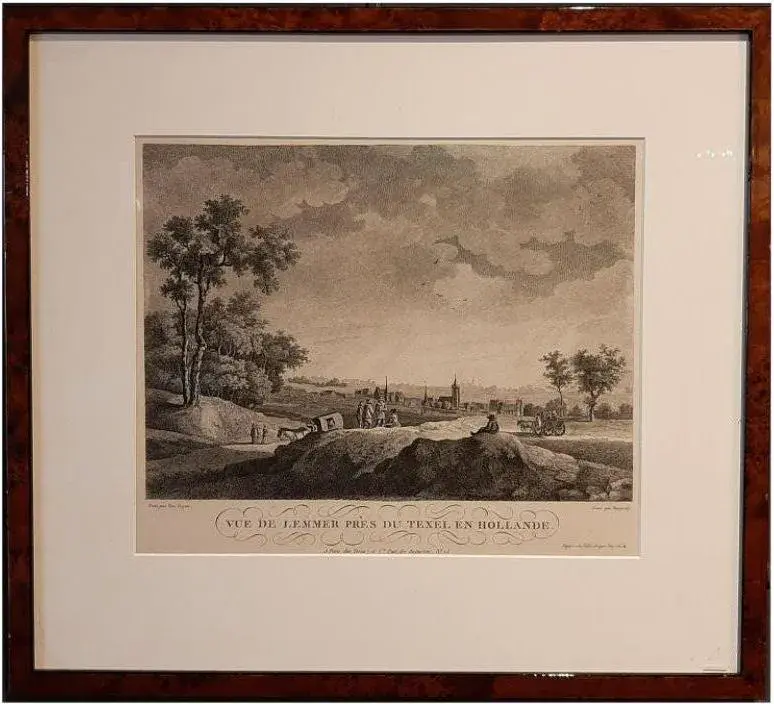
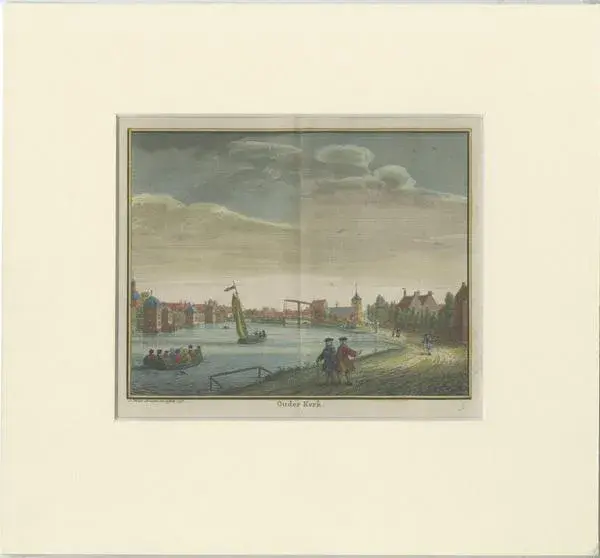
This original antique aquatint is a picturesque depiction of Söderfors, a place likely to be in Sweden, given the naming convention and style of the artwork. Crafted by Ulrik Thersner in 1825, the image portrays a vibrant, pastoral scene set by a rushing waterway, suggesting the presence of a river or stream. The landscape is dotted with buildings that have the architectural hallmarks of early 19th-century Swedish design. A group of figures is depicted in the foreground, which adds a human element and scale to the scene. Söderfors, if it is the same location known today, has a historical industrial background and is located in Uppsala County, Sweden. The area has been known for its ironworks and manufacturing history dating back to the 17th century. It is a locality situated in Tierp Municipality, Uppsala County, Sweden with 1,572 inhabitants in 2010 If the aquatint represents this area, it may have captured Söderfors at a time when it was transitioning from a more agricultural society to one influenced by industrialization. Today, the region may still have remnants of its historical past, although it would have undoubtedly undergone significant changes since Thersner's time. More about the maker: Ulrik Thersner was a multifaceted individual, having an impactful military career alongside his work as a draftsman and topographer. Born on April 2, 1779, in Kyrkslätt parish in Finland, Thersner began his military service early, becoming a ship's boy in the Swedish navy at the tender age of seven. His naval service during Gustav III's Russian War marked the beginning of a lifelong commitment to the military. In 1794, he advanced to the rank of sergeant in the Army's fleet and was appointed as an ensign five years later. His career took a significant turn in 1804 when he was appointed information officer at the Gothenburg squadron, a role that involved hydrographic measurements in Bohuslän. Thersner's military engagements were diverse and geographically spread; in 1807, he transitioned to the Field Survey Corps, where he became a lieutenant in 1808. His expertise in surveying was put to use during the Finnish War, where he was involved in operations in Åland and battles at Sävar and Ratan. By 1810, Thersner had risen to the rank of captain and contributed to the border delineation between Sweden and Russia. His membership in the Royal Academy of Military Sciences in 1811 further affirmed his academic and professional stature. During the war of 1813-14, Thersner held various commands and notably led the engineering efforts during the siege of Glückstadt. Promoted to major in the Field Survey Brigade in 1814, Thersner post-war undertook triangulation measurements in Skåne from 1815 to 1817, demonstrating his proficiency in the practical applications of surveying and mapping. His retirement came in 1825, when he left the service with the rank of lieutenant colonel. Beyond his military service, Thersner is most renowned for his authorship of "Fordna och närvarande Sverige" (Antiquity and Present Sweden), a work that illustrated Swedish estates and landscapes, reflecting both his artistic talent and his technical skills as a surveyor and cartographer. Thersner's artistic endeavors served as a historical record and a tribute to Sweden's cultural and geographic landscapes. Thersner's life came to an end on September 2, 1828, in Västerås, Sweden. His dual legacy as a dedicated military officer and as an artist who meticulously recorded Sweden's geographical beauty ensures his enduring place in Swedish history.
Similar products