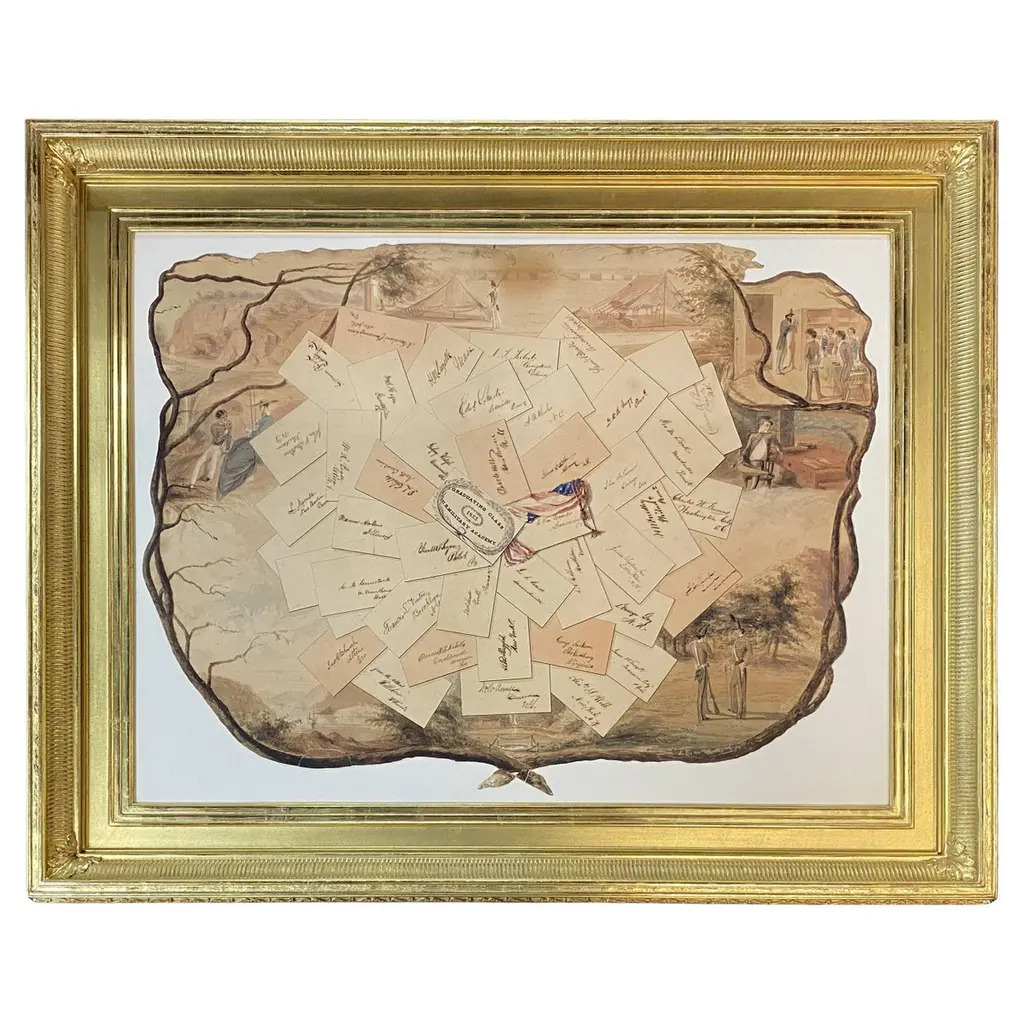
West Point Military Academy Trompe L’oeil Watercolor Graduating Class 1855
$12,800
1st Dibs
A nicely detailed trompe l’oeil watercolor on paper of a collage of autographs and scenes from the graduating class of the US Military Academy at West Point, 1855, attributed to Francis Laurens Vinton (1835-1879). Vinton was a cadet at the academy and a close friend of artist James McNeill Whistler, who was also a cadet and peer at that time. Watercolor on paper, mounted under glass and housed in a molded giltwood frame.Provenance:General Alexander Stewart Webb.Descended to Webb's granddaughter, Anna Remsen Alexandre (1895-1984).Sold from her estate, "The Strawberry House" / Calvin Burnham House, Lenox, Massachusetts, Douglass Auctions, South Deerfield, Massachusetts, April 25, 1985, Lot #91, for $300.Elliot Sherman, Everett, Massachusetts.Ed Jerome, Old Bridge, New Jersey (who replaced the water-stained mat).Richard Blodgett ll, 1987.Notes:Drawing skills were critical training at West Point as soldiers would need to draw maps and sketch battlefield scenarios. Drafting was taught by Hudson River School painter Robert Walter Weir (1803-1889) and many of the cadets were prolific sketch artists, often as a comedic outlet.It was previously believed the vignettes were painted by classmate James Abbot Whistler, who entered the Academy in 1851. The images are similar to known drawings by Whistler done during his years at West Point, before he flunked out at the end of June 1854, about five months before this is believed to have been drawn. (Whistler's appeal to be reinstated was submitted to Jefferson Davis then forwarded to Lee, who denied it.)The attribution to Vinton comes from an entry in the diary of cadet Cyrus Ballou Comstock dated November 17, 1854: "Seven months from today and our courses here closes-we were talking of it tonight. Webb has cut a sheet of drawing paper into cards to receive the autographs of one class, and Vinton painted a border consisting of various scenes around the Point and in Cadet life. A view of camp up the river, old Cog, […] his likeness is perfect. It is the best thing I have seen in a long time". Comstock himself went on to be an important leader during the Civil War and was an aide to President Grant, appointed to oversee the Lincoln assassination trial. "Old Cog" refers to Lee, who referred to West Point as the "Snake Pit".Vinton graduated from West Point with the Class of 1856 as the required course of study at West Point was changed from four years to five years in August 1854. He continued studying mine engineering in Paris, graduating from the Ecole de Mines in 1860. Upon returning to New York he taught mechanical drawing at Cooper Union. During the Civil War, he rose through the ranks to brigadier general but was badly wounded at the Battle of Gettysburg. After the war he became a professor at the newly founded Columbia College School of Mines. He relocated to Colorado in 1877.The similar style exhibited in Whistler's and Vinton's work shows the influence of the classmates' drawing teacher, Robert W. Weir. Indeed, a Vinton sketch at the Walters Art Gallery was first attributed to Whistler but later was changed to Vinton.In an email, Whistler scholar Margaret MacDonald states she does not believe the vignettes in this work could be by Whistler because he was no longer at West Point by Comstock's journal account of November 17, 1854.The work was owned by General Alexander Stewart Webb (1835-1911) and descended through his heirs. Webb graduated from West Point with the Class of 1855 and became a career U.S. Army officer. He served as a Union general during the Civil War and was awarded the Medal of Honor in 1891 for gallantry at the Battle of Gettysburg. During the battle, Webb's brigade manned a portion of Cemetery Ridge and brilliantly succeeded in destroying an attacking Confederate brigade. The following day, during Pickett's Charge, Webb's Pennsylvanian's were situated in the famous "copse of trees" and bore the full fury of the surging forces. More than 450 of Webb's men were killed or wounded defending the "high water mark". Webb was among those wounded at Gettysburg and then later received a debilitating wound at Spotsylvania in 1864.He remained in the army until 1870 when he was discharged at his own request. In his later years Webb served as president of New York City College. A statue of him still stands at Gettysburg.Of note, Webb created a West Point Class of 1854 album, which included similarly scattered autographed cards, a drawing of Trophy Point signed "Merrill" and a topography map signed "Webb". Webb had many drawings and sketches by Whistler given to him during their time together at the Academy.Minor conservation was done in the 1990's - see document attached on verso. Please contact us directly for a full condition report before purchasing.Dimensions: Watercolor: Approximately 22 in H x 29 in W, actual; 30.25 in H x 37.75 in W x 2.25 in D. Ref: 8
Similar Items