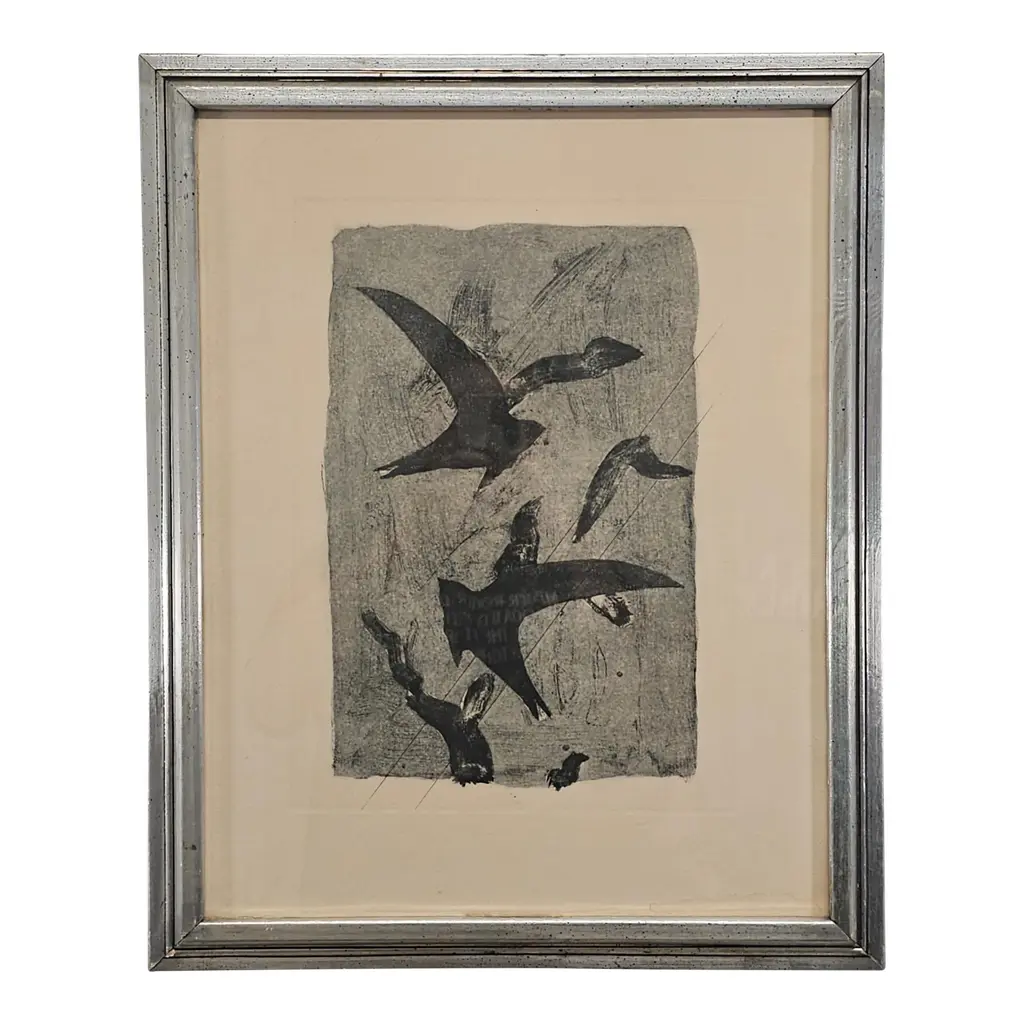
Zao Wou-Ki (Chinese-French, 1921–2013), *Untitled (Agerup 120)*, 1959, color etching and aquatint on Rives BFK paper, signed and dated in graphite at lower right, numbered 9/75 at lower left. This hauntingly lyrical composition emerges from Zao’s early explorations in printmaking during a period of transformative experimentation in Paris. The image presents a densely layered atmosphere of fluid, gestural abstraction—its composition defined by sweeping, calligraphic strokes in smoky blacks and shadowy browns, subtly modulated by hints of ochre and grey. The overall effect evokes both natural and metaphysical forces: a landscape suspended in motion, suggestive of birds, wind, water, or cloud—yet firmly grounded in Zao’s signature fusion of East Asian spiritual aesthetics and Western abstraction. Printed by Raymond Dutrou in Paris and published by L’Oeuvre Gravée, Zürich, this etching belongs to a limited edition of 75 and is catalogued in *Zao Wou-Ki: L’œuvre gravé* by Agerup as no. 120. Housed in a vintage silver giltwood frame with silk-covered mat and a gold leaf inner fillet, the full framed dimensions of 22.125 inches high by 31.125 inches wide. Zao Wou-Ki stands among the most internationally celebrated figures of postwar abstraction. Born in Beijing in 1921, Zao trained at the China Academy of Art in Hangzhou before relocating to Paris in 1948, where he soon entered the orbit of the École de Paris. Early works retained figurative elements, but under the influence of artists such as Paul Klee—whose synthesis of symbolic abstraction and musicality Zao admired—he gradually developed a gestural, non-objective language deeply informed by traditional Chinese ink painting. His calligraphic marks and dynamic brushwork became hallmarks of a transcultural idiom that bridged Taoist philosophy and Western modernism. Though primarily known for his large-scale oil paintings, Zao also produced a significant body of graphic work throughout his career. His prints, like his paintings, often retain a sense of spatial ambiguity and meditative rhythm, and are widely collected by institutions including the Musée d’Art Moderne de Paris, the British Museum, the Metropolitan Museum of Art, and the Art Institute of Chicago. Zao Wou-Ki became a naturalized French citizen in 1964, was named a commander of the Legion of Honour, and was elected to the Académie des Beaux-Arts in 2002. His work continues to garner strong international acclaim, praised for its seamless fusion of East and West, of gesture and silence.
Similar products