Ontology 1: A Successor Architecture for Search
We've built Ontology 1, a neurosymbolic model that answers complex, intent-heavy searches more accurately than today's leading engines, and improves itself through continuous self-driven learning. While we’ve tested it on e-commerce queries, its methodology generalizes beyond that domain.
A new standard
Complex, intent-heavy searches increasingly drive product discovery — and they’re exactly where conventional search struggles. On a benchmark of 90 such queries, scored by three independent judges, Onton won 52 outright (compared to Google Shopping's 19 and Amazon's 16) despite having indexed only 1%1 of their catalog.
Unlocking new ways of searching
E-commerce hasn’t fundamentally changed since its inception. There’s a category page, a product page, and a checkout page. Users search a category, then narrow down with filters. This works fine when user intent maps cleanly onto categories and attributes (size, price, material, brand) but breaks down the moment user intent doesn't. There's no filter for "pet-friendly", or for “furniture that fits in my room”. We’ve been locked into this single-threaded “catalog interface” for nearly 30 years.
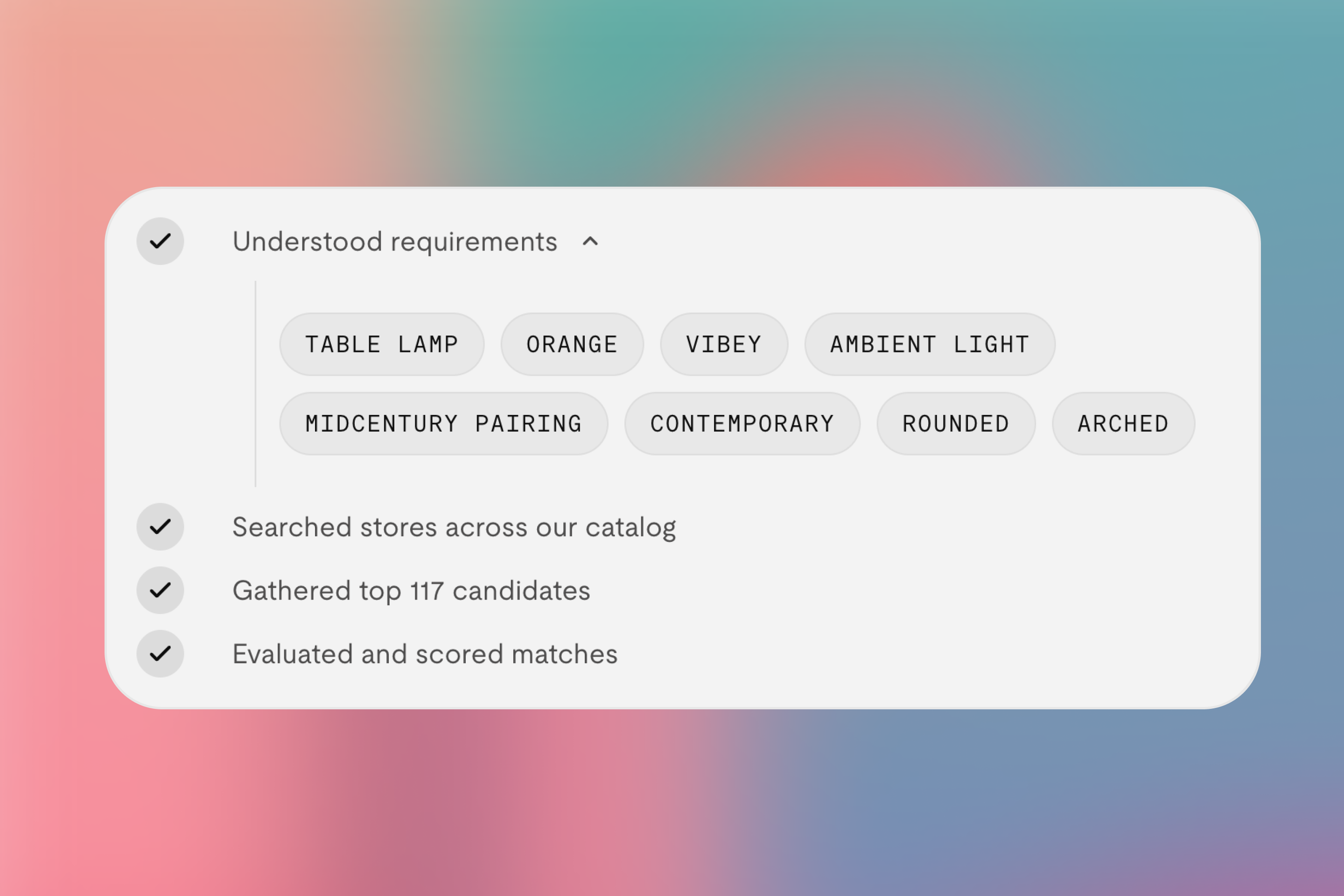
Ontology enables a new paradigm for search. We’ve tested multimodal and multi-object searches, searches riddled with partial data, multi-category searches, “vibe” searches with Onton Canvases (our multimodal surface for moodboard and search). But the depth is more striking than the breadth. The simplest-looking queries are often the hardest. “Furniture that might belong in this room” — a few words and a picture — hides a tangle of inference no filter or keyword can touch: style, scale, palette, what's there, what's missing.
Below we show some searches that were difficult for conventional models and search engines, but easy for Ontology 1:
Query → Results
Ontology makes accurate inferences across categories to produce meaningful results
AI generated reference image
Results
Query → Results
Ontology can parse multimodal queries, with partial and even conflicting data
Complex and conflicting inputs Pendant light mislabeled as a wall sconce
Results
Query → Results
Ontology turns Onton canvases into rich search context
Whimsical room moodboard Used as multimodal search context
Results
Comparison
Ontology handles ambiguity that vector search can’t
Comparison
Ontology surfaces taste-driven results that keyword filters miss
From our early assessment, the reach is broader than the benchmark suggests. Ontology 1 handles the style-based, taste-driven, ambiguous, complex multimodal searches that defy keyword and vector retrieval, and is markedly more accurate on long, requirements-heavy queries. It learns efficiently: once it works out what makes a few products "cozy," it applies that understanding across millions. It doesn't just compress you into a vector and match on similarity; it reasons from what it knows about you — that "small" means it has to fit in your 400-square-foot studio — which opens the door to genuinely personalized search. And none of this is specific to products: Ontology searches non-product data with essentially no reconfiguration.
We keep reaching for the edge of what it can do. We haven't found it yet.
A better approach to accuracy
Most search engines use some combination of vector search, keyword search, and user feedback to approximate matches to user queries. Ontology 1 takes a different approach.
Take the query “pet-friendly sectional”. Most engines match it against the title and description. But what if the seller never wrote “pet-friendly”? Or wrote it, but it isn’t true? Ontology works differently: rather than trust the label, it reasons from properties that are more likely to be objective. It checks the fiber, weave, and construction that actually determine pet-friendliness, and flags claims the product data contradicts. It also weighs the source — some listings try to game the algorithm, and some reviews are bought. These and other techniques let Ontology surface products that keyword and vector search overlook, and discard ones that resemble a match but fail on substance.
It also learns from queries. Unlike an LLM, which absorbs patterns into inscrutable weights, Ontology builds an explicit, inspectable world model of how things relate and why products are the way they are — and it can tell when that model has a hole in it. Ask for a "pet-friendly sectional" and, if it has no account of what makes something pet-friendly, that's a gap. Rather than guess from surface associations the way an LLM would, it works the answer out: what makes something pet-friendly? Perhaps cleanability and durability. What makes something cleanable and durable? It might find that polyester upholstery is a good indicator. Later, when someone searches “pet-friendly chair” or “cleanable blue couch”, it reuses what it’s learned. This learning loop runs continuously, and Ontology’s accuracy compounds with use.
The successor architecture
For all their capabilities, LLMs fare little better at e-commerce queries than vector and keyword search. RAG’s recall is only as good as the vector search beneath it. And even LLMs with a context window vast enough to hold our entire catalog — billions of tokens — can’t escape a fundamental problem: LLMs aren’t optimized for truth.
LLMs, like all connectionist (”neural”) systems, handle approximation well, and are robust to noisy data. But even with trillions of parameters trained on trillions of tokens, they still fail on problems humans find obvious. As a 2024 paper from Apple researchers put it, LLMs “are not capable of genuine logical reasoning; instead, they attempt to replicate the reasoning steps observed in their training data.” Symbolic systems have the opposite profile: they give exact, factual answers, but only from precise inputs. And they “learn” only when a human adds data or programs a new capability.
Ontology 1 introduces a new synthesis: a neurosymbolic architecture that applies exact reasoning where it can, and learns from noisy data where it can't.
A common fix for fabrication is to anchor an LLM to a knowledge graph: a structured map of facts and how they relate. Traditionally, humans build these by hand. Someone has to enter that a sectional is a kind of sofa, and that sofas have upholstery. This is slow and expensive — but the deeper problem is what gets built. Hand-curated graphs tend toward a tidy, simplified world: crisp categories, clean rules, and no room for the vague or semi-contradictory cases real queries are full of. They often disallow exactly the predicates that matter most: "cozy," "pet-friendly," "won't look dated in ten years" — because those resist clean definition. The result models a kind of voxel world: internally consistent, but a low-fidelity approximation of the real one.
Ontology takes the opposite approach. It expands the graph's entities and relationships toward the full breadth of human knowledge. Because its representation can encode any pattern, it goes after the hard cases rather than avoiding them. Its world model remains internally consistent even as it grows more and more faithful to the messiness of reality.
A graph database fast enough to reason
Everything Ontology does — answering a user query, testing a hypothesis, tracing why a result holds — rests on graph queries. Ontology 1’s knowledge graph runs atop a custom graph database, Ograph. In 2023, Ograph’s predecessor ran our production queries 700× faster than RedisGraph, then state-of-the-art. Ograph has pulled further ahead: on a single core, it beats SuiteSparse:GraphBLAS running on 14. That's ~100× the throughput per core.
The larger step is GPU. Ograph now runs on the same hardware that powers neural networks: 43× faster than its CPU variant, with early runs touching 1000× as we tune the implementation. That headroom lets us scale our knowledge graph and run the deep, multi-step reasoning that harder queries demand.
What's next
If you're a researcher excited by neurosymbolic systems, your organization has a search or discovery problem that conventional tools handle poorly, or you've found a use for Ontology we haven't thought of, we’d love to talk ([email protected]).
Meanwhile we’re expanding our catalog beyond home decor, and above all, accelerating Ontology’s self-learning loop.
Built for where e-commerce is heading
Since conversational AI arrived, the average shopping journey has gotten longer, not shorter. More shoppers are abandoning their carts to analysis paralysis. The biggest e-commerce development of 2025 was agentic commerce, and the first attempts have underdelivered. Part of the reason is trust and authenticity, which are scarcer and more valuable than ever. LLMs generate exabytes of unstructured, unverified content daily, and the tools shoppers have are neither built nor incentivized to handle it.
Worse, LLMs are driving the mass extinction of the very data they depend on. As AI captures the clicks that once rewarded genuine reviews, expert guides, and blog posts, the incentive to produce them disappears, and the burden of separating fact from fiction falls on the consumer. In this environment, products built on trust grow increasingly valuable.
With its answers grounded in evidence, and its reasoning open to inspection, Ontology 1 is a necessary step toward trustworthy search. We don’t know whether agentic commerce will ever become the dominant paradigm. But for it to work at all, something like this has to exist first.
Footnotes
1 Amazon has ~600M unique products (ASINs) as of 2025 (~100x Onton), and ~2.6B listings worldwide as of 3/2026. Google Shopping has 50B+ listings as of 1/2026, with no published number on uniques; if Amazon’s ratio holds, one could extrapolate to 11.5B (~1000x Onton).