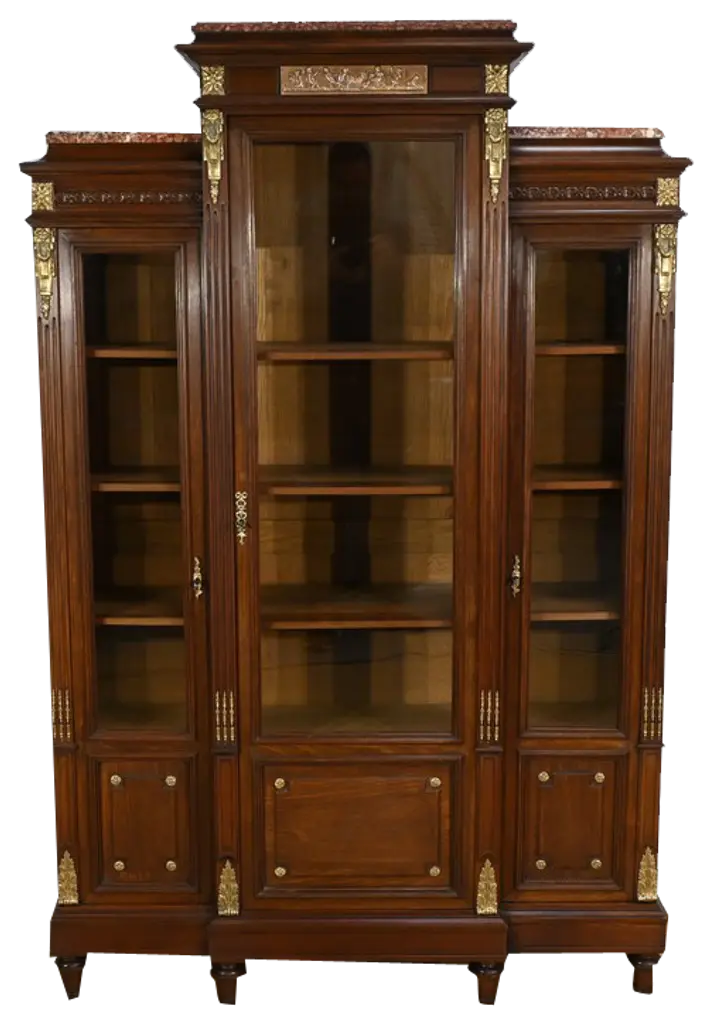
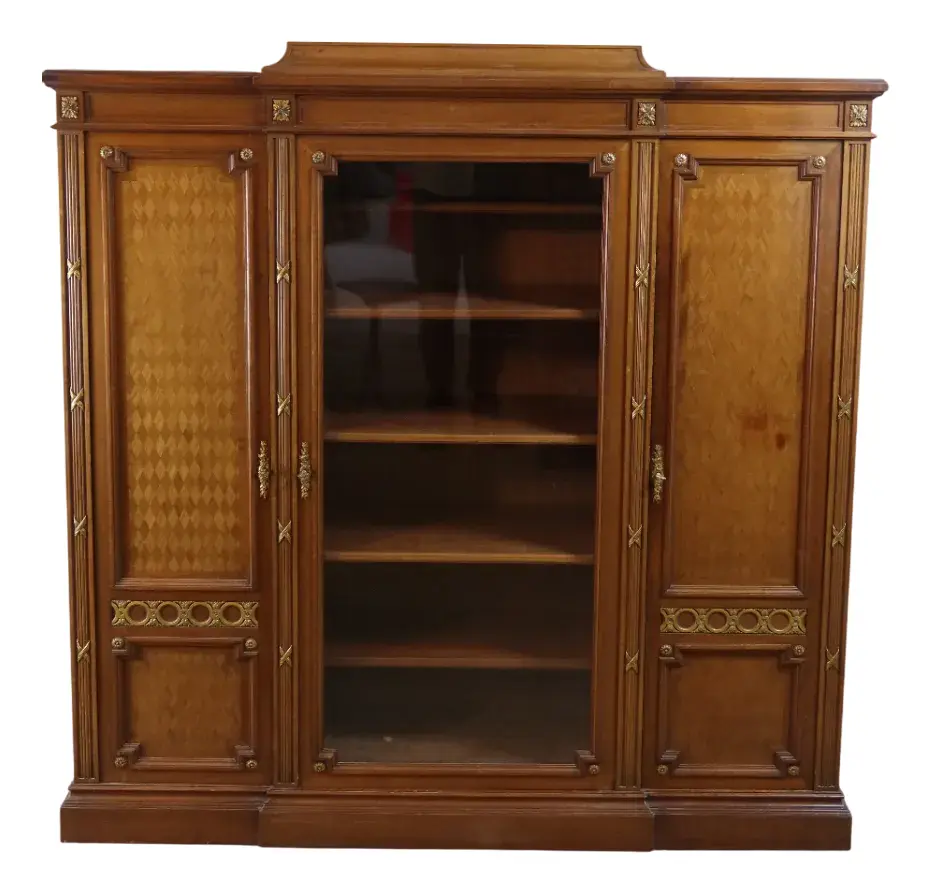
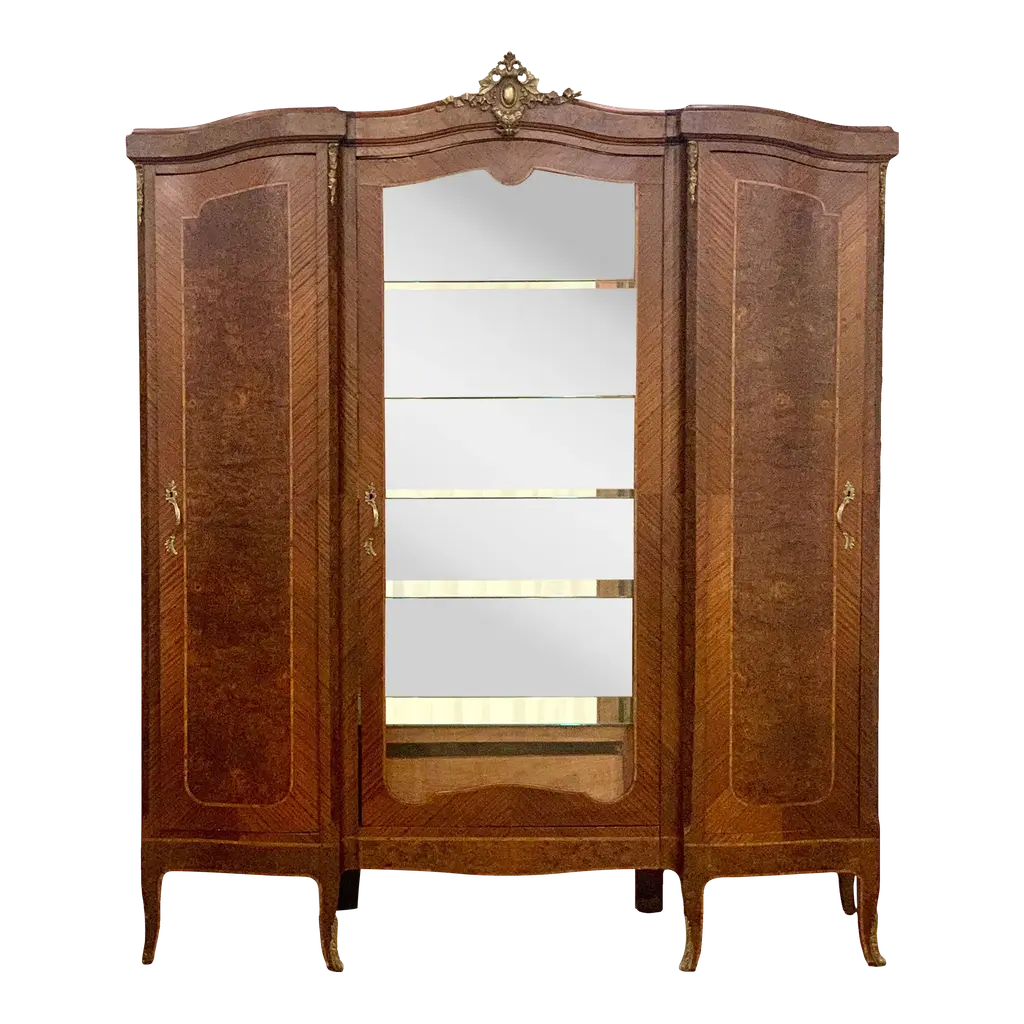
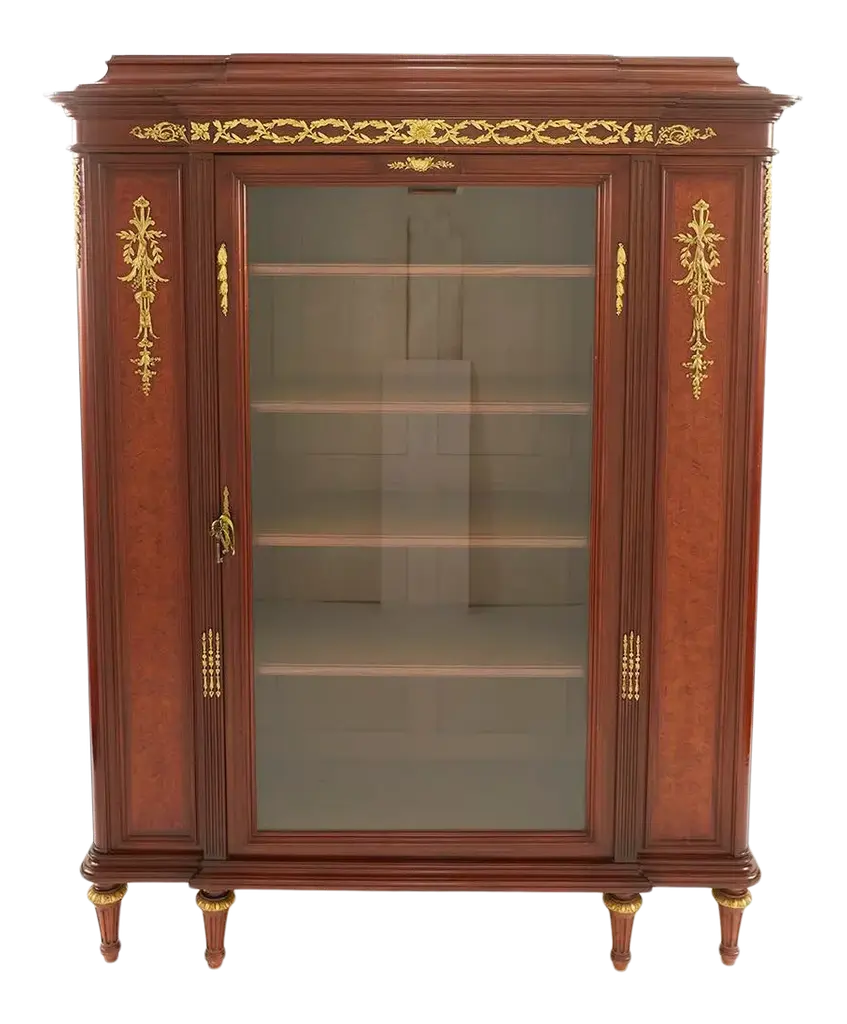
There are armoires… and then there are armoires that look as though they have been quietly judging lesser furniture for over a century. This magnificent French Louis XVI style armoire, dating to the 1890s, is the sort of piece that makes you instinctively straighten your posture when you approach it. Crafted in richly figured walnut and adorned with carved giltwood and finely cast bronze mounts, it carries that unmistakable late 19th-century French confidence — a revival piece made when craftsmanship still meant something you could feel in your knuckles. The façade is an elegant architectural composition. A gracefully arched central bonnet, crowned with a gilt bronze medallion and flanked by turned finials, anchors the top like a dignified crest. The symmetry is pure Louis XVI: restrained, balanced, yet undeniably regal. Vertical side panels display intricate parquetry in diamond patterns, the walnut veneers glowing in warm honey and caramel tones beneath a lustrous finish. Gilt bronze mounts punctuate the surface with precision — delicate floral garlands, ribbon-tied wreaths, and neoclassical medallions that shimmer against the darker walnut ground. Each ormolu detail is thoughtfully placed, not cluttered, but composed like a well-rehearsed string quartet. The lower panels feature musical trophy motifs and crossed instruments rendered in gilded relief, giving the piece a quiet narrative flair. The central section opens to reveal generous interior storage, with shelves and drawers designed for practicality without sacrificing elegance. This is not merely a decorative cabinet; it is a functional wardrobe or display armoire, built when furniture was expected to last generations. The substantial base rests on rounded feet, lending stability and grounding the vertical grandeur above. As an SEO-optimized description: French Louis XVI style armoire, 19th century French walnut armoire, gilt bronze mounted cabinet, 1890s neoclassical wardrobe, antique French carved walnut armoire — every phrase fits, because every detail delivers. But beyond the keywords and craftsmanship lies something harder to quantify. Stand before it long enough and you can almost hear the faint echo of Parisian salons — polished shoes crossing parquet floors, a distant piano scale drifting through tall windows. It is dignified without being dour, ornate without being ostentatious. This 1890s French Louis XVI armoire is ideal for collectors of fine European antiques, designers seeking a commanding focal point, or anyone who believes storage should come with a touch of ceremony. Because sometimes, even a wardrobe deserves to feel like royalty. Measures 94.25 tall x 23.25 deep x 74.25 Now we are in rarefied territory. If this armoire is attributed to François Linke, and the locks are signed “Duvivier Paris,” you are looking at a piece that sits squarely within the elite ecosystem of Belle Époque Parisian luxury craftsmanship. Who Was François Linke? François Linke (1855–1946) was one of the most important cabinetmakers of the late 19th and early 20th centuries. Born in Bohemia, he moved to Paris and established a workshop that became synonymous with extraordinary revival furniture inspired by the reigns of Louis XV and Louis XVI. Linke did not merely copy 18th-century models — he elevated them. His work is characterized by: Exceptional veneer selection and parquetry Architectural balance with dramatic sculptural bronze mounts Rich, deeply chased gilt bronze (ormolu) A heightened sense of theatrical elegance His international reputation exploded at the 1900 Exposition Universelle in Paris, where his monumental bureau — lavishly mounted in bronze — stunned audiences. Linke collaborated with master bronzier Léon Messagé, whose sculptural mounts gave Linke’s furniture a distinctive vitality and fluidity. Why This Armoire Is Attributed to Linke Several elements strongly support a Linke attribution: 1. The Quality of the Ormolu The finely cast gilt bronze mounts — musical trophies, ribbon-tied wreaths, classical medallions, and delicate garlands — are crisply chased and harmoniously integrated into the walnut structure. Linke’s mounts were never applied decoration; they were part of the architectural rhythm of the piece. 2. Parquetry and Veneer Work The diamond-patterned parquetry panels and symmetrical veneer selection reflect high Parisian workshop standards. Linke was meticulous about grain matching and polish depth, producing that glass-like finish seen here. 3. Architectural Bonnet Crest The arched Louis XVI bonnet crowned by an oval gilt medallion and flanking finials aligns with Linke’s tendency to amplify classical restraint with sculptural grandeur. 4. Overall Proportion and Refinement The balance between neoclassical discipline and opulent bronze presence is very much in the Linke vocabulary. While many of Linke’s pieces were stamped “FL” or “Linke,” not all were marked — especially those retailed through luxury firms. Who Were Duvivier Paris? The locks signed “Duvivier Paris” add a fascinating layer. Duvivier was a highly respected Parisian lockmaker active in the 19th century, supplying precision hardware to elite ébénistes and luxury cabinetmakers. Their locks were not utilitarian afterthoughts; they were finely engineered mechanisms often used in high-end furniture workshops. Finding Duvivier locks on a piece suggests: Commission-quality production Parisian manufacture Association with top-tier cabinetmaking ateliers Leading cabinetmakers frequently sourced hardware from specialist firms like Duvivier, just as they commissioned bronzes from expert foundries. Taken together — the ormolu quality, parquetry, architectural design, and Duvivier Paris locks — this armoire fits squarely within the world of high Belle Époque Paris craftsmanship. If firmly authenticated, it would not merely be a fine 1890s French Louis XVI armoire. It would be a product of the very workshop culture that defined the golden age of Parisian decorative arts.
Similar products