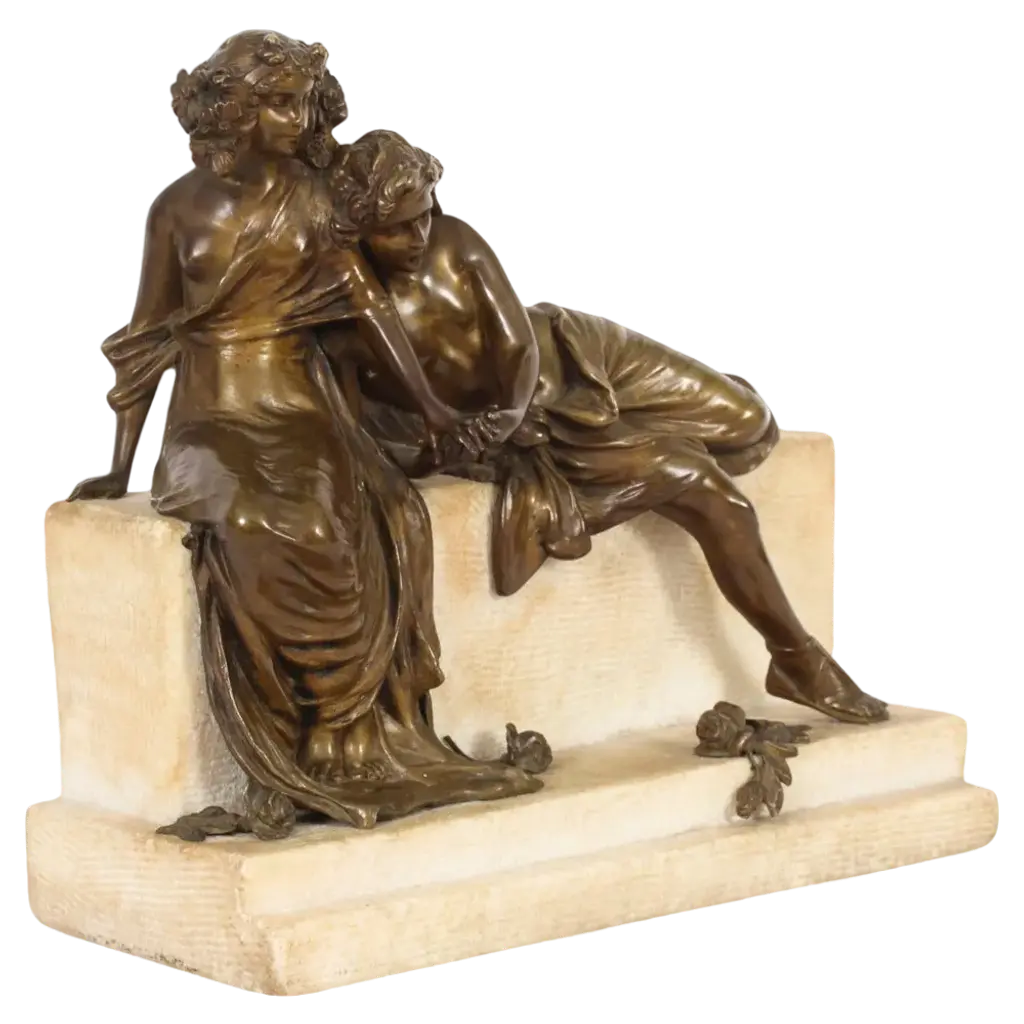
Auguste rodin, after (1840-1917) l'éternelle idole (the eternal idol) year of ideation: 1891 year of casting: 1986 material: bronze (brown patina) on marble base size: 18 cm high edition: 18/750 foundry: royal art collection, düsseldorf, germany signed: a. Rodin marked: rac (royal art collection), 18/750, nachguss (casting) 1986 great condition: minor signs of age catalogue raisonné: antoinette le normand-romain, "rodin et le bronze - catalogue des œuvres conservées au musée rodin", éditions de la réunion des musées nationaux, paris, 2007, tome i, p. 328 (illustrated) ___ this work is one of rodin's most poetic and sensual compositions. It depicts a man kneeling in a posture of profound adoration before a woman. Unlike many classical sculptures of the time that focused on a mutual embrace, this artwork highlights a specific dynamic. the man is positioned in a state of humble worship, his arms behind his back, leaning forward to kiss the woman just below her breast. she sits with a quiet, almost detached grace, her posture suggesting a goddess-like presence receiving a tribute. rodin was a master at capturing raw human emotion through the serpentine movement. In the eternal idol, he captures a moment that feels both intimate and sacred. the title itself suggests that the woman represents an unreachable or divine ideal. It captures the tension between physical desire and spiritual reverence. - collector’s note - while rodin created the original models by sand casting (fonte au sable, in french) or marble, all lost wax bonze casts of this subject are posthumous. for the modern collector, the preciousness of a bronze often depends on the specific era of the cast and the reputation of the foundry. this piece is particularly notable for several reasons. it is cast by rac, a respected german company that closed at the end of the xxth century; thus, these specific editions are no longer in production; moreover, casts produced before 2000 are increasingly prized for their superior craftsmanship. This 1986 edition features a rich, hand-applied dark patina and the fine detail work characteristic of high-end late-20th-century german casting. This piece has an attribution mark, i am sure that it is completely authentic and take full responsibility for any authenticity issues arising from misattribution
Similar products