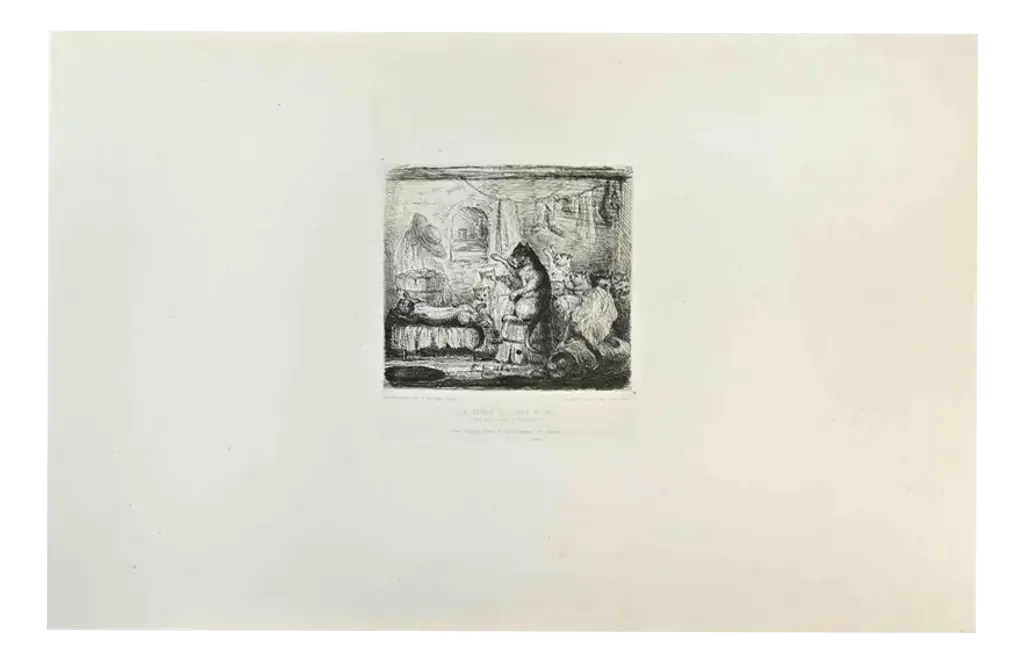
Etching in paper realized by Eugène Champonnion after Mariano Fortuny. Signed "Fortuny 68" loer right, in the plate. Foreground Figures: Two Moroccan men are seated on the ground. One, positioned in the center, crouches attentively while extending a stick toward a large vulture. His companion leans back slightly, more relaxed, while watching. Both wear draped garments resembling robes or burnooses, typical attire in North Africa. The Vulture: On the right, the large bird is rendered with impressive detail — its head lowered, wings partially spread, engaging with the men as if in a contest of wills. The creature dominates the right side of the composition, its menacing form contrasting with the human figures. Female Figure: On the left, leaning against the wall, stands a veiled woman in traditional attire, partially in shadow. She adds a sense of mystery and gravity to the scene, her presence emphasizing observation rather than participation. Setting: The backdrop is a plain wall with a section of richly decorated Moroccan tilework on the left side. The simple, dark background enhances the stark contrast between figures, costume, and bird. A shallow bowl of patterned objects (possibly food, eggs, or game tokens) sits between the men and the vulture, heightening the dramatic tension. The scene likely reflects European fascination with North African life during the 19th century, combining ethnographic interest with exoticism. The interaction with the vulture may symbolize power, danger, and survival, themes often romanticized in Orientalist art. Presented at the Salon of 1872, the work would have appealed to Parisian audiences intrigued by North African culture and Fortuny’s influence, blending realism with exotic spectacle. This piece is attributed to the mentioned designer/maker. It has no attribution mark and no official proof of authenticity, however it is well documented in design history. I take full responsibility for any authenticity issues arising from misattribution
Similar products