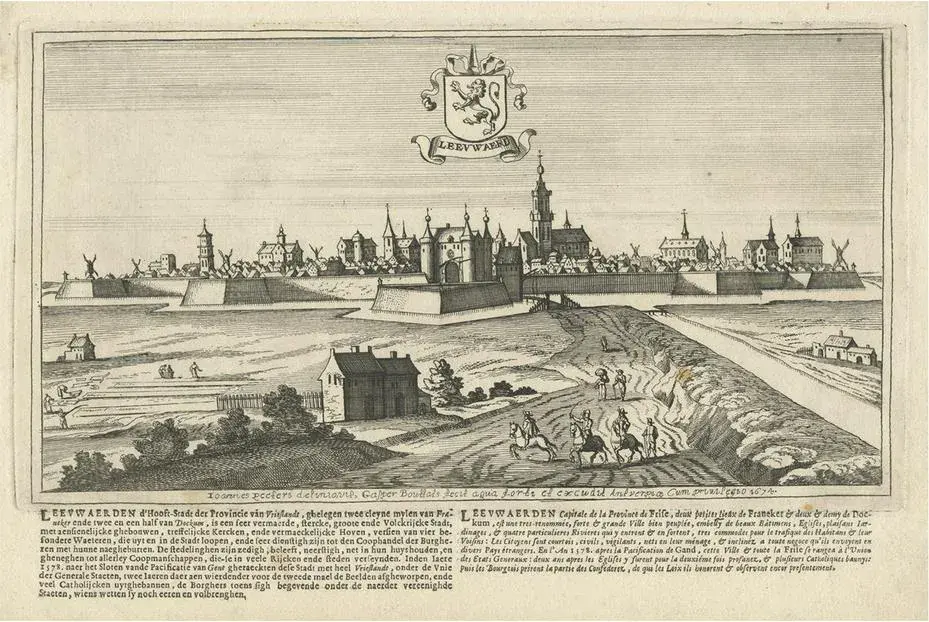
Antique Bird’s Eye View of Leeuwarden, Friesland, by Jollain, circa 1670 This rare and decorative antique engraving presents a panoramic bird’s eye view of the fortified city of Leeuwarden (spelled “Lewarden” on the print), the capital of Friesland in the northern Netherlands. Created around 1670 by the French engraver Gerard Jollain, this view captures the city in impressive detail, showcasing its dense urban layout, canals, churches, and military fortifications. The map includes an explanatory legend at upper right, listing prominent landmarks with corresponding letters on the print. These include churches and religious houses such as the Church of St. Clare, a priory church, the former palace chapel, a cloister church, and the Church of St. Catherine. These refer to historical institutions known to have existed in Leeuwarden, rendered here with a touch of artistic license. Notably, the tall, unfinished leaning tower of the Oldehove can be identified near the center of the image—a key landmark of the city still standing today, suggesting that the engraver or publisher had at least some awareness of Leeuwarden’s true layout. However, several visual elements in the print raise questions about its topographical accuracy. The mountainous landscape in the background and the grand riverfront scene are geographically inconsistent with Friesland’s flat terrain. These features suggest that the plate may have been repurposed or adapted from a view of another city—possibly Vienna—and relabeled as “Lewarden” to appeal to a broader print-buying audience. Gerard Jollain, active in Paris in the second half of the 17th century, was known for issuing both original and derivative city views, and in some cases reworked earlier plates to represent different cities. The addition of the Oldehove may have been an attempt to localize an otherwise generic or reappropriated engraving. This hybrid character makes the print not only a decorative piece but also a fascinating historical artifact of how urban identity was constructed and sold through printed images in the early modern period. Condition report: Very good condition for its age. The original centerfold is present, as issued. There is a visible vertical crease at the right-hand side and a smaller crease in the lower left margin. Slight soiling and a few marginal stains are evident, with a small manuscript note in the lower right of the caption. Overall, the sheet shows minor age-related toning and handling wear, consistent with 17th-century prints. Blank verso. Framing suggestions: A dark oak or blackened wood frame with an off-white or ivory archival mat will complement the historical character of the print. Museum glass is recommended to preserve the paper and reduce glare, enhancing both legibility and visual impact. Given its size and narrative appeal, it would make a striking focal point in a hallway, library, or study.
Similar products