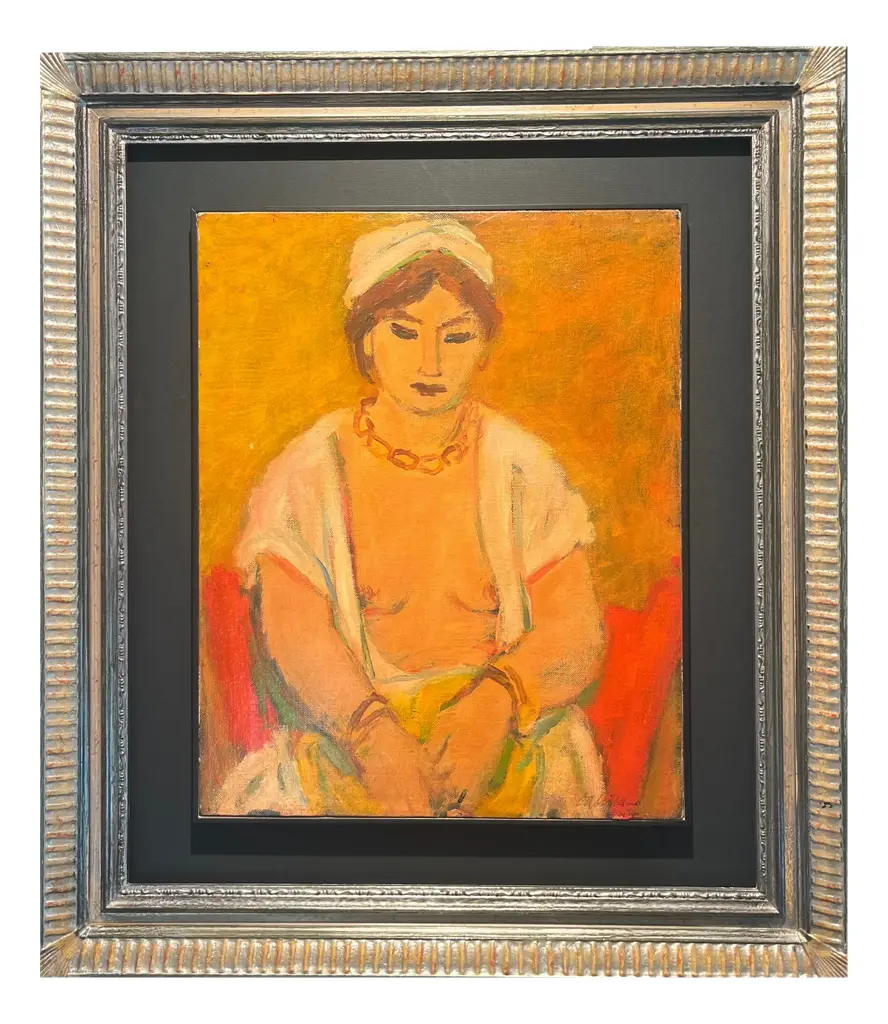
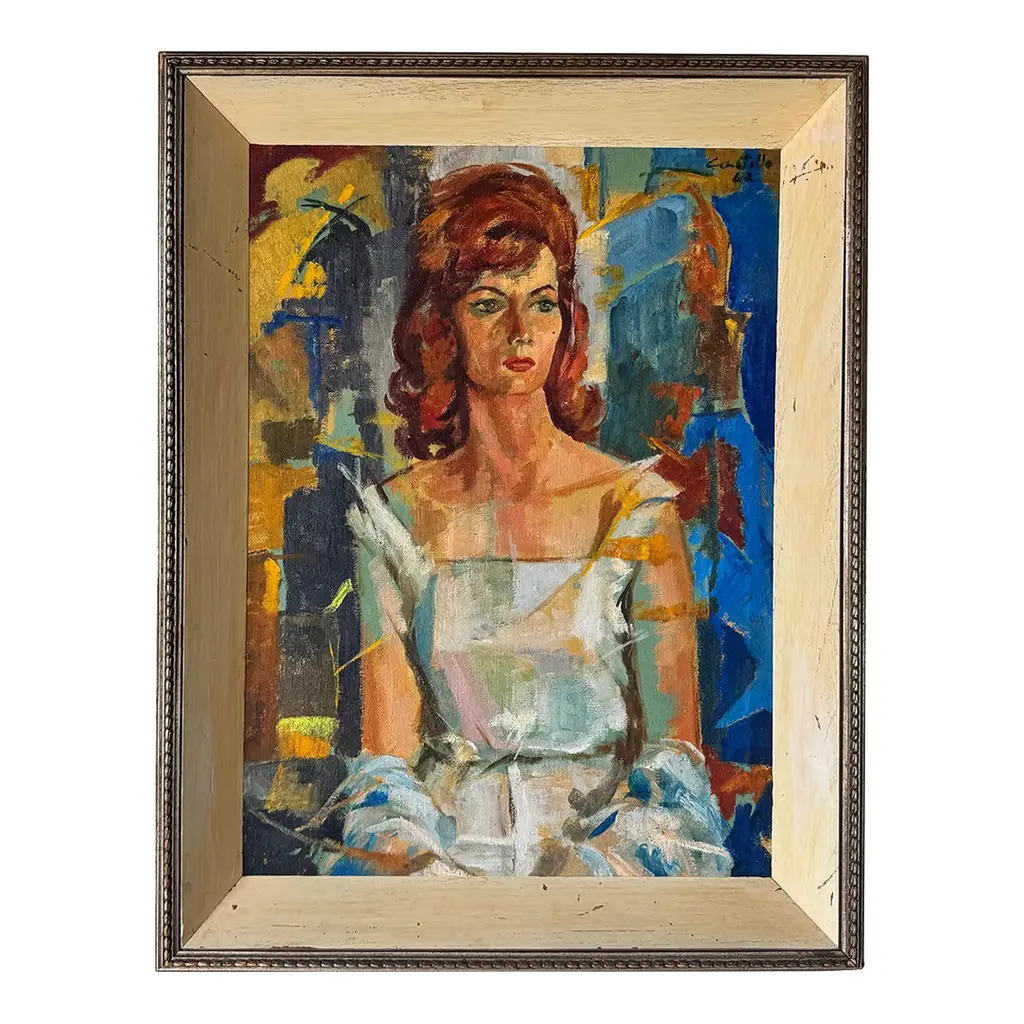
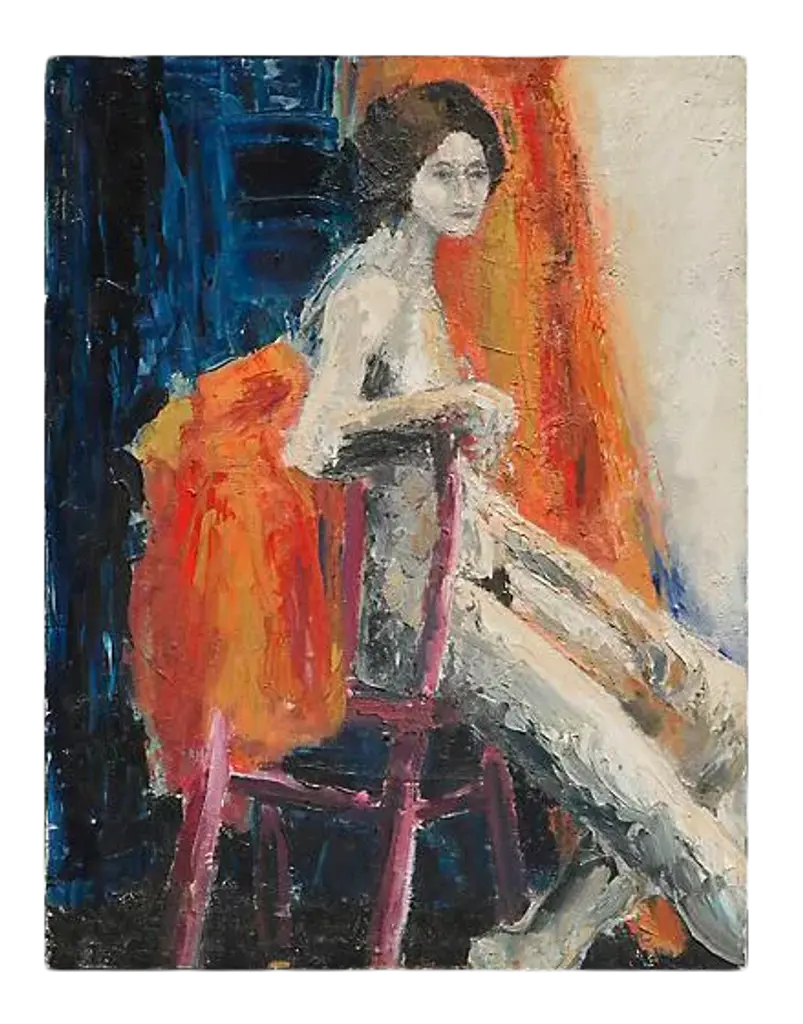
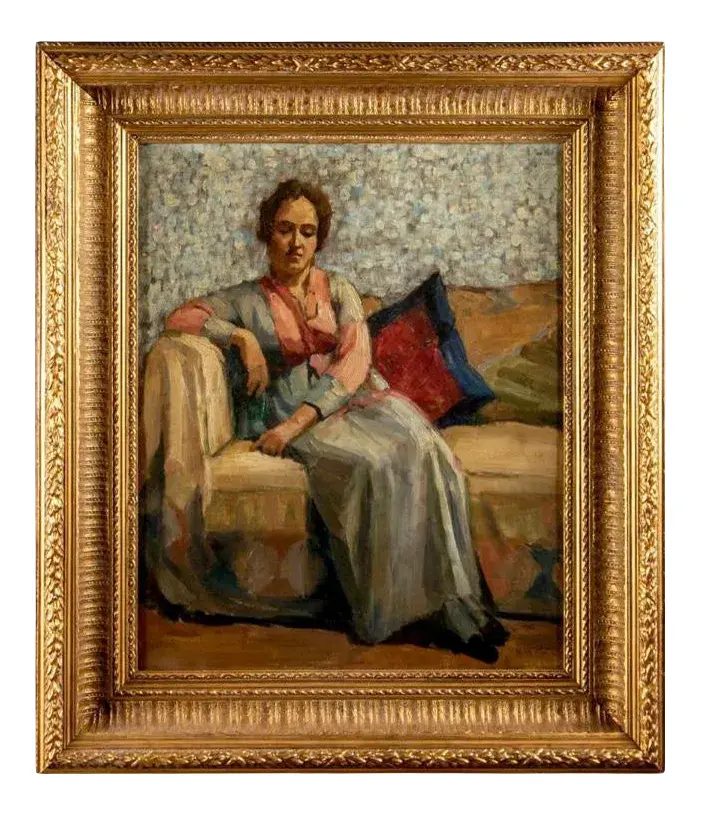
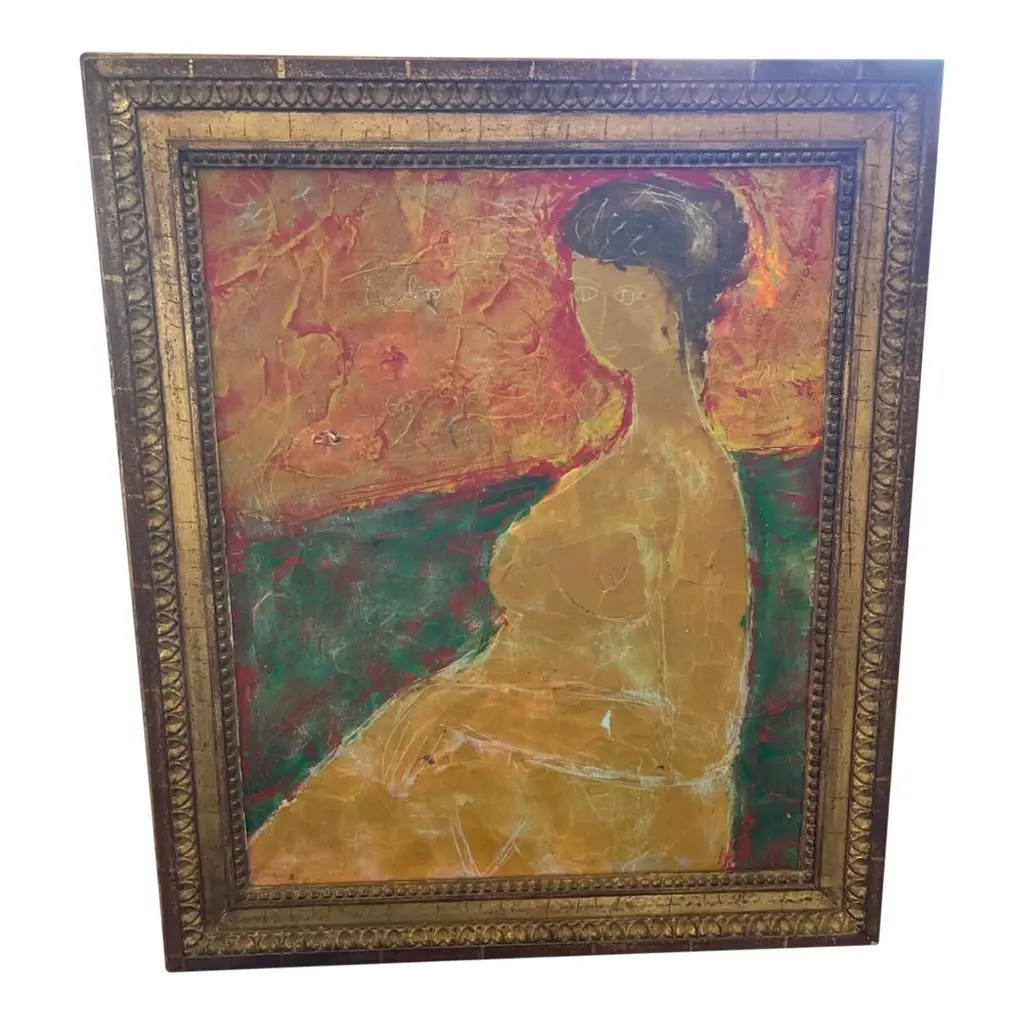
Nicola Simbari - Saffron Daydream - 1964 Oil painting Italian post Impressionist - Oil painting on Canvas - signed and dated 1964 Canvas size 39x35" - Frame size 44x40x2" Description This painting is a masterful display of Impressionistic modernism, characterized by its luminous palette and bold, tactile execution. It centers on a seated female figure, rendered in a profile view that suggests a moment of quiet, sun-drenched contemplation. Composition and Subject The artist uses a geometric abstraction of space, dividing the background into broad, overlapping planes of color. The Figure: Dressed in a loose, white garment with a hint of a blue sash, the subject is sculpted through thick, rhythmic brushstrokes. Her form is both solid and ethereal, catching the "light" that seems to radiate from within the canvas. The Setting: The environment is suggests a Mediterranean interior or a terrace. The chair is reduced to simple, linear strokes, allowing the focus to remain on the interplay of light and shadow on the figure. Color and Texture The work is defined by its vibrant, warm-toned palette: Radiant Hues: Dominant strokes of ochre, burnt orange, and vivid pink create a sense of intense midday heat. Cool Accents: Strategically placed patches of turquoise and deep violet provide a sophisticated visual counterpoint, adding depth to the flatter areas of color. Impasto Technique: The heavy application of paint—likely using a palette knife—gives the surface a rich, sculptural quality. This texture allows the painting to catch physical light, changing its appearance slightly depending on the viewer's angle. Mood and Atmosphere There is an overarching sense of serene nostalgia. The lack of sharp facial detail invites the viewer to project their own emotions onto the scene, making the piece feel universal. It captures a fleeting "slice of life," frozen in a high-contrast world of color and light. Artist Biography Born in Italy, Nicola Simbari (1927–2012) was an influential modern artist best known as a "master of the palette knife". His work, including "Interior in Pink" (1964), is celebrated for its vibrant Mediterranean light and bold, semi-abstract impressionism. Early Life and Education Background: Born in Calabria, he moved to Rome at age three when his father became an architect for the Vatican. This early exposure to architectural forms and Renaissance masterpieces like the Sistine Chapel deeply influenced his sense of composition. Education: At just 13, he enrolled in the Accademia di Belle Arti di Roma, where he excelled in both painting and architecture. Career Highlights Early Success: He opened his first studio in Rome at age 22 and gained international recognition by the 1950s with shows in London and New York. Major Commissions: In 1958, he was commissioned to paint murals for the Italian Pavilion at the Brussels World's Fair. He also designed bold graphic posters for the Royal Ballet featuring stars like Rudolf Nureyev. "Simbari Style": Often described as a "semi-abstract impressionist," his work captures "La Dolce Vita" (the sweet life) through vivid colors and thick, rhythmic textures. He frequently used a palette knife to create deep, sculptural layers of paint. Subjects and Legacy Simbari’s paintings act as a "visual diary" of his life, featuring Mediterranean landscapes, fishing villages, and quiet figurative moments. His work is held in prestigious collections worldwide, including the Christian Dior Collection in Paris, the Bank of Tokyo, and the Virginia Museum of Fine Arts.
Similar products