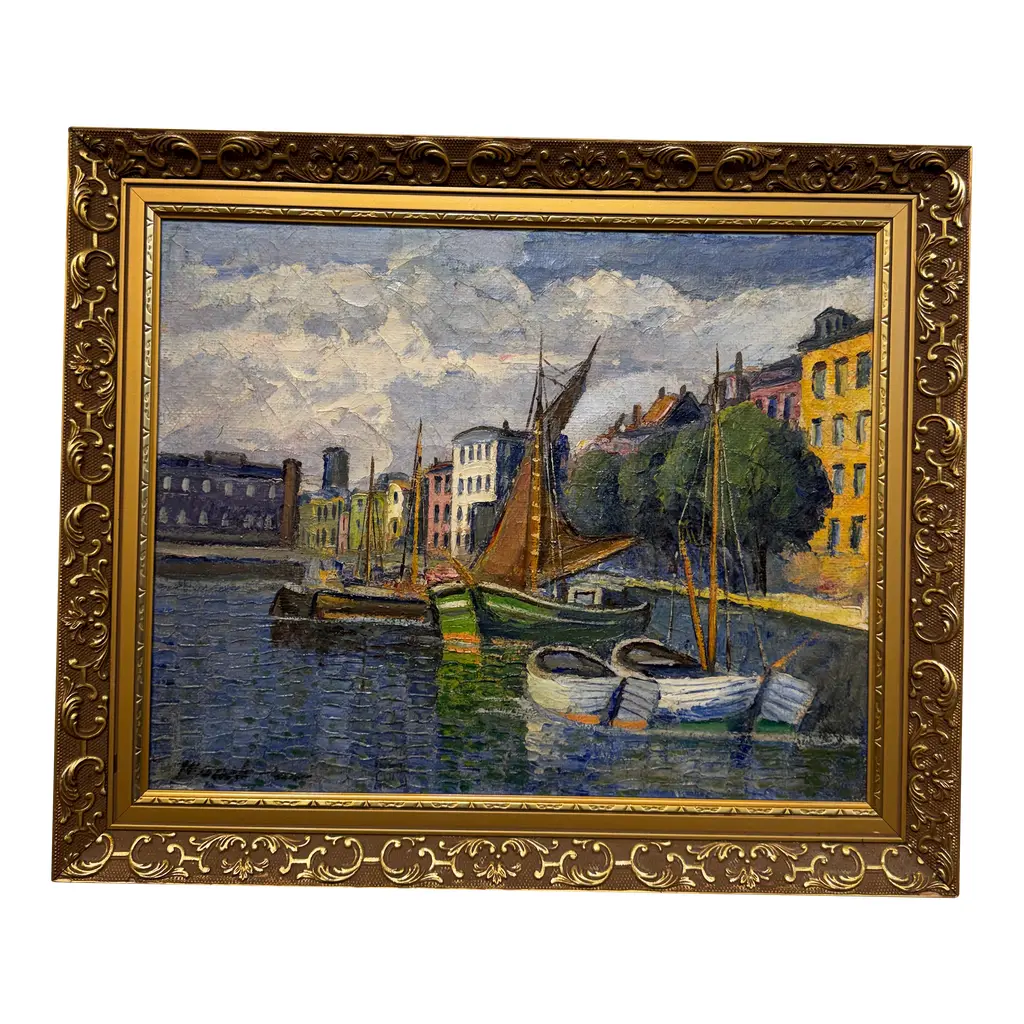
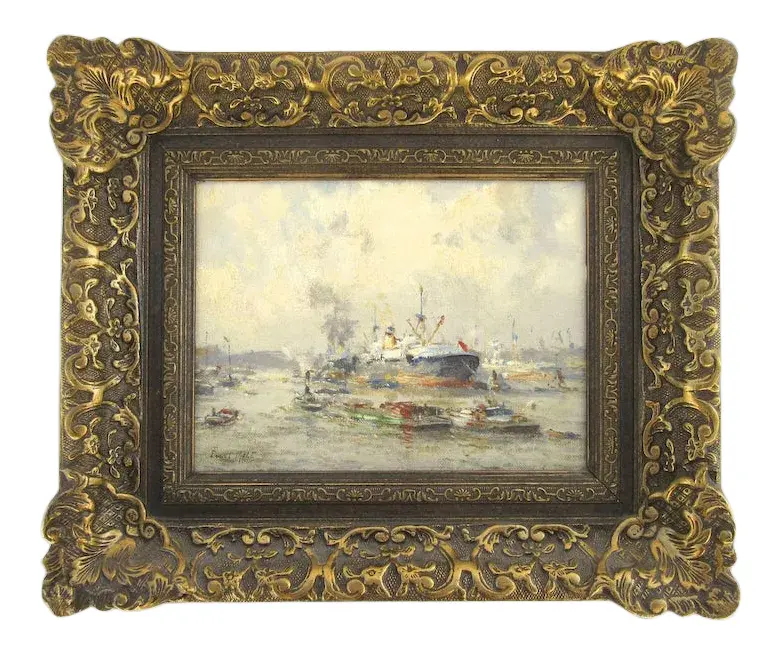
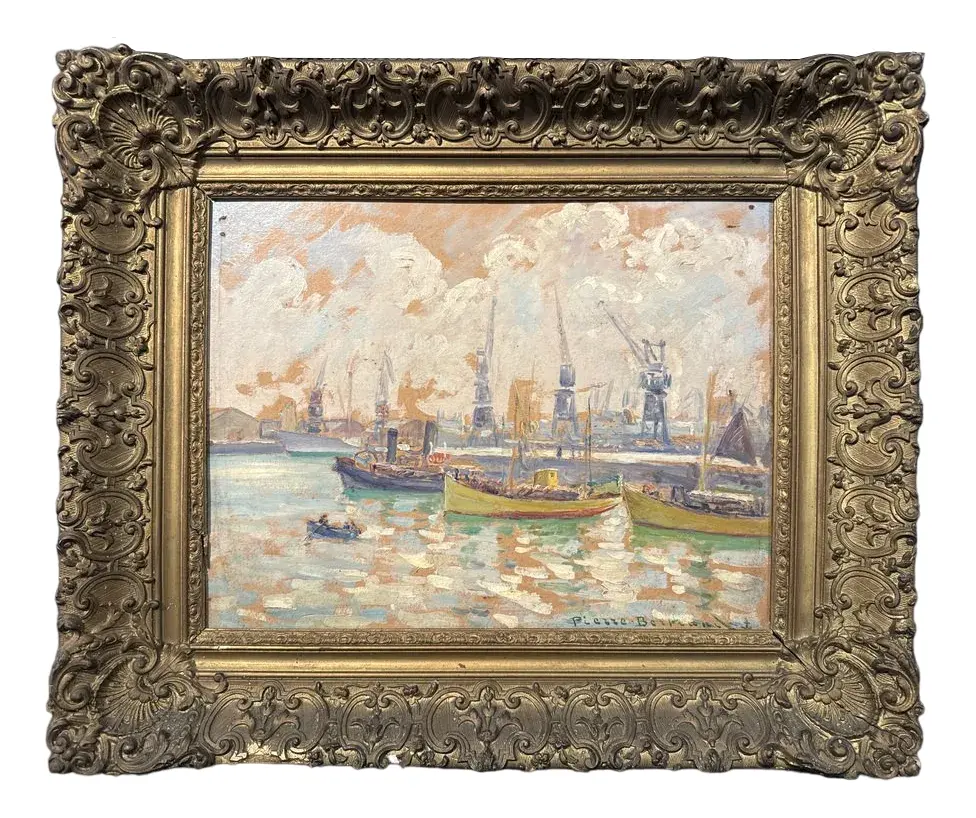
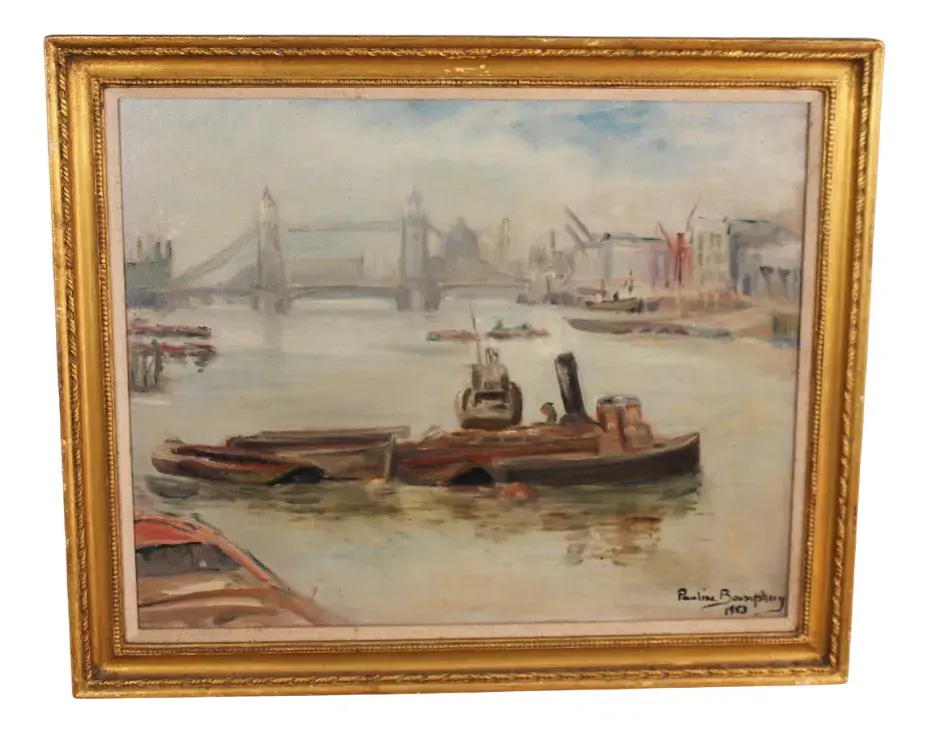
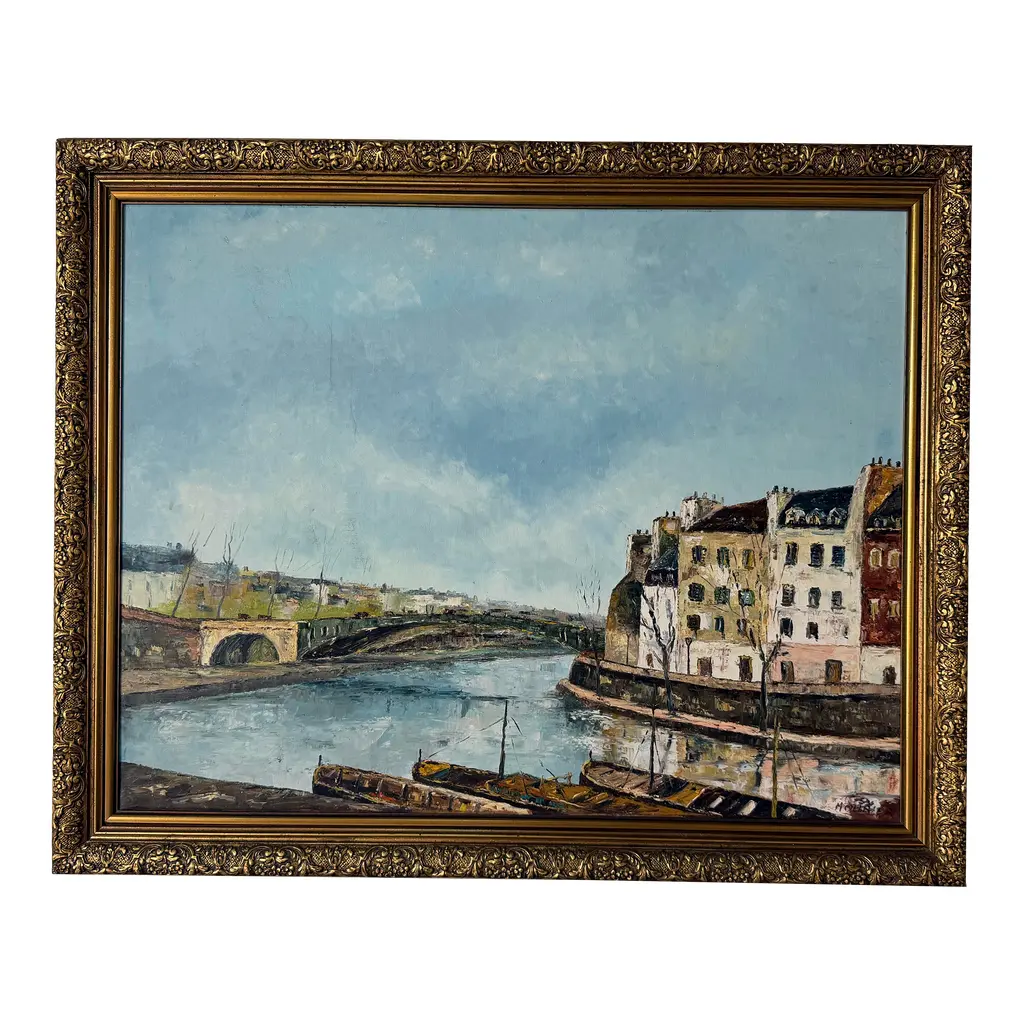
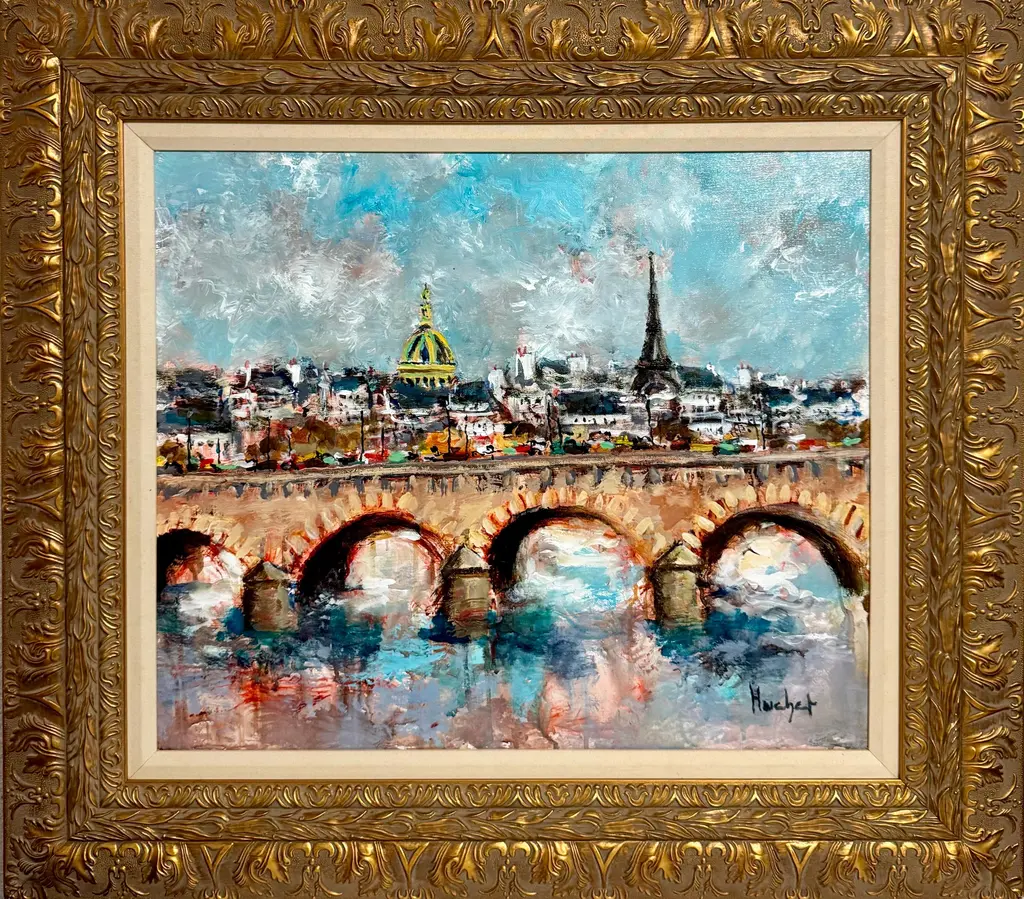
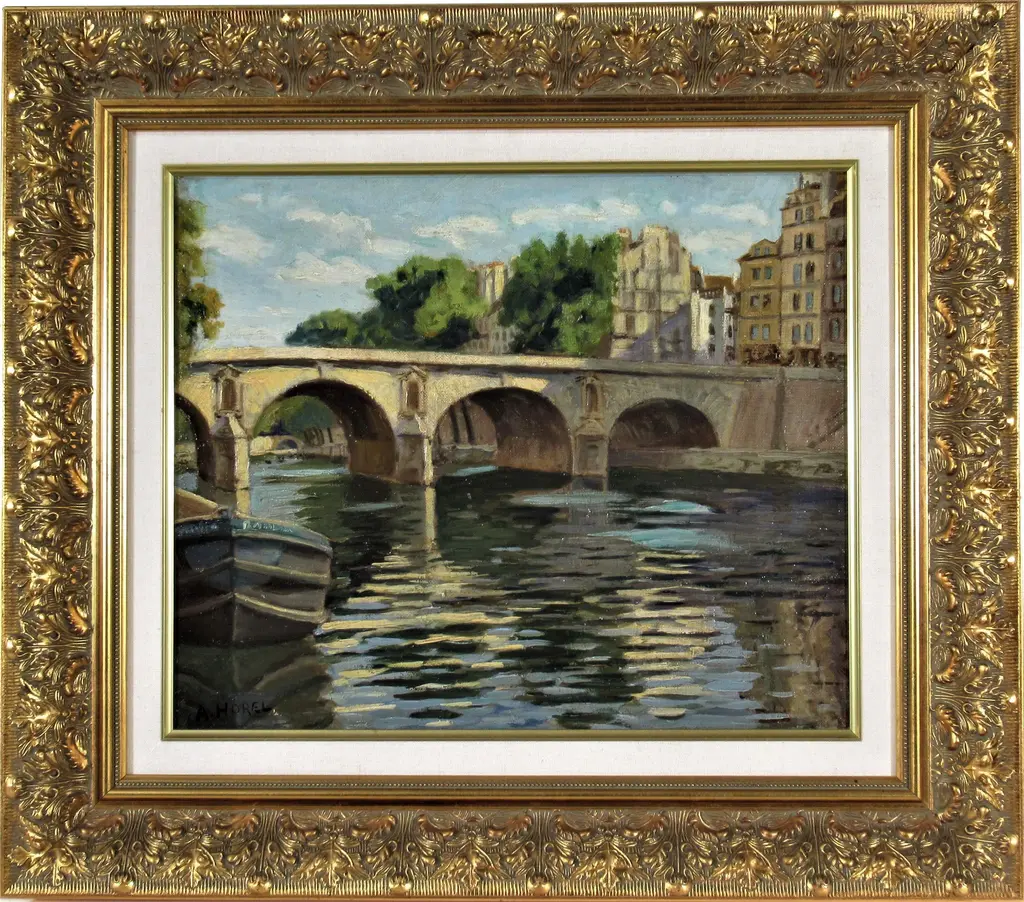
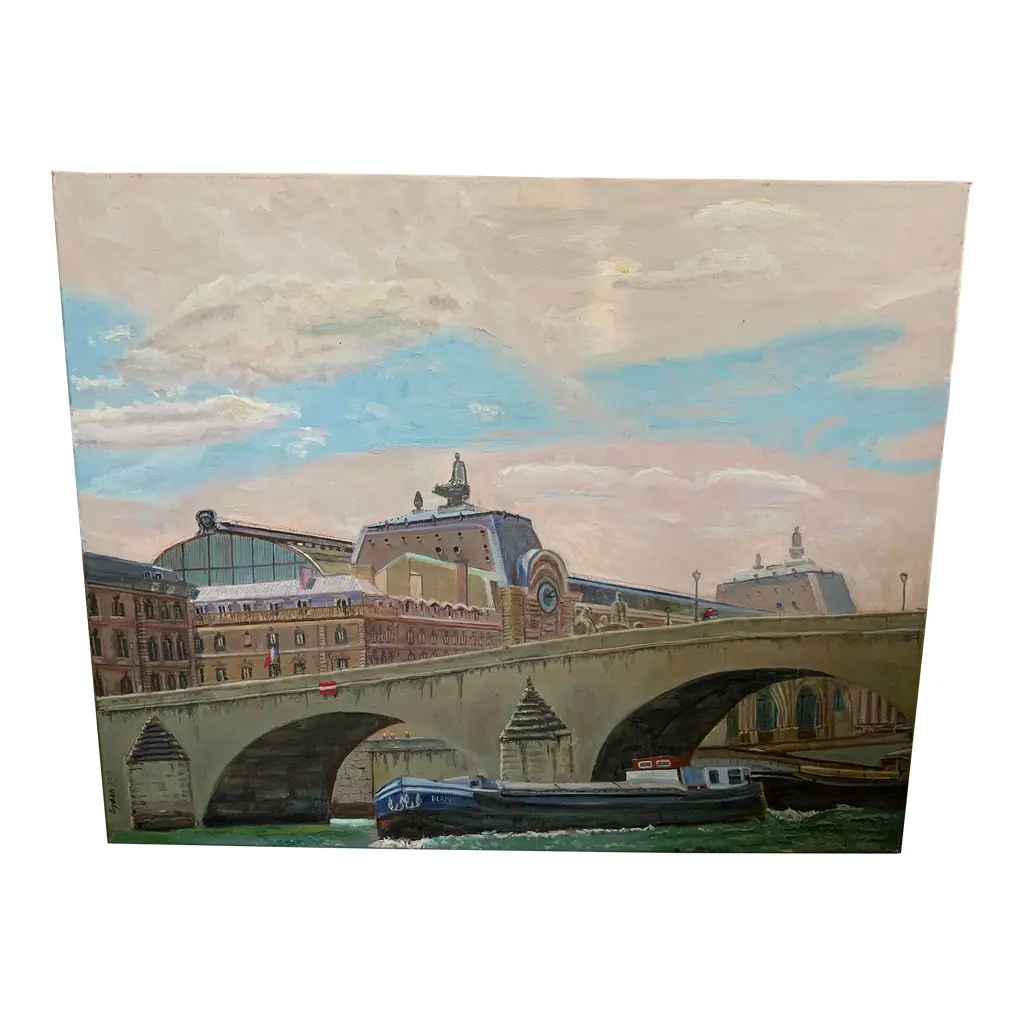
Maximilien Luce -Construction on the Bridge along the River-1930s Oil painting French post impressionist - Oil painting on board - Signed board size 11x13" - Frame size 18x20" Description: In this luminous oil on board work "Bridge Scene" the French Neo-Impressionist Maximilien Luce (1858–1941) captures the vibrant, gritty energy of a modernizing Paris. The painting serves as a masterful intersection of industrial progress and artistic light, characteristic of Luce’s unique vision at the turn of the 20th century. The work is centered on a grand, multi-arched bridge bathed in a warm, cream-colored light. This architectural weight is balanced by the fluid energy of the Seine in the foreground, rendered in a mosaic of deep blues, violets, and teals. Luce’s brushwork is energetic and thick with impasto, particularly in the churning wake of the small tugboats that navigate the river. To the right, a dark, skeletal construction crane punctuates the horizon—a symbol of the city's ceaseless growth—while plumes of industrial smoke mingle with the soft, atmospheric clouds of the Parisian sky. The tiny, gestural figures seen laboring on the bridge and the banks imbue the scene with a sense of human scale and collective effort. Rather than smooth blends, Luce uses distinct, short strokes that create a shimmering effect, characteristic of his interest in how light interacts with industrial environments.Atmosphere: The sky is a mix of pale blue and soft white clouds, partially obscured by the dark, hazy smoke of industry, creating a "grey weather" or overcast atmospheric quality often found in his urban landscapes.Context:Maximilien Luce was known for his empathetic depictions of the working class and the changing face of French cities during the industrial revolution. This particular piece, measuring approximately 11 x 13 inches, captures the raw energy of urban construction and maritime life at the turn of the 20th century. Artist Biography Maximilien Luce (1858–1941) was a prolific French painter, engraver, and anarchist activist who became a pivotal figure in the Neo-Impressionist movement. Born into a working-class family in Paris, his life and art were deeply intertwined with the social and political transformations of late 19th-century France. Early Career and Artistic Evolution: From Engraver to Painter: Luce began his career as an apprentice wood engraver at age 14. When new printing technologies made his trade nearly obsolete in the early 1880s, he transitioned to painting full-time. Neo-Impressionist Pioneer: Initially influenced by Impressionism, Luce met Georges Seurat and Paul Signac in 1887. He adopted their Divisionist (Pointillist) technique, using small dots of contrasting colors to create vibrant light effects. Later Style: In his later years, Luce moved away from the strict scientific precision of Pointillism, returning to a freer, more fluid Impressionistic style often focused on serene landscapes and urban scenes.Political Activism and Subject MatterLuce was a fervent anarchist whose political beliefs heavily dictated his choice of subjects.The Proletariat: Unlike many contemporaries who painted idealized nature, Luce focused on the gritty realities of industrial labor, depicting dockers, steelworkers, and building sites. Mazas Prison: In 1894, he was arrested as a suspected anarchist following the assassination of President Sadi Carnot. During his 42-day imprisonment, he created Mazas, a series of ten lithographs documenting the experience of political prisoners. Wartime and Resistance: During World War I, he painted poignant scenes of wounded soldiers and weary families at railway stations. In 1940, he resigned as President of the Société des Artistes Indépendants to protest the Vichy regime's exclusion of Jewish artists.Legacy : Luce was one of the most productive Neo-Impressionists, leaving behind over 2,000 oil paintings and thousands of other works. While sometimes overlooked during his lifetime due to his radical politics, today, Luce is celebrated for his ability to find beauty in the industrial. "Bridge Scene" is a testament to this legacy, transforming a site of noisy construction into a shimmering study of light and color. His work remains a vital record of a France in transition, held in high esteem by institutions such as the Musée d’Orsay and the Art Institute of Chicago.
Similar products