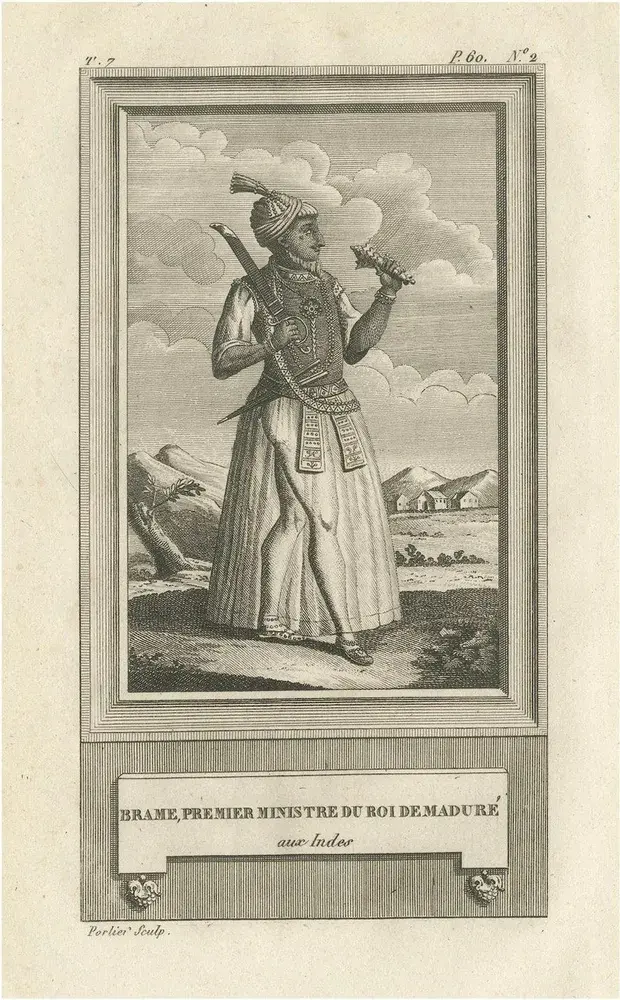
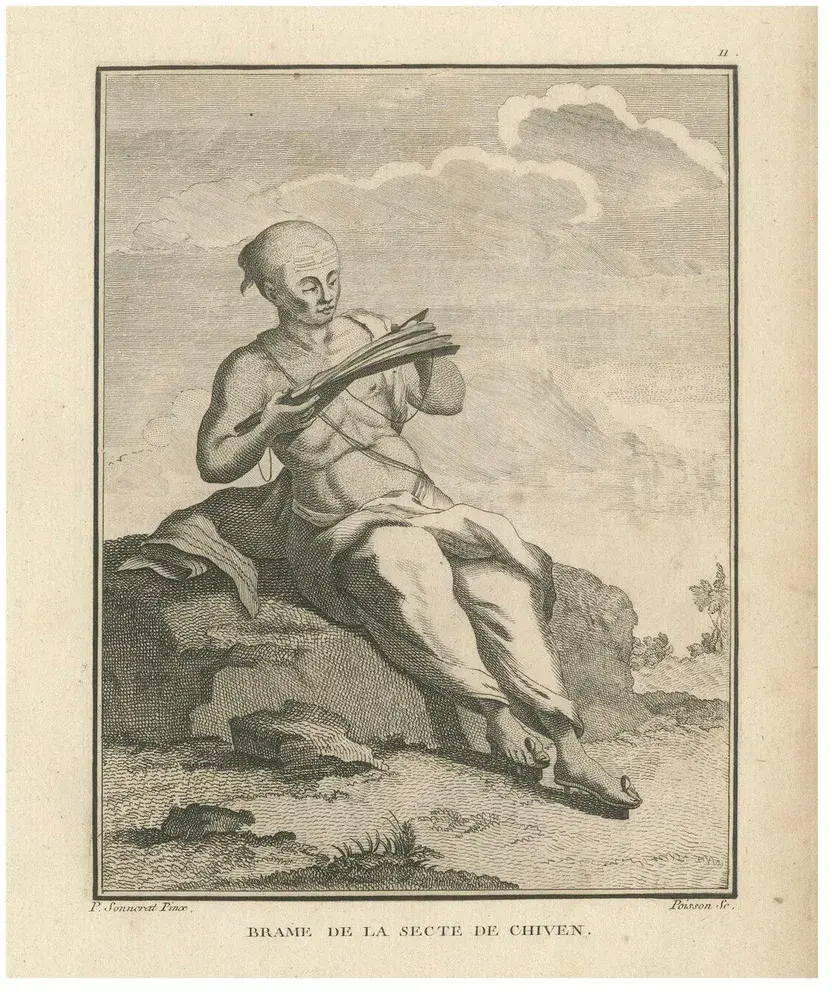
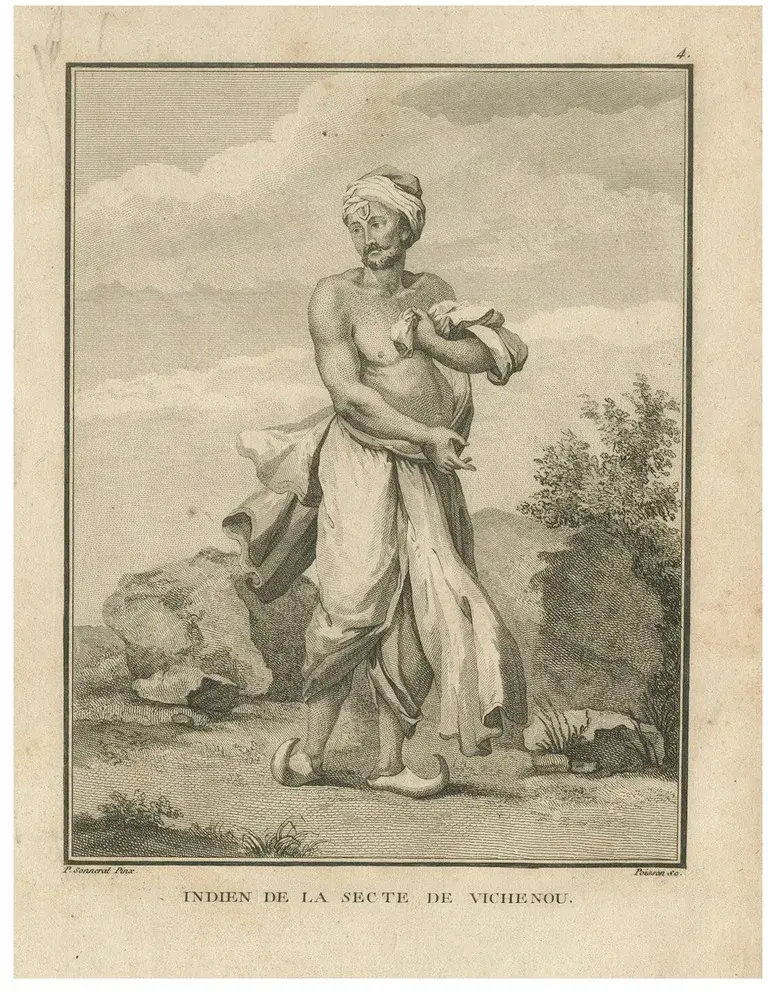
This finely engraved plate titled *Brame de la Secte de Vichenou* (Brahmin of the Sect of Vishnu) is plate number 12 from *Collection de Planches pour servir au Voyage aux Indes Orientales et à la Chine* by Pierre Sonnerat, issued in its second edition in 1806 by Dentu, Paris. It is part of a remarkable series documenting Indian religious life and culture as observed during Sonnerat’s travels through South Asia in the 1770s. The image features a standing Vaishnavite Brahmin, a priest devoted to Vishnu, portrayed in a relaxed yet poised posture. He wears the traditional *dhoti*, wrapped around his waist and legs, leaving his upper body bare except for a sacred thread (*yajnopavita*) slung over his left shoulder. On his forehead, chest, and upper arms, we see the vertical *tilaka* marks made with sandalwood or white clay, typical of Vishnu worshippers. His hair is tied into a small *jata* or knot, and his footwear is composed of traditional wooden sandals with toe knobs. The Brahmin gestures with his right hand, possibly engaged in discourse or ritual instruction, while his left hand rests calmly at his side. Behind him is a sparse landscape with a gnarled tree trunk and rolling terrain, giving a sense of depth and solitude that reflects his contemplative role. This engraving, based on Sonnerat’s original field sketches and executed by Poisson, serves as a valuable European interpretation of India’s religious specialists during the colonial period. While the work inevitably reflects the lens of Enlightenment-era ethnography, it is rendered with notable detail and respect for posture, attire, and expression. The image provides insight into the visual distinctions between Shaivite and Vaishnavite Brahmins as perceived by 18th-century European observers, particularly through their markings and dress. It is a significant piece within Sonnerat’s broader visual anthropology of the Indian subcontinent. Condition: Good condition with a strong plate impression. Slight toning around the edges and a few scattered foxing marks, mainly in the margins. Printed on laid paper with wide margins and blank verso.
Similar products